9RMU | pdb_00009rmu

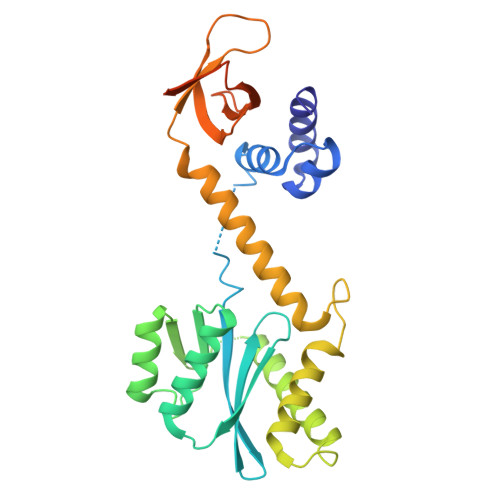
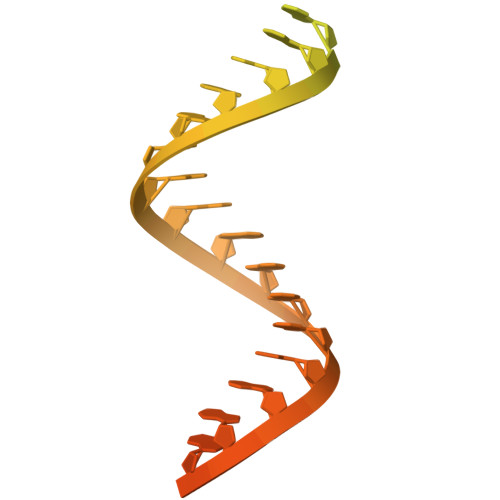
SIVtal integrase in complex with RNA stem-loop (focused refinement of the filament repeat unit)


Experimental Data Snapshot

  • Method: ELECTRON MICROSCOPY
  • Resolution: 3.30 Å
  • Aggregation State: PARTICLE 
  • Reconstruction Method: SINGLE PARTICLE 

wwPDB Validation   3D Report Full Report


This is version 1.3 of the entry. See complete history


Literature

Integrase anchors viral RNA to the HIV-1 capsid interior.

Singer, M.R.Li, Z.Rey, J.S.Hope, J.Chenavier, F.Cook, N.J.Punch, E.Smith, J.Zhou, Z.Maslen, S.Masino, L.Nans, A.Skehel, M.Taylor, I.A.Zanetti, G.Zhang, P.Perilla, J.R.Engelman, A.N.Cherepanov, P.

(2026) Nature 

  • DOI: https://doi.org/10.1038/s41586-026-10154-x
  • Primary Citation of Related Structures:  
    9RMU, 9RMX

  • PubMed Abstract: 

    HIV-1 integrase (IN) promotes encapsulation of viral genomic RNA into mature viral cores, and this function is a target for ongoing antiretroviral drug development efforts 1-3 . Here we determined the cryogenic electron microscopy (cryo-EM) structure of a primate lentiviral IN in a complex with RNA, revealing a linear filament made of IN octamer repeat units, each comprising a pair of asymmetric homotetramers. The assembly is stabilized through IN-RNA interactions involving mainly the IN C-terminal domains and RNA backbone. The spacing and orientation of the IN filament repeat units closely matched those of consecutive capsid (CA) hexamers within the mature CA lattice. Using cryo-EM images of native purified HIV-1 cores, we refined the structure of the IN filament as it propagates along the luminal side of the CA lattice. Each IN tetramer within the filament nestled in a CA hexamer, engaging closely with the major homology regions. Substitutions of residues involved in IN-CA contacts yielded eccentric virions with RNA nucleoids located outside of the cores. Collectively, our results establish the structural basis for the HIV-1 IN-RNA interaction and reveal that IN forms an RNA-binding module on the luminal side of the mature CA lattice.


  • Organizational Affiliation
    • Chromatin Structure & Mobile DNA Laboratory, The Francis Crick Institute, London, UK.

Macromolecules

Find similar proteins by:  (by identity cutoff)  |  3D Structure
Entity ID: 1
MoleculeChains Sequence LengthOrganismDetailsImage
Pol protein296Simian immunodeficiency virusMutation(s): 0 
Gene Names: POL
UniProt
Find proteins for Q1XE75 (Simian immunodeficiency virus)
Explore Q1XE75 
Go to UniProtKB:  Q1XE75
Entity Groups  
Sequence Clusters30% Identity50% Identity70% Identity90% Identity95% Identity100% Identity
UniProt GroupQ1XE75
Sequence Annotations
Expand
  • Reference Sequence
Find similar nucleic acids by:  (by identity cutoff) 
Entity ID: 2
MoleculeChains LengthOrganismImage
RNAE [auth J],
K [auth I],
M [auth j],
N [auth i]
57Human immunodeficiency virus 1
Sequence Annotations
Expand
  • Reference Sequence
Small Molecules
Ligands 1 Unique
IDChains Name / Formula / InChI Key2D Diagram3D Interactions
ZN
Query on ZN

Download Ideal Coordinates CCD File 
O [auth A]
P [auth B]
Q [auth C]
R [auth D]
S [auth b]
O [auth A],
P [auth B],
Q [auth C],
R [auth D],
S [auth b],
T [auth E],
U [auth F],
V [auth G],
W [auth H],
X [auth f]
ZINC ION
Zn
PTFCDOFLOPIGGS-UHFFFAOYSA-N
Experimental Data & Validation

Experimental Data

  • Method: ELECTRON MICROSCOPY
  • Resolution: 3.30 Å
  • Aggregation State: PARTICLE 
  • Reconstruction Method: SINGLE PARTICLE 
EM Software:
TaskSoftware PackageVersion
RECONSTRUCTIONcryoSPARC4.5.3
MODEL REFINEMENTPHENIX1.21.2_5419

Structure Validation

View Full Validation Report


Entry History & Funding Information

Deposition Data


Funding OrganizationLocationGrant Number
Cancer Research UKUnited KingdomCC2058
Medical Research Council (MRC, United Kingdom)United KingdomCC2058
Wellcome TrustUnited KingdomCC2058
The Francis Crick InstituteUnited KingdomCC2058
National Institutes of Health/National Institute Of Allergy and Infectious Diseases (NIH/NIAID)United StatesU54AI170791

Revision History  (Full details and data files)

  • Version 1.0: 2025-12-10
    Type: Initial release
  • Version 1.1: 2025-12-24
    Changes: Data collection, Structure summary
  • Version 1.2: 2026-02-18
    Changes: Data collection, Database references
  • Version 1.3: 2026-03-04
    Changes: Data collection, Database references