Download Mendeley
Structural Basis for a Scaffolding Role of the COM Domain in Nonribosomal Peptide Synthetases.
Diecker, J., Hermanns, B., Ruschenbaum, J., Rasche, R., Dorner, W., Schroder, A., Kummel, D., Mootz, H.D.(2025) Angew Chem Int Ed Engl 64: e202506621-e202506621
- PubMed: 40627840 Search on PubMed
- DOI: https://doi.org/10.1002/anie.202506621
- Primary Citation Related Structures:
9RDE - PubMed Abstract:
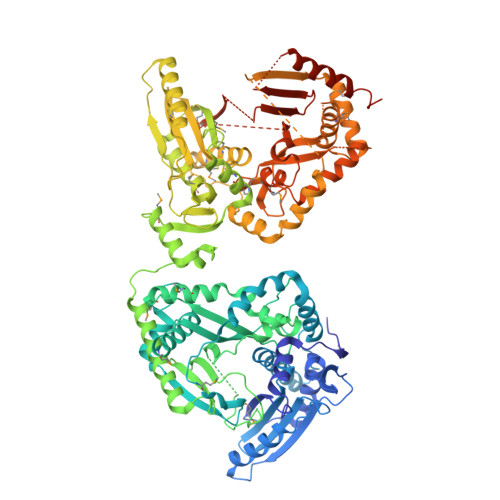
Nonribosomal peptide synthetases (NRPSs) are multi-domain enzymes that catalyze the biosynthesis of therapeutically relevant natural products. Efficient peptide synthesis relies on intricate domain interactions, whose underlying principles remain poorly understood. The communication-mediating (COM) domains facilitate interactions between separate NRPS subunits. For unknown reasons, COM domains co-occur with epimerization (E) domains, are partially embedded within the adjacent condensation (C) domains and can also be found as internal cis-COM domains. These features set COM domains apart from other docking domains. We present the first crystal structure of a cis-COM domain within an E-COM-C domain arrangement from modules 4 and 5 of bacitracin synthetase 3 (BacC). The structure reveals a compactly folded COM domain sandwiched between E and C domains, suggesting a role of the COM domain in orienting these domains for efficient peptidyl carrier protein (PCP) shuttling. Through mutational analyses, dipeptide formation assays, and proximity-dependent photo-crosslinking experiments, we investigated both cis- and trans-COM domains and provide evidence supporting a principal role of COM domains as scaffolds of NRPS architecture. Their function as docking domains may be a secondary consequence of their division into separate donor and acceptor parts.
- Institute of Biochemistry, Department of Chemistry and Pharmacy, University of Münster, Correnstraße 36, 48149, Münster, Germany.
Organizational Affiliation: