Download Mendeley
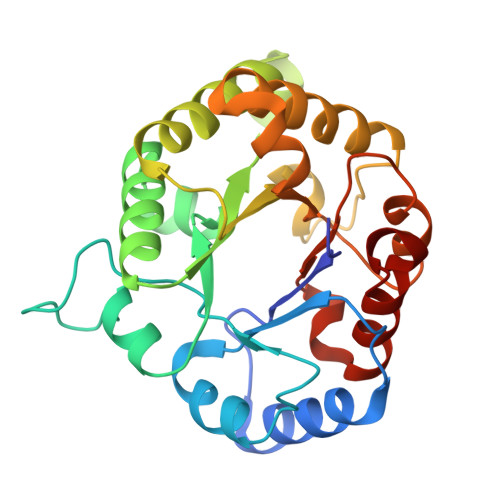
Molecular and structural basis for nitrosoglutathione-dependent redox regulation of triosephosphate isomerase from Chlamydomonas reinhardtii.
Meloni, M., Mattioli, E.J., Fanti, S., Peppi, G.M.E., Bin, T., Gabellini, G., Tedesco, D., Henri, J., Trost, P., Lemaire, S.D., Calvaresi, M., Fermani, S., Zaffagnini, M.(2025) Plant Sci 362: 112768-112768
- PubMed: 40946919 Search on PubMed
- DOI: https://doi.org/10.1016/j.plantsci.2025.112768
- Primary Citation Related Structures:
9QM7, 9R6M - PubMed Abstract:
Protein S-nitrosylation is a reversible redox-based post-translational modification that plays an important role in cell signaling by modulating protein function and stability. At the molecular level, S-nitrosylation consists of the formation of a nitrosothiol (-SNO) and is primarily induced by the trans-nitrosylating agent nitrosoglutathione (GSNO). Triosephosphate isomerase (TPI), which catalyzes the interconversion of dihydroxyacetone phosphate and glyceraldehyde-3-phosphate, has been identified as a putative target of S-nitrosylation in both plant and non-plant systems. Here we investigate the molecular basis for GSNO-dependent regulation of chloroplast TPI from the model green alga Chlamydomonas reinhardtii (CrTPI). Molecular modelling identified Cys14 and Cys219 as potential sites for interaction with GSNO, though crystallography of GSNO-treated CrTPI revealed S-nitrosylation only at Cys14. To disclose GSNO target sites, we generated and characterized Cys-to-Ser variants for Cys14 and Cys219, identifying Cys219 as a key residue mediating the GSNO-dependent modulation of CrTPI activity. Molecular dynamics simulations further revealed the stabilizing interactions of S-nitrosylated cysteines with their local environments. Overall, our results indicate that CrTPI catalysis is modulated by GSNO through a redox-based mechanism involving Cys219, which highlights a conserved regulatory strategy shared with human TPI.
- Department of Pharmacy and Biotechnology, University of Bologna, via Irnerio 42, Bologna I-40126, Italy.
Organizational Affiliation: