9R2Z | pdb_00009r2z

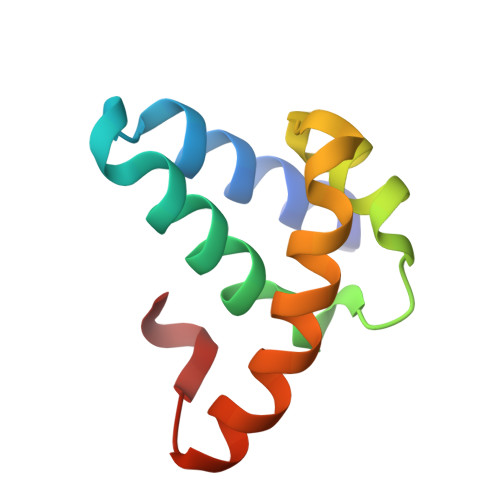
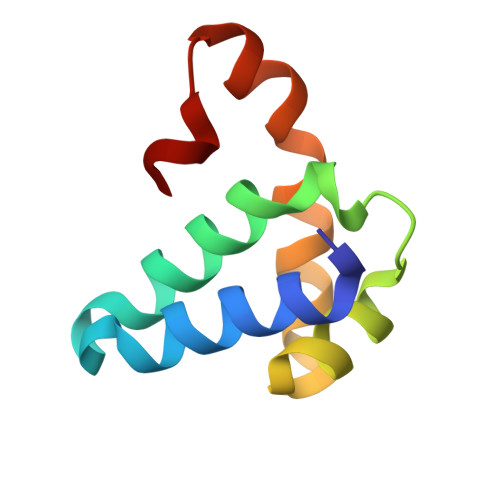
RptR transcriptional repressor


Experimental Data Snapshot

  • Method: X-RAY DIFFRACTION
  • Resolution: 1.30 Å
  • R-Value Free: 
    0.195 (Depositor), 0.193 (DCC) 
  • R-Value Work: 
    0.165 (Depositor), 0.171 (DCC) 
  • R-Value Observed: 
    0.167 (Depositor) 

wwPDB Validation   3D Report Full Report


This is version 1.0 of the entry. See complete history


Literature

Regulation of a phage defence island by RptR, a novel repressor that controls restriction-modification systems in diverse bacteria.

Zhang, Y.Schuller, M.Ahel, I.Blower, T.R.Exley, R.M.Tang, C.M.

(2025) Nucleic Acids Res 53

  • DOI: https://doi.org/10.1093/nar/gkaf645
  • Primary Citation of Related Structures:  
    9R2Z

  • PubMed Abstract: 

    Bacteria encode a panoply of defence systems to overcome phage infection. In recent years, over 100 defence systems have been identified, with the majority of these found co-localized in defence islands. Although there has been much progress in understanding the mechanisms of anti-phage defence employed by bacteria, far less is known about their regulation before and during phage infection. Here, we describe RptR (RMS-proximal transcriptional regulator), a small transcriptional regulator of a defence island in enteropathogenic Escherichia coli composed of a toxin-antitoxin system, DarTG2, embedded within a Type I restriction-modification system (RMS). We determined the molecular structure of a RptR homodimer and, using transcriptional reporter and in vitro DNA binding assays, show that RptR represses the promoter of the defence island by binding to a series of three direct repeats in the promoter. Furthermore, we demonstrate, using the structural models of RptR validated with electrophoretic mobility shift assays, that the minimal RptR binding site is a 6-bp palindrome, TAGCTA. Both RptR and its binding site are highly conserved across diverse bacterial genomes with a strong genetic association with Type I RMS, highlighting the role of RptR as a novel regulatory component of an important mechanism for anti-phage defence in bacteria.


  • Organizational Affiliation
    • Sir William Dunn School of Pathology, University of Oxford, South Parks Road, Oxford OX1 3RE, United Kingdom.

Macromolecules
Find similar proteins by:  (by identity cutoff)  |  3D Structure
Entity ID: 1
MoleculeChains Sequence LengthOrganismDetailsImage
Transcription factorA [auth B]78Escherichia coli O127:H6 str. E2348/69Mutation(s): 0 
Gene Names: E2348C_1096
UniProt
Find proteins for B7UP23 (Escherichia coli O127:H6 (strain E2348/69 / EPEC))
Explore B7UP23 
Go to UniProtKB:  B7UP23
Entity Groups  
Sequence Clusters30% Identity50% Identity70% Identity90% Identity95% Identity100% Identity
UniProt GroupB7UP23
Sequence Annotations
Expand
  • Reference Sequence
Find similar proteins by:  (by identity cutoff)  |  3D Structure
Entity ID: 2
MoleculeChains Sequence LengthOrganismDetailsImage
Transcription factorB [auth A]79Escherichia coli O127:H6 str. E2348/69Mutation(s): 0 
Gene Names: E2348C_1096
UniProt
Find proteins for B7UP23 (Escherichia coli O127:H6 (strain E2348/69 / EPEC))
Explore B7UP23 
Go to UniProtKB:  B7UP23
Entity Groups  
Sequence Clusters30% Identity50% Identity70% Identity90% Identity95% Identity100% Identity
UniProt GroupB7UP23
Sequence Annotations
Expand
  • Reference Sequence
Experimental Data & Validation

Experimental Data

  • Method: X-RAY DIFFRACTION
  • Resolution: 1.30 Å
  • R-Value Free:  0.195 (Depositor), 0.193 (DCC) 
  • R-Value Work:  0.165 (Depositor), 0.171 (DCC) 
  • R-Value Observed: 0.167 (Depositor) 
Space Group: P 1 21 1
Unit Cell:
Length ( Å )Angle ( ˚ )
a = 30.603α = 90
b = 41.541β = 90.115
c = 63.261γ = 90
Software Package:
Software NamePurpose
REFMACrefinement
PHENIXrefinement
PHASERphasing
autoPROCdata processing
Cootmodel building

Structure Validation

View Full Validation Report


Entry History & Funding Information

Deposition Data


Funding OrganizationLocationGrant Number
Wellcome TrustUnited Kingdom221924/Z/20/Z, 214374/Z/18/Z

Revision History  (Full details and data files)

  • Version 1.0: 2025-07-23
    Type: Initial release