9QWO | pdb_00009qwo

Vinculin tail bound to paxillin LD2


Experimental Data Snapshot

  • Method: X-RAY DIFFRACTION
  • Resolution: 2.54 Å
  • R-Value Free: 
    0.259 (Depositor), 0.261 (DCC) 
  • R-Value Work: 
    0.225 (Depositor), 0.233 (DCC) 
  • R-Value Observed: 
    0.227 (Depositor) 

Starting Model: experimental
View more details

wwPDB Validation   3D Report Full Report


This is version 1.1 of the entry. See complete history


Literature

Phospho-regulated tethering of focal adhesion kinase to vinculin links force transduction to focal adhesion signaling.

Diaz-Palacios, K.Lopez Navajas, P.Rodrigo Martin, B.Matesanz, R.Luque-Ortega, J.R.Echarri, A.Lietha, D.

(2025) Cell Commun Signal 23: 190-190

  • DOI: https://doi.org/10.1186/s12964-025-02201-3
  • Primary Citation of Related Structures:  
    9QWO

  • PubMed Abstract: 

    Focal Adhesion Kinase (FAK) is a key signaling molecule in focal adhesions (FAs) orchestrating the formation, maturation and turnover of the FA complex. A controlled FA lifecycle is essential for various cellular processes requiring mesenchymal cell migration and is harnessed by advanced cancers to initiate cancer invasion and metastasis. The mechanical force for migration is transmitted from actin stress fibers to FAs via specialized force transduction components in FAs. These forces are known to activate FA signaling, suggesting a communication between FA force transduction and FA signaling components, yet how this occurs mechanistically is unknown. Here we demonstrate that paxillin can act as an adaptor protein to connect FAK with the force transduction component vinculin. Our data show that this connection forms inefficient in the basal state but suggest Y925 phosphorylation in FAK as a key mechanism for optimal formation of the FAK:paxillin:vinculin linkage. This is achieved by switching binding of the paxillin LD2 motif from FAK to vinculin while keeping paxillin LD4 tethered to FAK. We further provide the first high-resolution crystal structure of LD2 bound to the vinculin tail domain, which importantly shows that vinculin can simultaneously link to actin. This therefore ensures an intact force transduction role of vinculin while tethered via paxillin to the signaling apparatus in FAs. With this data, all interactions of the force transmitting tether to FAK are structurally defined and we provide an atomic model for FAK force activation. In summary, we propose a phospho-regulated connection between signaling and force transduction components in FAs allowing for force induced activation of FA signaling.


  • Organizational Affiliation
    • Molecular and Cellular Biosciences, Margarita Salas Center for Biological Research (CIB), Spanish National Research Council (CSIC), Madrid, Spain.

Macromolecules
Find similar proteins by:  (by identity cutoff)  |  3D Structure
Entity ID: 1
MoleculeChains Sequence LengthOrganismDetailsImage
Isoform 1 of VinculinA,
B,
E [auth C],
F [auth D]
181Homo sapiensMutation(s): 0 
Gene Names: VCL
UniProt & NIH Common Fund Data Resources
Find proteins for P18206 (Homo sapiens)
Explore P18206 
Go to UniProtKB:  P18206
PHAROS:  P18206
GTEx:  ENSG00000035403 
Entity Groups  
Sequence Clusters30% Identity50% Identity70% Identity90% Identity95% Identity100% Identity
UniProt GroupP18206
Sequence Annotations
Expand
  • Reference Sequence

Find similar proteins by:  Sequence   |   3D Structure  

Entity ID: 2
MoleculeChains Sequence LengthOrganismDetailsImage
Isoform Gamma of PaxillinC [auth E],
G [auth F]
19Homo sapiensMutation(s): 0 
UniProt & NIH Common Fund Data Resources
Find proteins for P49023 (Homo sapiens)
Explore P49023 
Go to UniProtKB:  P49023
PHAROS:  P49023
GTEx:  ENSG00000089159 
Entity Groups  
Sequence Clusters30% Identity50% Identity70% Identity90% Identity95% Identity100% Identity
UniProt GroupP49023
Sequence Annotations
Expand
  • Reference Sequence

Find similar proteins by:  Sequence   |   3D Structure  

Entity ID: 3
MoleculeChains Sequence LengthOrganismDetailsImage
PaxillinD [auth G],
H
13Homo sapiensMutation(s): 0 
UniProt & NIH Common Fund Data Resources
Find proteins for A0A1B0GTU4 (Homo sapiens)
Explore A0A1B0GTU4 
Go to UniProtKB:  A0A1B0GTU4
GTEx:  ENSG00000089159 
Entity Groups  
Sequence Clusters30% Identity50% Identity70% Identity90% Identity95% Identity100% Identity
UniProt GroupA0A1B0GTU4
Sequence Annotations
Expand
  • Reference Sequence
Small Molecules
Ligands 2 Unique
IDChains Name / Formula / InChI Key2D Diagram3D Interactions
SO4
Query on SO4

Download Ideal Coordinates CCD File 
I [auth A]
J [auth A]
M [auth B]
Q [auth C]
R [auth C]
I [auth A],
J [auth A],
M [auth B],
Q [auth C],
R [auth C],
S [auth C],
T [auth C],
W [auth D]
SULFATE ION
O4 S
QAOWNCQODCNURD-UHFFFAOYSA-L
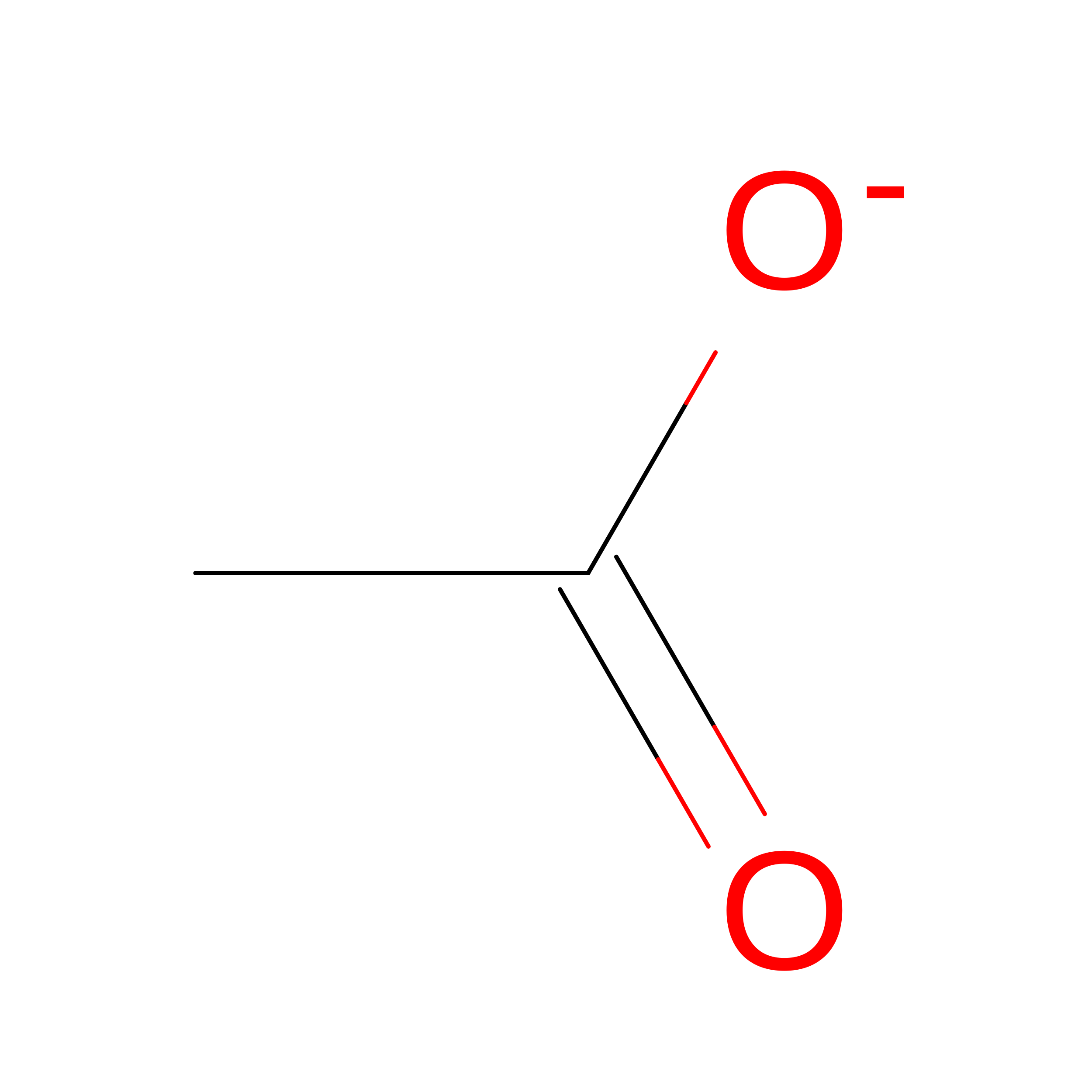
ACT
Query on ACT

Download Ideal Coordinates CCD File 
K [auth A]
L [auth A]
N [auth B]
O [auth B]
P [auth G]
K [auth A],
L [auth A],
N [auth B],
O [auth B],
P [auth G],
U [auth C],
V [auth C],
X [auth D],
Y [auth D],
Z [auth D]
ACETATE ION
C2 H3 O2
QTBSBXVTEAMEQO-UHFFFAOYSA-M
Experimental Data & Validation

Experimental Data

  • Method: X-RAY DIFFRACTION
  • Resolution: 2.54 Å
  • R-Value Free:  0.259 (Depositor), 0.261 (DCC) 
  • R-Value Work:  0.225 (Depositor), 0.233 (DCC) 
  • R-Value Observed: 0.227 (Depositor) 
Space Group: C 1 2 1
Unit Cell:
Length ( Å )Angle ( ˚ )
a = 177.382α = 90
b = 70.562β = 131.25
c = 117.372γ = 90
Software Package:
Software NamePurpose
REFMACrefinement
SCALAdata scaling
XDSdata reduction
PHASERphasing
PDB_EXTRACTdata extraction

Structure Validation

View Full Validation Report


Entry History & Funding Information

Deposition Data


Funding OrganizationLocationGrant Number
Other governmentSpainPID2021-127058NB-I00

Revision History  (Full details and data files)

  • Version 1.0: 2025-04-23
    Type: Initial release
  • Version 1.1: 2025-05-07
    Changes: Database references