Download Mendeley
Fragment-based drug design of a bacterial kinase inhibitor capable of increasing the antibiotic sensitivity of clinical isolates.
Kowalewski, J., Deutscher, R., Richardoz, M., Tomaszczyk, M., Gelin, M., Labesse, G., Hausch, F., Wright, G.D., Dunyach-Remy, C., Guichou, J.F., Lionne, C.(2025) Commun Chem 8: 417-417
- PubMed: 41310159 Search on PubMedSearch on PubMed Central
- DOI: https://doi.org/10.1038/s42004-025-01795-6
- Primary Citation Related Structures:
9QMR, 9QN6, 9QNN, 9QNQ, 9QNS, 9QNW, 9QNX, 9QNY, 9QOC, 9QOD, 9QOE, 9QOI, 9QOK, 9QOL, 9QOM, 9QOS, 9QP9, 9QPB, 9QPD, 9QPL - PubMed Abstract:
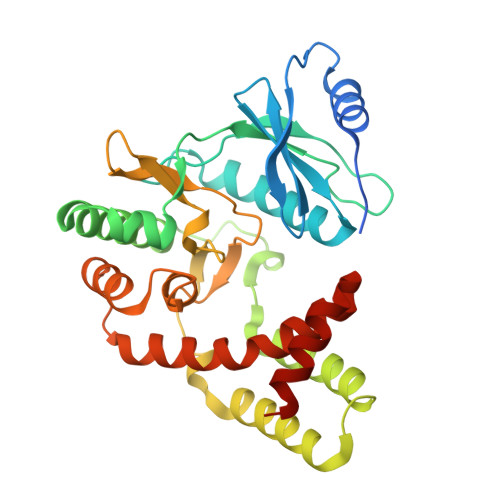
According to the World Health Organization (WHO), antimicrobial resistance is a serious global health issue. Overcoming antibiotic resistance involves several strategies, including the inhibition of resistance mechanisms. Among the various resistance mechanisms, aminoglycoside phosphotransferases (APHs) catalyze the transfer of the γ-phosphate from a nucleotide donor to various aminoglycosides, leading to their inactivation. In this work, using a fragment-based drug design (FBDD) approach, we have identified and characterized a promising APH inhibitor capable of increasing the sensitivity of Pseudomonas aeruginosa and Staphylococcus aureus resistant to aminoglycosides. It is therefore a good candidate for the future development of APH inhibitors to be prescribed in combination with aminoglycosides. This molecule is a competitive inhibitor of adenosine 5'-triphosphate (ATP), the phosphate donor of APHs. Further studies are required to optimize this molecule to improve its specificity for APHs and its bioavailability in bacteria.
- Centre de Biologie Structurale (CBS), University of Montpellier, CNRS UMR 5048, INSERM U1054, Montpellier, France.
Organizational Affiliation: