9QDQ | pdb_00009qdq

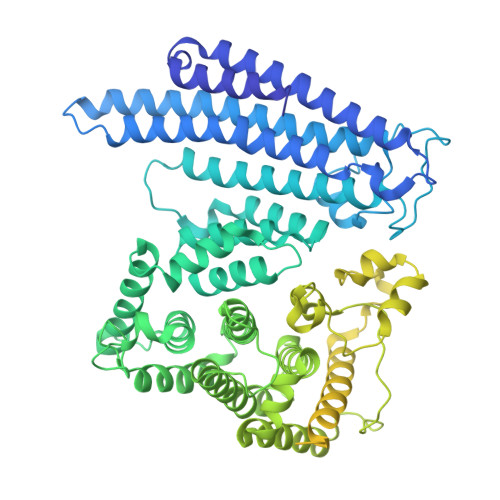
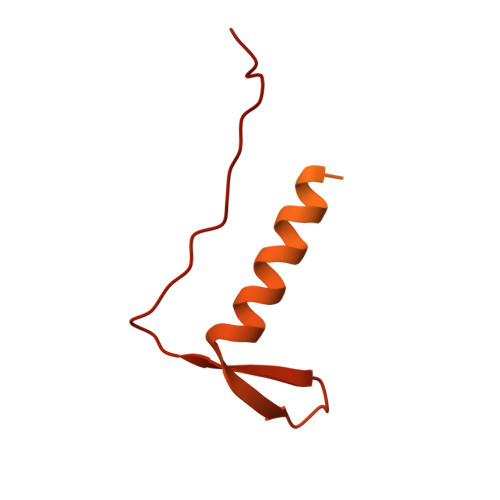
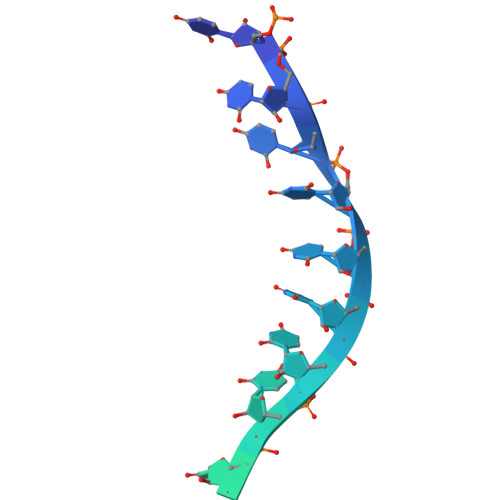
Cryo-EM structure of Upf1-Nmd4-Ebs1 in complex with RNA


Experimental Data Snapshot

  • Method: ELECTRON MICROSCOPY
  • Resolution: 3.60 Å
  • Aggregation State: PARTICLE 
  • Reconstruction Method: SINGLE PARTICLE 

Starting Model: in silico
View more details

wwPDB Validation   3D Report Full Report


This is version 1.0 of the entry. See complete history


Literature

Molecular mechanisms governing the formation of distinct Upf1-containing complexes in yeast.

Iermak, I.Wilson Eisele, N.R.Kurscheidt, K.Loukeri, M.J.Basquin, J.Bonneau, F.Langer, L.M.Keidel, A.Conti, E.

(2025) Cell Rep 44: 116415-116415

  • DOI: https://doi.org/10.1016/j.celrep.2025.116415
  • Primary Citation of Related Structures:  
    9QDQ

  • PubMed Abstract: 

    Upf1 is a master regulator of nonsense-mediated mRNA decay (NMD), an mRNA surveillance and degradation pathway conserved from yeast to human. In Saccharomyces cerevisiae, Upf1 exists in two distinct complexes with factors that mediate NMD activation or 5'-3' mRNA degradation. We combined endogenous purifications and biochemical reconstitutions of yeast Upf1 complexes with structural analyses and biochemical assays to elucidate the molecular mechanisms driving the organization of the Upf1-5'-3' and Upf1-2-3 complexes. We show that yeast Upf1 is in a constitutive complex, whereby its CH, RecA, and C-terminal domains interact with the mRNA decapping factor Dcp2, NMD-associated proteins Nmd4 and Ebs1, and the 5'-3' exoribonuclease Xrn1, respectively. Together, the interacting surfaces and closed conformation of Upf1 in the Upf1-5'-3' complex sterically obstruct the binding of Upf2-3. Our work points to a major restructuring upon recruitment of these factors during NMD and provides insights into evolutionary divergence amongst species.


  • Organizational Affiliation
    • Department of Structural Cell Biology, Max Planck Institute of Biochemistry, Am Klopferspitz 18, Martinsried, 82152 Munich, Germany. Electronic address: iermak@biochem.mpg.de.

Macromolecules

Find similar proteins by:  (by identity cutoff)  |  3D Structure
Entity ID: 1
MoleculeChains Sequence LengthOrganismDetailsImage
ATP-dependent helicase NAM7971Saccharomyces cerevisiaeMutation(s): 0 
Gene Names: NAM7IFS2MOF4UPF1YMR080CYM9582.05C
EC: 3.6.4.12 (PDB Primary Data), 3.6.4.13 (PDB Primary Data)
UniProt
Find proteins for P30771 (Saccharomyces cerevisiae (strain ATCC 204508 / S288c))
Explore P30771 
Go to UniProtKB:  P30771
Entity Groups  
Sequence Clusters30% Identity50% Identity70% Identity90% Identity95% Identity100% Identity
UniProt GroupP30771
Sequence Annotations
Expand
  • Reference Sequence
Find similar proteins by:  (by identity cutoff)  |  3D Structure
Entity ID: 2
MoleculeChains Sequence LengthOrganismDetailsImage
Nonsense-mediated mRNA decay factor EBS1884Saccharomyces cerevisiaeMutation(s): 0 
Gene Names: EBS1YDR206WYD8142.03
UniProt
Find proteins for Q03466 (Saccharomyces cerevisiae (strain ATCC 204508 / S288c))
Explore Q03466 
Go to UniProtKB:  Q03466
Entity Groups  
Sequence Clusters30% Identity50% Identity70% Identity90% Identity95% Identity100% Identity
UniProt GroupQ03466
Sequence Annotations
Expand
  • Reference Sequence
Find similar proteins by:  (by identity cutoff)  |  3D Structure
Entity ID: 3
MoleculeChains Sequence LengthOrganismDetailsImage
Nonsense-mediated decay protein 4218Saccharomyces cerevisiaeMutation(s): 0 
Gene Names: NMD4YLR363C
UniProt
Find proteins for Q12129 (Saccharomyces cerevisiae (strain ATCC 204508 / S288c))
Explore Q12129 
Go to UniProtKB:  Q12129
Entity Groups  
Sequence Clusters30% Identity50% Identity70% Identity90% Identity95% Identity100% Identity
UniProt GroupQ12129
Sequence Annotations
Expand
  • Reference Sequence
Find similar nucleic acids by:  (by identity cutoff)  |  3D Structure
Entity ID: 4
MoleculeChains LengthOrganismImage
RNA (5'-R(P*UP*UP*UP*UP*UP*UP*UP*UP*UP*U)-3')30Saccharomyces cerevisiae
Sequence Annotations
Expand
  • Reference Sequence
Experimental Data & Validation

Experimental Data

  • Method: ELECTRON MICROSCOPY
  • Resolution: 3.60 Å
  • Aggregation State: PARTICLE 
  • Reconstruction Method: SINGLE PARTICLE 
EM Software:
TaskSoftware PackageVersion
MODEL REFINEMENTPHENIX1.20.1_4487

Structure Validation

View Full Validation Report


Entry History & Funding Information

Deposition Data


Funding OrganizationLocationGrant Number
Max Planck SocietyGermany--
European Research Council (ERC)European Union740329
European Research Council (ERC)European Union101054447
German Research Foundation (DFG)GermanySFB1035
Novo Nordisk FoundationDenmark31199

Revision History  (Full details and data files)

  • Version 1.0: 2025-10-22
    Type: Initial release