Download Mendeley
Cryo-EM Structure of the Cyclase Domain and Evaluation of Substrate Channeling in a Bifunctional Class II Terpene Synthase.
Gaynes, M.N., Schultz, K., Wenger, E.S., Marmorstein, R., Christianson, D.W.(2025) bioRxiv
- PubMed: 40894651 Search on PubMedSearch on PubMed Central
- DOI: https://doi.org/10.1101/2025.08.20.671325
- Primary Citation Related Structures:
9Q3I - PubMed Abstract:
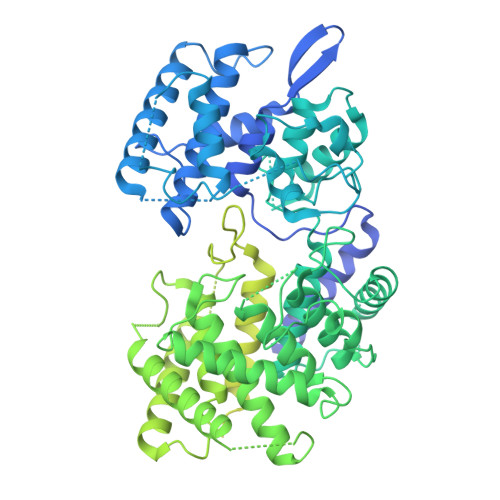
Copalyl diphosphate synthase from Penicillium verruculosum (PvCPS) is a bifunctional class II terpene synthase containing a prenyltransferase that produces geranylgeranyl diphosphate (GGPP) and a class II cyclase that utilizes GGPP as a substrate to generate the bicyclic diterpene copalyl diphosphate. The various stereoisomers of copalyl diphosphate establish the greater family of labdane natural products, many of which have environmental and medicinal impact. Understanding structure-function relationships in class II diterpene synthases is crucial for guiding protein engineering campaigns aimed at the generation of diverse bicyclic diterpene scaffolds. However, only a limited number of structures are available for class II cyclases from bacteria, plants, and humans, and no structures are available for a class II cyclase from a fungus. Further, bifunctional class II terpene synthases have not been investigated with regard to substrate channeling between the prenyltransferase and the cyclase. Here, we report the 2.9 Å-resolution cryo-EM structure of the 63-kD class II cyclase domain from PvCPS. Comparisons with bacterial and plant copalyl diphosphate synthases reveal conserved residues that likely guide the formation of the bicyclic labdane core, but divergent catalytic dyads that mediate the final deprotonation step of catalysis. Substrate competition experiments reveal preferential GGPP transit from the PvCPS prenyltransferase to the cyclase, even when prepared as separate constructs. These results are consistent with a model in which transient prenyltransferase-cyclase association facilitates substrate channeling due to active site proximity.
- Roy and Diana Vagelos Laboratories, Department of Chemistry, University of Pennsylvania, Philadelphia, Pennsylvania, 19104-6323, USA.
Organizational Affiliation: