9PQZ | pdb_00009pqz

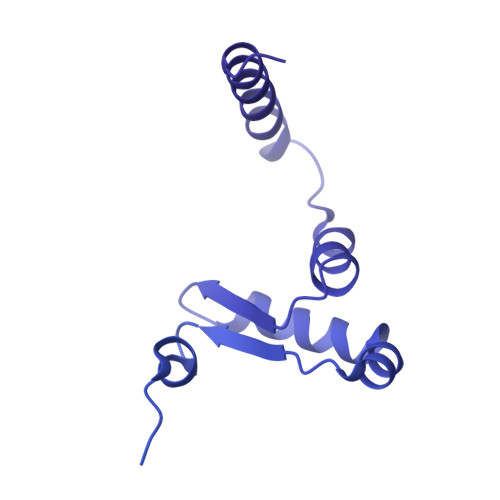
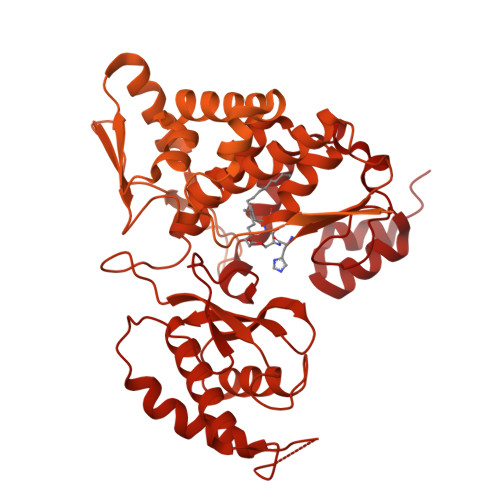
Structure of MPT domain of S. cerevisiae type-I FAS, thio-esterified to palmitate


Experimental Data Snapshot

  • Method: ELECTRON MICROSCOPY
  • Resolution: 2.22 Å
  • Aggregation State: PARTICLE 
  • Reconstruction Method: SINGLE PARTICLE 

Starting Model: experimental
View more details

wwPDB Validation   3D Report Full Report


This is version 1.1 of the entry. See complete history


Literature

Structural basis of product recognition by Mycobacterium tuberculosis fatty acid synthase.

Samani, E.K.Hasan, S.M.N.Keszei, A.F.A.Heydari, M.Mazhab-Jafari, M.T.

(2026) Protein Sci 35: e70412-e70412

  • DOI: https://doi.org/10.1002/pro.70412
  • Primary Citation of Related Structures:  
    9PQX, 9PQY, 9PQZ

  • PubMed Abstract: 

    Microbial iterative fatty acid synthases (FAS) are versatile multienzymes under scrutiny for their potential as anti-infectious targets and their biotechnological applications. They produce saturated fatty acids with defined chain length and release them as coenzyme A-conjugates. How they recognize appropriate acyl length to initiate the process of product release is unknown. Here, we resolved two intermediate state structures of FAS, one from each of the two organisms: bacterium Mycobacterium tuberculosis and yeast Saccharomyces cerevisiae. These structures reveal how acyl carrier protein (ACP) domain and nascent fatty acids interact with the substrate-promiscuous malonyl-palmitoyl transferase (MPT) domain that is involved in product cleavage from the enzyme. MPT adopts a transient channel necessary for the accommodation of long-chain fatty acids. This channel is formed by the transient retraction of a conserved arginine side chain involved in malonate binding. These insights uncover structural determinants that enable M. tuberculosis type I FAS to produce very long-chain fatty acids used for evading host immunity in tuberculosis (TB).


  • Organizational Affiliation
    • Department of Medical Biophysics, University of Toronto, Toronto, Ontario, Canada.

Macromolecules
Find similar proteins by:  (by identity cutoff)  |  3D Structure
Entity ID: 1
MoleculeChains Sequence LengthOrganismDetailsImage
Fatty acid synthase subunit alpha1,887Saccharomyces cerevisiaeMutation(s): 0 
Gene Names: FAS2YPL231WP1409
EC: 2.3.1.86 (PDB Primary Data), 1.1.1.100 (PDB Primary Data), 2.3.1.41 (PDB Primary Data)
UniProt
Find proteins for P19097 (Saccharomyces cerevisiae (strain ATCC 204508 / S288c))
Explore P19097 
Go to UniProtKB:  P19097
Entity Groups  
Sequence Clusters30% Identity50% Identity70% Identity90% Identity95% Identity100% Identity
UniProt GroupP19097
Sequence Annotations
Expand
  • Reference Sequence
Find similar proteins by:  (by identity cutoff)  |  3D Structure
Entity ID: 2
MoleculeChains Sequence LengthOrganismDetailsImage
Fatty acid synthase subunit betaB [auth G]2,051Saccharomyces cerevisiaeMutation(s): 0 
Gene Names: FAS1YKL182W
EC: 2.3.1.86 (PDB Primary Data), 4.2.1.59 (PDB Primary Data), 1.3.1.9 (PDB Primary Data), 2.3.1.38 (PDB Primary Data), 2.3.1.39 (PDB Primary Data), 3.1.2.14 (PDB Primary Data)
UniProt
Find proteins for P07149 (Saccharomyces cerevisiae (strain ATCC 204508 / S288c))
Explore P07149 
Go to UniProtKB:  P07149
Entity Groups  
Sequence Clusters30% Identity50% Identity70% Identity90% Identity95% Identity100% Identity
UniProt GroupP07149
Sequence Annotations
Expand
  • Reference Sequence
Experimental Data & Validation

Experimental Data

  • Method: ELECTRON MICROSCOPY
  • Resolution: 2.22 Å
  • Aggregation State: PARTICLE 
  • Reconstruction Method: SINGLE PARTICLE 
EM Software:
TaskSoftware PackageVersion
RECONSTRUCTIONcryoSPARC
MODEL REFINEMENTPHENIX

Structure Validation

View Full Validation Report


Entry History & Funding Information

Deposition Data


Funding OrganizationLocationGrant Number
Canadian Institutes of Health Research (CIHR)Canada195698
Canadian Institutes of Health Research (CIHR)Canada419240
Natural Sciences and Engineering Research Council (NSERC, Canada)CanadaRGPIN-2018-06070

Revision History  (Full details and data files)

  • Version 1.0: 2025-12-10
    Type: Initial release
  • Version 1.1: 2026-01-14
    Changes: Data collection, Database references