Download Mendeley
Molecular characterisation of the Bacillus subtilis SpbK antiphage defence system.
Mishra, B.P., Loyo, C.L., Cai, Y., Litfin, T., Miraj, G., Brillault, L., Masic, V., Mosaiab, T., Rajaratnam, P., Rudrawar, S., Gu, W., Kobe, B., Gerdt, J.P., Grossman, A.D., Shi, Y., Ve, T.(2025) Nat Commun 17: 1051-1051
- PubMed: 41462020 Search on PubMedSearch on PubMed Central
- DOI: https://doi.org/10.1038/s41467-025-67810-5
- Primary Citation Related Structures:
9PHA, 9PHB - PubMed Abstract:
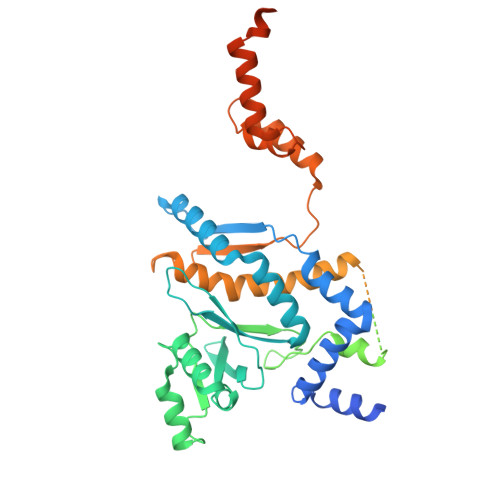
Bacteria have a variety of mechanisms for limiting predation by phages. SpbK is a Toll/interleukin-1 receptor (TIR) domain-containing antiphage defence protein from Bacillus subtilis that provides protection against the temperate phage SPβ via abortive infection. Here we structurally characterise SpbK and its interaction with the SPβ protein YonE. We demonstrate that SpbK is an NADase that produces both ADP-ribose (ADPR) and canonical cyclic ADPR with a N1-glycosidic bond (cADPR, also referred to as N1-cADPR). Combining cryo-EM, in silico predictions, site-directed mutagenesis, and phage infection assays, we show that formation of two-stranded head-to-tail assemblies of SpbK TIR domains is required for both NADase activity and antiphage defence. We also demonstrate that YonE is a dodecameric portal protein that activates the NADase function of SpbK by facilitating TIR domain clustering. Collectively, our results provide insight into how bacterial TIR NADases recognise phage infection.
- Institute for Biomedicine and Glycomics, Griffith University, Gold Coast, QLD, Australia.
Organizational Affiliation: