Download Mendeley
Tat-dependent bundling pilus of a halophilic archaeon assembles by a strand donation mechanism and facilitates biofilm formation.
Sonani, R.R., Liu, Y., Xiang, J., Cvirkaite-Krupovic, V., Du, S., Chen, X., Krupovic, M., Egelman, E.H.(2025) Proc Natl Acad Sci U S A 122: e2514980122-e2514980122
- PubMed: 40737320 Search on PubMedSearch on PubMed Central
- DOI: https://doi.org/10.1073/pnas.2514980122
- Primary Citation Related Structures:
9P0A - PubMed Abstract:
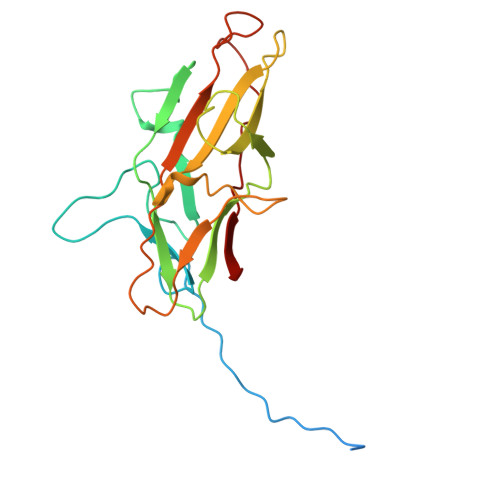
Diverse extracellular filaments present on the surface of archaea mediate multiple key processes, such as motility, adhesion, and biofilm formation. Although several archaeal filament types have been characterized in considerable detail, many remain understudied, particularly those utilizing noncanonical secretion systems. Here, we describe the Tafi bundling pilus that facilitates biofilm formation in the haloarchaeon Natrinema sp. J7-2. Unlike previously characterized archaeal pili, Tafi is secreted via the twin-arginine translocation (Tat) pathway, which transports fully folded proteins across the cytoplasmic membrane. Structural analysis reveals that although Tafi pili assemble via a canonical strand-donation mechanism, the pilin subunit (TafE) adopts a distinct structural topology that sets it apart from the previously characterized Sec-dependent pilins that form bundling pili in archaea. Sequence analyses show that TafE homologs are also present in thermophilic archaea from different phyla, but Tat-signal sequences are exclusive to pilins of halophilic archaea. Nevertheless, we find that Tat signal peptides in haloarchaeal TafE-like pili were exchanged back to the Sec signal peptides on multiple independent occasions. These findings expand our understanding of the diversity and evolution of archaeal extracellular filaments and highlight the Tat pathway as a route for pilus assembly in halophilic archaea.
- Department of Biochemistry and Molecular Genetics, University of Virginia Medical School, Charlottesville, VA 22903.
Organizational Affiliation: