Download Mendeley
Curvature Generation and Engineering Principles from Shewanella oneidensis Multi-flagellin Flagellum.
Lou, Q., Fan, H., Liu, Y., Miller, J.F., Huang, Y., Zhou, Z.H.(2025) ACS Nano 19: 25682-25696
- PubMed: 40627653 Search on PubMedSearch on PubMed Central
- DOI: https://doi.org/10.1021/acsnano.5c02744
- Primary Citation Related Structures:
9OXJ, 9OXK - PubMed Abstract:
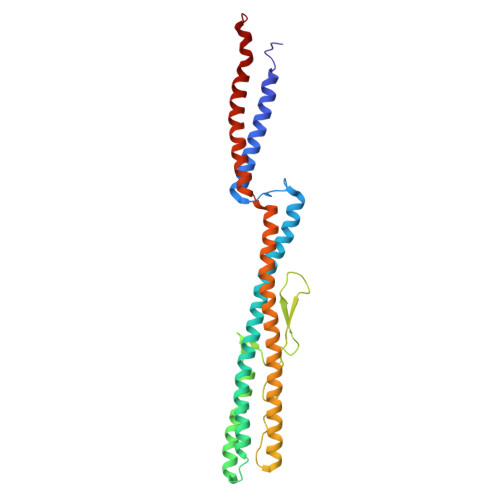
Motility driven by nanoscale flagella is vital to microbial survival and spread in fluid and structured environments. The absence of native flagellum structures, however, has limited our understanding of the mechanisms of microbial motility, hindering efforts to engineer microbe-based microbots for applications. Here, by cryogenic electron tomography (cryoET) and microscopy (cryoEM), we determined the structural basis of motility driven by the single flagellum anchored to one pole of Shewanella oneidensis MR-1 ( S. oneidensis ), an electrogenic bacterium commonly used in biotechnology. The structures of the curved flagellum, representing the conformation during motion, are captured, allowing delineation of molecular interactions among the subunits of its three components─filament, hook, and hook-filament junction. The structures of the filament, i.e., the propeller, reveal varying compositions of the flagellin isoforms FlaA and FlaB throughout the filament. Distinct inter-subunit interactions along the 5-start direction are identified at residues 129 and 134, which are the major determinants of functional differences in motility for the two isoforms. The hook─the universal joint─has a significantly larger curvature than that of the filament, despite both containing 11 curvature-defining conformers of their subunits. Transition between the propeller and the universal joint is mediated by the hook-filament junction, composed of 11 subunits of FlgK and FlgL, reconciling the incompatibility between the filament and the hook. Correlating these compositional and structural transitions with varying levels of curvature in flagellar segments reveals the molecular mechanism enabling propulsive motility. Mechanistic understanding from S. oneidensis could suggest engineering principles for nanoscale biomimetic systems.
- Department of Materials Science and Engineering, University of California, Los Angeles (UCLA) Los Angeles, California 90095, United States.
Organizational Affiliation: