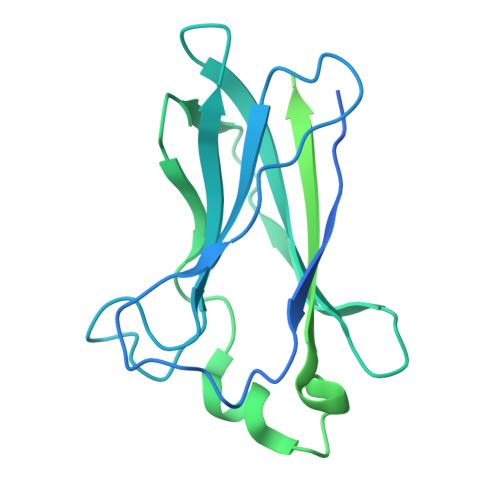
9OUW | pdb_00009ouw

SPOP double donut locally refined MATH domains

  • Classification: PROTEIN BINDING
  • Organism(s): Homo sapiens
  • Expression System: Escherichia coli
  • Mutation(s): No 

  • Deposited: 2025-05-29 Released: 2025-07-30 
  • Deposition Author(s): Cuneo, M.J.
  • Funding Organization(s): National Institutes of Health/National Institute of General Medical Sciences (NIH/NIGMS)

Experimental Data Snapshot

  • Method: ELECTRON MICROSCOPY
  • Resolution: 3.20 Å
  • Aggregation State: PARTICLE 
  • Reconstruction Method: SINGLE PARTICLE 

wwPDB Validation   3D Report Full Report


This is version 1.0 of the entry. See complete history


Literature

The equilibrium between two quaternary assembly states determines the activity of SPOP and its cancer mutants.

Cuneo, M.J.Gullulu, O.Ammar, M.R.Gui, X.Churion, K.Turk, M.O'Flynn, B.G.Sabri, N.Mittag, T.

(2025) bioRxiv 

  • DOI: https://doi.org/10.1101/2025.06.19.659812
  • Primary Citation of Related Structures:  
    9OUT, 9OUU, 9OUW

  • PubMed Abstract: 

    Proteostasis is critical for preventing oncogenesis. Both activating and inactivating mutations in the ubiquitin ligase subunit SPOP result in oncogenesis in different tissues. SPOP assembles into filaments that are multivalent for substrates, and substrates have multiple weak motifs for SPOP that are not activated via post-translational modifications. It is thus unclear how regulation is achieved. Here, we show that SPOP filaments circularize into rings that dimerize into up to 2.5 MDa-large, auto-inhibited double donuts. The equilibrium between double donuts and linear filaments determines SPOP activity. Activating and deactivating cancer mutations shift the equilibrium towards the filament or the double donut, respectively, and this influences substrate turnover and subcellular localization. This regulatory mechanism requires long filaments that can circularize into rings, likely explaining the presence of multiple weak SPOP-binding motifs in substrates. Activating and deactivating mutations combine to give rise to intermediate activities, suggesting new levers for cancer therapies. SPOP assemblies exist in an equilibrium between circular double donuts and linear filaments.Double donuts occlude access to the substrate binding site and are inactive.Mutations in different cancers shift the equilibrium towards active or inactive states.Regulation through these structural transitions requires large filamentous assemblies.


Macromolecules
Find similar proteins by:  (by identity cutoff)  |  3D Structure
Entity ID: 1
MoleculeChains Sequence LengthOrganismDetailsImage
Speckle-type POZ protein373Homo sapiensMutation(s): 0 
Gene Names: SPOP
UniProt & NIH Common Fund Data Resources
Find proteins for O43791 (Homo sapiens)
Explore O43791 
Go to UniProtKB:  O43791
PHAROS:  O43791
GTEx:  ENSG00000121067 
Entity Groups  
Sequence Clusters30% Identity50% Identity70% Identity90% Identity95% Identity100% Identity
UniProt GroupO43791
Sequence Annotations
Expand
  • Reference Sequence
Experimental Data & Validation

Experimental Data

  • Method: ELECTRON MICROSCOPY
  • Resolution: 3.20 Å
  • Aggregation State: PARTICLE 
  • Reconstruction Method: SINGLE PARTICLE 
EM Software:
TaskSoftware PackageVersion
MODEL REFINEMENTPHENIX1.21_5207

Structure Validation

View Full Validation Report


Entry History & Funding Information

Deposition Data

  • Released Date: 2025-07-30 
  • Deposition Author(s): Cuneo, M.J.

Funding OrganizationLocationGrant Number
National Institutes of Health/National Institute of General Medical Sciences (NIH/NIGMS)United States--

Revision History  (Full details and data files)

  • Version 1.0: 2025-07-30
    Type: Initial release