9OSR | pdb_00009osr

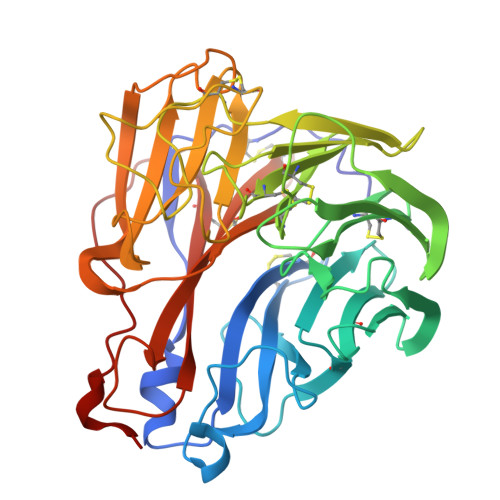
Structure of Fab HB420 in complex with influenza H3N2 A/Moscow/10/1999 neuraminidase


Experimental Data Snapshot

  • Method: ELECTRON MICROSCOPY
  • Resolution: 2.16 Å
  • Aggregation State: PARTICLE 
  • Reconstruction Method: SINGLE PARTICLE 

wwPDB Validation   3D Report Full Report


This is version 1.2 of the entry. See complete history


Literature

Evolution of antibody cross-reactivity to influenza H5N1 neuraminidase from an N2-specific germline.

Lv, H.Huan, Y.W.Teo, Q.W.Chen, C.Pholcharee, T.Gopal, A.B.Ardagh, M.R.Huang, J.J.Lei, R.Chen, X.Sun, Y.Tang, Y.S.Mehta, A.Szlembarski, M.Mao, K.J.Ma, E.X.Wittenborn, L.E.Tong, M.Rodriguez, L.A.Wang, L.Mok, C.K.P.Wu, N.C.

(2025) Cell Host Microbe 33: 1916

  • DOI: https://doi.org/10.1016/j.chom.2025.09.015
  • Primary Citation of Related Structures:  
    9OSR

  • PubMed Abstract: 

    The ongoing spread of highly pathogenic avian influenza H5N1 clade 2.3.4.4b virus in animals and its occasional spillover to humans have raised concerns about a potential H5N1 pandemic. Although recent studies have shown that pre-existing human antibodies can recognize H5N1 neuraminidase, the molecular basis of how this cross-reactivity develops remains poorly understood. In this study, we used a phage display antibody library derived from 245 healthy donors to isolate an antibody, HB420, that cross-reacts with neuraminidases of human H3N2 and avian H5N1 clade 2.3.4.4b viruses and confers protection in vivo. Cryogenic electron microscopy analysis reveals that HB420 targets the neuraminidase active site by mimicking sialic acid binding through a single Asp residue. Furthermore, the inferred germline of HB420 is N2 specific but acquires cross-reactivity to H5N1 neuraminidase through somatic hypermutation. Overall, our findings provide insights into how neuraminidase antibody evolves breadth, which has important implications for the development of broadly protective influenza vaccines.


  • Organizational Affiliation
    • Department of Biochemistry, University of Illinois Urbana-Champaign, Urbana, IL 61801, USA; Carl R. Woese Institute for Genomic Biology, University of Illinois Urbana-Champaign, Urbana, IL 61801, USA.

Macromolecules
Find similar proteins by:  (by identity cutoff)  |  3D Structure
Entity ID: 1
MoleculeChains Sequence LengthOrganismDetailsImage
Neuraminidase
A, B, C, D
388Influenza A virusMutation(s): 0 
Gene Names: NA
EC: 3.2.1.18
UniProt
Find proteins for Q8AZ87 (Influenza A virus)
Explore Q8AZ87 
Go to UniProtKB:  Q8AZ87
Entity Groups  
Sequence Clusters30% Identity50% Identity70% Identity90% Identity95% Identity100% Identity
UniProt GroupQ8AZ87
Sequence Annotations
Expand
  • Reference Sequence
Find similar proteins by:  (by identity cutoff)  |  3D Structure
Entity ID: 2
MoleculeChains Sequence LengthOrganismDetailsImage
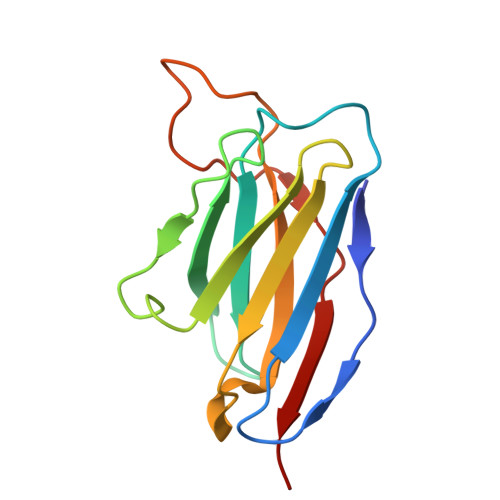
Variable domain of the heavy chain of Fab hb420E [auth J],
F [auth H],
H [auth K],
K [auth I]
125Homo sapiensMutation(s): 0 
Entity Groups  
Sequence Clusters30% Identity50% Identity70% Identity90% Identity95% Identity100% Identity
Sequence Annotations
Expand
  • Reference Sequence
Find similar proteins by:  (by identity cutoff)  |  3D Structure
Entity ID: 3
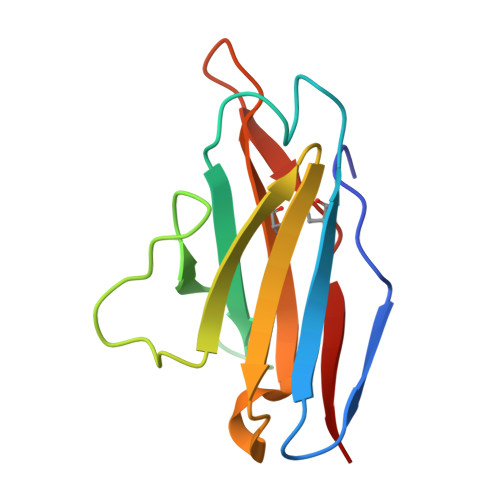
MoleculeChains Sequence LengthOrganismDetailsImage
Variable domain of the light chain of Fab HB420G [auth N],
I [auth L],
J [auth R],
L [auth M]
110Homo sapiensMutation(s): 0 
Entity Groups  
Sequence Clusters30% Identity50% Identity70% Identity90% Identity95% Identity100% Identity
Sequence Annotations
Expand
  • Reference Sequence
Experimental Data & Validation

Experimental Data

  • Method: ELECTRON MICROSCOPY
  • Resolution: 2.16 Å
  • Aggregation State: PARTICLE 
  • Reconstruction Method: SINGLE PARTICLE 
EM Software:
TaskSoftware PackageVersion
RECONSTRUCTIONcryoSPARC4.5

Structure Validation

View Full Validation Report


Entry History & Funding Information

Deposition Data


Funding OrganizationLocationGrant Number
Howard Hughes Medical Institute (HHMI)United StatesEmerging Pathogens Initiative

Revision History  (Full details and data files)

  • Version 1.0: 2025-10-01
    Type: Initial release
  • Version 1.1: 2025-10-29
    Changes: Data collection, Database references
  • Version 1.2: 2025-11-26
    Changes: Data collection, Database references