9ORE | pdb_00009ore

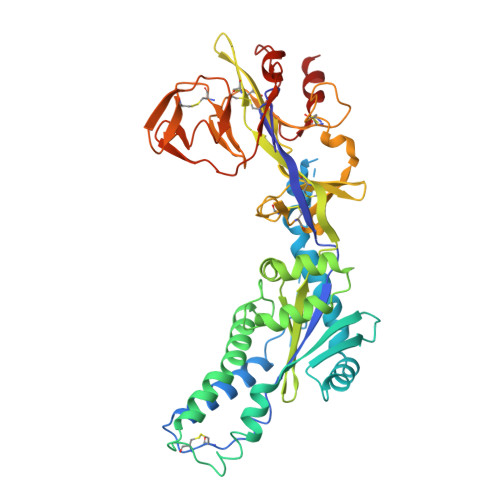
CryoEM structure of 4F11 Fab bound to stabilized MPV-2c HMPV preF


Experimental Data Snapshot

  • Method: ELECTRON MICROSCOPY
  • Resolution: 4.13 Å
  • Aggregation State: PARTICLE 
  • Reconstruction Method: SINGLE PARTICLE 

wwPDB Validation   3D Report Full Report


This is version 1.0 of the entry. See complete history


Literature

DEVELOPMENT OF A POTENT MONOCLONAL ANTIBODY FOR TREATMENT OF HUMAN METAPNEUMOVIRUS INFECTIONS.

Harris, E.D.McGovern, M.Pernikoff, S.Ikeda, R.Kipnis, L.Hannon, W.Sobolik, E.B.Gray, M.Greninger, A.L.He, S.Chin, C.N.Fu, T.M.Pancera, M.Boonyaratanakornkit, J.

(2025) bioRxiv 

  • DOI: https://doi.org/10.1101/2025.06.09.657676
  • Primary Citation of Related Structures:  
    9ORE

  • PubMed Abstract: 

    Human metapneumovirus (HMPV) is a major cause of respiratory infections, particularly among vulnerable populations, yet effective therapeutics remain unavailable. Monoclonal antibodies (mAbs) offer a promising approach for both treatment and prevention. Here, we describe the discovery and characterization of 4F11, a highly potent and broadly neutralizing mAb with demonstrated in vitro and in vivo efficacy against HMPV. Using cryo-electron microscopy, we defined a unique mechanism of binding HMPV employed by 4F11, which distinguishes it from previously characterized RSV and HMPV mAbs. 4F11 targets an epitope located at the apex of the prefusion F protein (site Ø) with a 1:1 stoichiometry, distinct from the 3:1 stoichiometry observed with other HMPV site Ø antibodies. Unlike other site Ø antibodies, which penetrate the glycan shield between Asn57 and Asn172, 4F11 binds vertically and directly interacts with the Asn172 glycan, representing a unique glycan-dependent mode of recognition. In vitro, 4F11 displayed high potency and broad neutralization across diverse HMPV strains. It also showed a low propensity for resistance development, with only a single escape mutation (K179E) identified, a mutation not found in any published HMPV sequence to date. Viruses rescued with the K179E escape mutation had significantly decreased fitness in vitro compared to wild-type virus. In a hamster challenge model, 4F11 significantly reduced viral loads in both the lungs and nasal turbinates. These findings highlight 4F11 as a promising candidate for therapeutic development, particularly for immunocompromised individuals and other high-risk groups.


Macromolecules
Find similar proteins by:  (by identity cutoff)  |  3D Structure
Entity ID: 1
MoleculeChains Sequence LengthOrganismDetailsImage
Fusion glycoprotein F0437human metapneumovirusMutation(s): 0 
Gene Names: FKMM_36597gpF
UniProt
Find proteins for Q6WB98 (Human metapneumovirus (strain CAN97-83))
Explore Q6WB98 
Go to UniProtKB:  Q6WB98
Entity Groups  
Sequence Clusters30% Identity50% Identity70% Identity90% Identity95% Identity100% Identity
UniProt GroupQ6WB98
Glycosylation
Glycosylation Sites: 2
Sequence Annotations
Expand
  • Reference Sequence
Find similar proteins by:  (by identity cutoff)  |  3D Structure
Entity ID: 2
MoleculeChains Sequence LengthOrganismDetailsImage
Fusion glycoprotein F0438human metapneumovirusMutation(s): 0 
UniProt
Find proteins for Q6WB98 (Human metapneumovirus (strain CAN97-83))
Explore Q6WB98 
Go to UniProtKB:  Q6WB98
Entity Groups  
Sequence Clusters30% Identity50% Identity70% Identity90% Identity95% Identity100% Identity
UniProt GroupQ6WB98
Glycosylation
Glycosylation Sites: 2
Sequence Annotations
Expand
  • Reference Sequence
Find similar proteins by:  (by identity cutoff)  |  3D Structure
Entity ID: 3
MoleculeChains Sequence LengthOrganismDetailsImage
Fusion glycoprotein F0439human metapneumovirusMutation(s): 0 
UniProt
Find proteins for Q6WB98 (Human metapneumovirus (strain CAN97-83))
Explore Q6WB98 
Go to UniProtKB:  Q6WB98
Entity Groups  
Sequence Clusters30% Identity50% Identity70% Identity90% Identity95% Identity100% Identity
UniProt GroupQ6WB98
Glycosylation
Glycosylation Sites: 1
Sequence Annotations
Expand
  • Reference Sequence
Find similar proteins by:  (by identity cutoff)  |  3D Structure
Entity ID: 4
MoleculeChains Sequence LengthOrganismDetailsImage
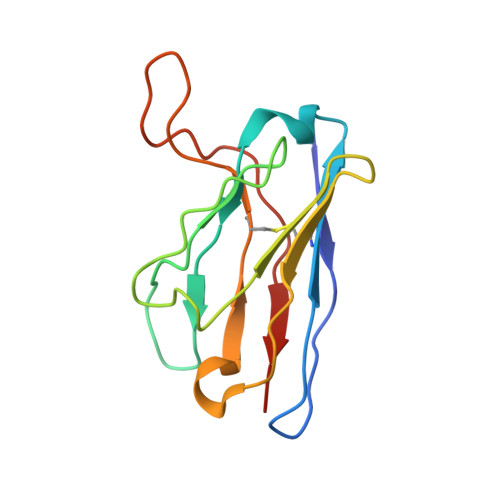
4F11 Heavy ChainD [auth H]123Homo sapiensMutation(s): 0 
Entity Groups  
Sequence Clusters30% Identity50% Identity70% Identity90% Identity95% Identity100% Identity
Sequence Annotations
Expand
  • Reference Sequence
Find similar proteins by:  (by identity cutoff)  |  3D Structure
Entity ID: 5
MoleculeChains Sequence LengthOrganismDetailsImage
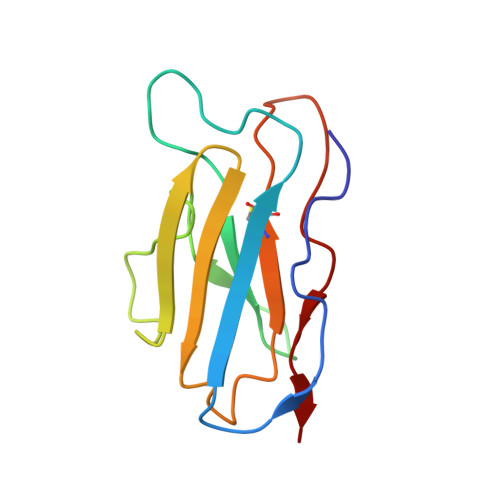
4F11 Light ChainE [auth L]113Homo sapiensMutation(s): 0 
Entity Groups  
Sequence Clusters30% Identity50% Identity70% Identity90% Identity95% Identity100% Identity
Sequence Annotations
Expand
  • Reference Sequence
Oligosaccharides

Help

Entity ID: 6
MoleculeChains Length2D Diagram Glycosylation3D Interactions
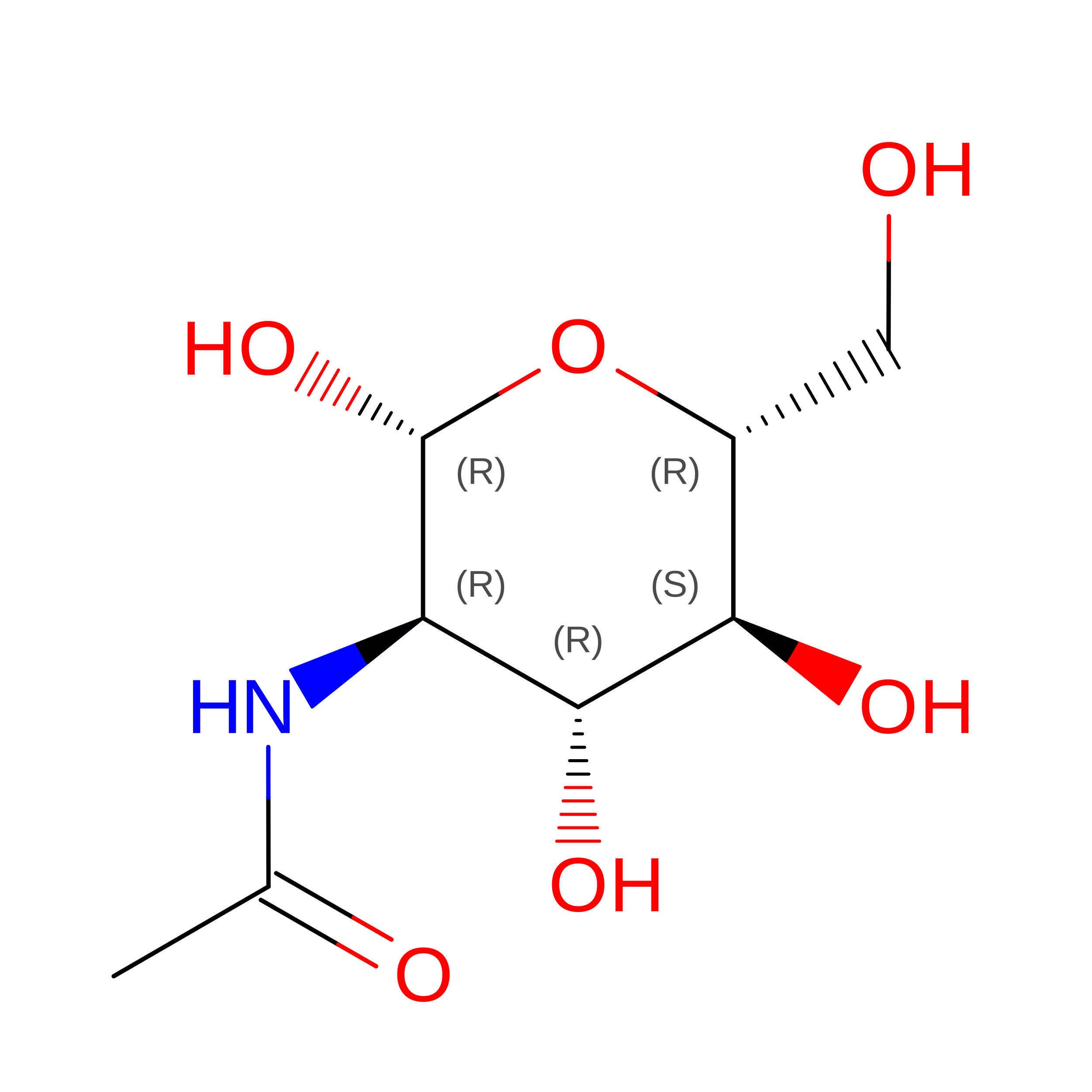
beta-D-mannopyranose-(1-4)-2-acetamido-2-deoxy-beta-D-glucopyranose-(1-4)-2-acetamido-2-deoxy-beta-D-glucopyranoseF [auth D]3N-Glycosylation
Glycosylation Resources
GlyTouCan:  G15407YE
GlyCosmos:  G15407YE
GlyGen:  G15407YE
Entity ID: 7
MoleculeChains Length2D Diagram Glycosylation3D Interactions
2-acetamido-2-deoxy-beta-D-glucopyranose-(1-4)-2-acetamido-2-deoxy-beta-D-glucopyranoseG [auth E]2N-Glycosylation
Glycosylation Resources
GlyTouCan:  G42666HT
GlyCosmos:  G42666HT
GlyGen:  G42666HT
Experimental Data & Validation

Experimental Data

  • Method: ELECTRON MICROSCOPY
  • Resolution: 4.13 Å
  • Aggregation State: PARTICLE 
  • Reconstruction Method: SINGLE PARTICLE 
EM Software:
TaskSoftware PackageVersion
MODEL REFINEMENTPHENIX1.20.1_4487
RECONSTRUCTIONcryoSPARC

Structure Validation

View Full Validation Report


Entry History & Funding Information

Deposition Data


Funding OrganizationLocationGrant Number
National Institutes of Health/National Institute Of Allergy and Infectious Diseases (NIH/NIAID)United StatesR01 AI171186

Revision History  (Full details and data files)

  • Version 1.0: 2025-07-30
    Type: Initial release