9OGE | pdb_00009oge

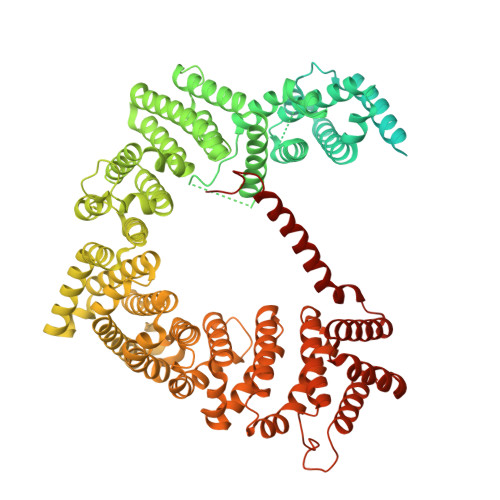
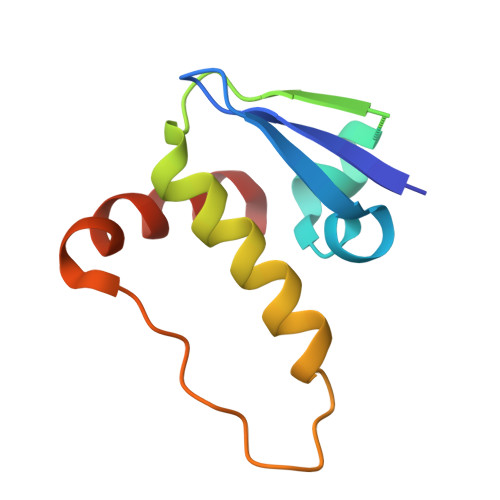
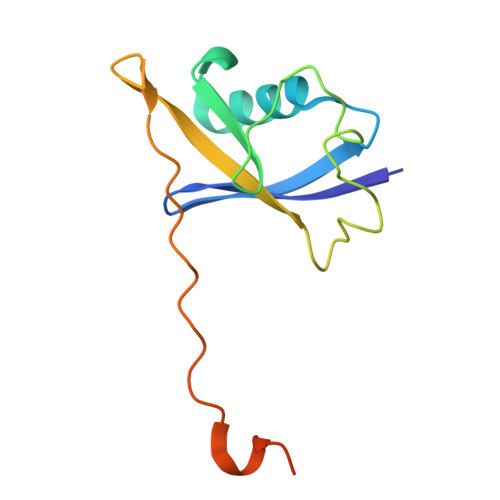
Cryo-EM structure of human exportin-1 conjugated with KPT-127 and bound to human ASB8-ELOB/C


Experimental Data Snapshot

  • Method: ELECTRON MICROSCOPY
  • Resolution: 3.28 Å
  • Aggregation State: PARTICLE 
  • Reconstruction Method: SINGLE PARTICLE 

Starting Model: experimental
View more details

wwPDB Validation   3D Report Full Report


This is version 1.1 of the entry. See complete history


Literature

SINE compounds activate exportin-1 degradation via an allosteric mechanism.

Wing, C.E.Fung, H.Y.J.Kwanten, B.Cagatay, T.Niesman, A.B.Jacquemyn, M.Gharghabi, M.Permentier, B.Shakya, B.Nandi, R.Ready, J.M.Kashyap, T.Shacham, S.Landesman, Y.Lapalombella, R.Daelemans, D.Chook, Y.M.

(2025) bioRxiv 

  • DOI: https://doi.org/10.1101/2024.10.07.617049
  • Primary Citation of Related Structures:  
    9OG9, 9OGA, 9OGB, 9OGC, 9OGD, 9OGE, 9OGF, 9OGN, 9OGO

  • PubMed Abstract: 

    The nuclear export receptor exportin 1 (XPO1/CRM1) is often overexpressed in cancer cells, leading to the mislocalization of numerous cancer-related protein cargoes 1,2 . Selinexor, a covalent XPO1 inhibitor, and other Selective Inhibitor of Nuclear Export (SINEs) restore proper nuclear localization by blocking XPO1-cargo binding 2-7 . SINEs also induce XPO1 degradation via the Cullin-RING E3 ubiquitin ligase (CRL) substrate receptor ASB8 7 . Here we elucidate the mechanism underlying the high-affinity engagement of CRL5 ASB8 with SINE-conjugated XPO1. Cryogenic electron microscopy (cryoEM) structures reveal that ASB8 binds to a cryptic site on XPO1, which becomes accessible only upon SINE conjugation. While molecular glue degraders typically interact with both CRL and the substrate 8-10 , SINEs bind to XPO1 without requiring interaction with ASB8 for efficient XPO1 degradation. Instead, an allosteric mechanism facilitates high affinity XPO1-ASB8 interaction, leading to XPO1 ubiquitination and degradation. ASB8-mediated degradation is also observed upon treatment of the endogenous itaconate derivate 4-octyl itaconate, which suggests a native mechanism that is inadvertently exploited by synthesized XPO1 inhibitors. This allosteric XPO1 degradation mechanism of SINE compounds expands the known modes of targeted protein degradation beyond the well-characterized molecular glue degraders and proteolysis targeting chimeras of CRL4.


Macromolecules
Find similar proteins by:  (by identity cutoff)  |  3D Structure
Entity ID: 1
MoleculeChains Sequence LengthOrganismDetailsImage
Exportin-11,073Homo sapiensMutation(s): 0 
Gene Names: XPO1CRM1
UniProt & NIH Common Fund Data Resources
Find proteins for O14980 (Homo sapiens)
Explore O14980 
Go to UniProtKB:  O14980
PHAROS:  O14980
GTEx:  ENSG00000082898 
Entity Groups  
Sequence Clusters30% Identity50% Identity70% Identity90% Identity95% Identity100% Identity
UniProt GroupO14980
Sequence Annotations
Expand
  • Reference Sequence
Find similar proteins by:  (by identity cutoff)  |  3D Structure
Entity ID: 2
MoleculeChains Sequence LengthOrganismDetailsImage
Ankyrin repeat and SOCS box protein 8274Homo sapiensMutation(s): 0 
Gene Names: ASB8PP14212
UniProt & NIH Common Fund Data Resources
Find proteins for Q9H765 (Homo sapiens)
Explore Q9H765 
Go to UniProtKB:  Q9H765
PHAROS:  Q9H765
GTEx:  ENSG00000177981 
Entity Groups  
Sequence Clusters30% Identity50% Identity70% Identity90% Identity95% Identity100% Identity
UniProt GroupQ9H765
Sequence Annotations
Expand
  • Reference Sequence
Find similar proteins by:  (by identity cutoff)  |  3D Structure
Entity ID: 3
MoleculeChains Sequence LengthOrganismDetailsImage
Elongin-CC [auth E]97Homo sapiensMutation(s): 0 
Gene Names: ELOCTCEB1
UniProt & NIH Common Fund Data Resources
Find proteins for Q15369 (Homo sapiens)
Explore Q15369 
Go to UniProtKB:  Q15369
PHAROS:  Q15369
GTEx:  ENSG00000154582 
Entity Groups  
Sequence Clusters30% Identity50% Identity70% Identity90% Identity95% Identity100% Identity
UniProt GroupQ15369
Sequence Annotations
Expand
  • Reference Sequence
Find similar proteins by:  (by identity cutoff)  |  3D Structure
Entity ID: 4
MoleculeChains Sequence LengthOrganismDetailsImage
Elongin-BD [auth F]118Homo sapiensMutation(s): 0 
Gene Names: ELOBTCEB2
UniProt & NIH Common Fund Data Resources
Find proteins for Q15370 (Homo sapiens)
Explore Q15370 
Go to UniProtKB:  Q15370
PHAROS:  Q15370
GTEx:  ENSG00000103363 
Entity Groups  
Sequence Clusters30% Identity50% Identity70% Identity90% Identity95% Identity100% Identity
UniProt GroupQ15370
Sequence Annotations
Expand
  • Reference Sequence
Small Molecules
Ligands 1 Unique
IDChains Name / Formula / InChI Key2D Diagram3D Interactions
A1CBC (Subject of Investigation/LOI)
Query on A1CBC

Download Ideal Coordinates CCD File 
E [auth A]propan-2-yl 3-[3-(3-chlorophenyl)-1H-1,2,4-triazol-1-yl]propanoate
C14 H16 Cl N3 O2
JGEAPQXGVPIXAY-UHFFFAOYSA-N
Experimental Data & Validation

Experimental Data

  • Method: ELECTRON MICROSCOPY
  • Resolution: 3.28 Å
  • Aggregation State: PARTICLE 
  • Reconstruction Method: SINGLE PARTICLE 
EM Software:
TaskSoftware PackageVersion
RECONSTRUCTIONcryoSPARC
MODEL REFINEMENTPHENIX

Structure Validation

View Full Validation Report


Entry History & Funding Information

Deposition Data


Funding OrganizationLocationGrant Number
Cancer Prevention and Research Institute of Texas (CPRIT)United StatesRP220582
Cancer Prevention and Research Institute of Texas (CPRIT)United StatesRP180410
Cancer Prevention and Research Institute of Texas (CPRIT)United States150053
Cancer Prevention and Research Institute of Texas (CPRIT)United StatesRP170170
National Institutes of Health/National Institute of General Medical Sciences (NIH/NIGMS)United StatesR35GM144137
National Institutes of Health/National Institute of General Medical Sciences (NIH/NIGMS)United StatesT32GM131963
Welch FoundationUnited StatesI-1532

Revision History  (Full details and data files)

  • Version 1.0: 2025-11-26
    Type: Initial release
  • Version 1.1: 2025-12-03
    Changes: Data collection, Database references