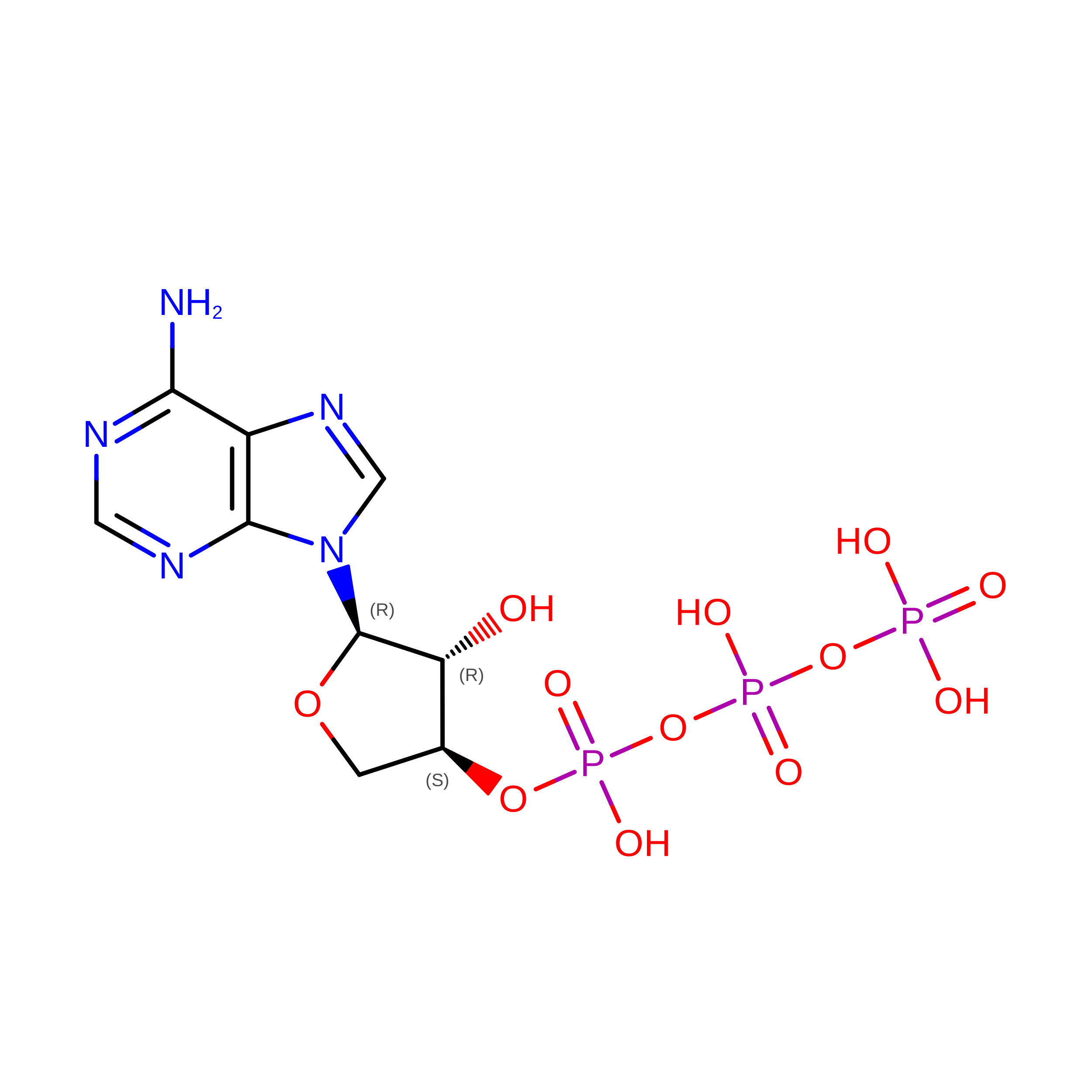
9OAX | pdb_00009oax

TNA polymerase, 5-270, ternary complex


Experimental Data Snapshot

  • Method: X-RAY DIFFRACTION
  • Resolution: 3.03 Å
  • R-Value Free: 
    0.278 (Depositor), 0.277 (DCC) 
  • R-Value Work: 
    0.224 (Depositor), 0.224 (DCC) 
  • R-Value Observed: 
    0.229 (Depositor) 

Starting Model: experimental
View more details

wwPDB Validation   3D Report Full Report


Ligand Structure Quality Assessment 


This is version 1.2 of the entry. See complete history


Literature

Directed evolution of a TNA polymerase identifies independent paths to fidelity and catalysis.

Hajjar, M.Maola, V.A.Lee, J.J.Holguin, M.J.Quijano, R.N.Nguyen, K.K.Ho, K.L.Medina, J.V.Botello-Cornejo, E.Barpuzary, B.Chim, N.Chaput, J.C.

(2025) Nat Commun 17: 925-925

  • DOI: https://doi.org/10.1038/s41467-025-67652-1
  • Primary Citation of Related Structures:  
    9OAT, 9OAU, 9OAV, 9OAW, 9OAX, 9OAY

  • PubMed Abstract: 

    Directed evolution facilitates functional adaptations through stepwise changes in sequence that alter protein structure. While most campaigns yield solutions that maintain the framework of a rigid protein architecture, a few have produced enzymes with more notable structural differences. One example is a polymerase that was evolved to synthesize threose nucleic acid (TNA) with near-natural activity. Understanding how this enzyme arose provides a model for studying pathways that guide enzymes toward more productive regions of the fitness landscape. Here, we trace the evolutionary trajectory of an unnatural polymerase by solving crystal structures of key intermediates along the pathway and evaluating their biochemical activity. Contrary to the view that fidelity is a product of increased catalytic efficiency, we find that accuracy and catalysis are decoupled activities guided by separate ground-state and transition-state discrimination events. Together, these results offer a glimpse into the forces responsible for shaping the emergence of new enzyme functions.


  • Organizational Affiliation
    • Department of Pharmaceutical Sciences, University of California, Irvine, CA, USA.

Macromolecules

Find similar proteins by:  (by identity cutoff)  |  3D Structure
Entity ID: 1
MoleculeChains Sequence LengthOrganismDetailsImage
5-270, TNA polymerase750Thermococcus kodakarensisMutation(s): 0 
Entity Groups  
Sequence Clusters30% Identity50% Identity70% Identity90% Identity95% Identity100% Identity
Sequence Annotations
Expand
  • Reference Sequence

Find similar nucleic acids by:  Sequence   |   3D Structure  

Entity ID: 2
MoleculeChains LengthOrganismImage
TemplateB [auth T]21synthetic construct
Sequence Annotations
Expand
  • Reference Sequence

Find similar nucleic acids by:  Sequence   |   3D Structure  

Entity ID: 3
MoleculeChains LengthOrganismImage
PrimerC [auth P]12synthetic construct
Sequence Annotations
Expand
  • Reference Sequence
Experimental Data & Validation

Experimental Data

  • Method: X-RAY DIFFRACTION
  • Resolution: 3.03 Å
  • R-Value Free:  0.278 (Depositor), 0.277 (DCC) 
  • R-Value Work:  0.224 (Depositor), 0.224 (DCC) 
  • R-Value Observed: 0.229 (Depositor) 
Space Group: P 21 21 21
Unit Cell:
Length ( Å )Angle ( ˚ )
a = 77.441α = 90
b = 101.713β = 90
c = 110.847γ = 90
Software Package:
Software NamePurpose
Blu-Icedata collection
XDSdata reduction
pointlessdata scaling
Aimlessdata scaling
PHASERphasing
PHENIXrefinement
Cootmodel building

Structure Validation

View Full Validation Report


Ligand Structure Quality Assessment 


Entry History & Funding Information

Deposition Data


Funding OrganizationLocationGrant Number
National Science Foundation (NSF, United States)United StatesMCB 1946312

Revision History  (Full details and data files)

  • Version 1.0: 2025-12-10
    Type: Initial release
  • Version 1.1: 2025-12-31
    Changes: Database references
  • Version 1.2: 2026-02-04
    Changes: Database references