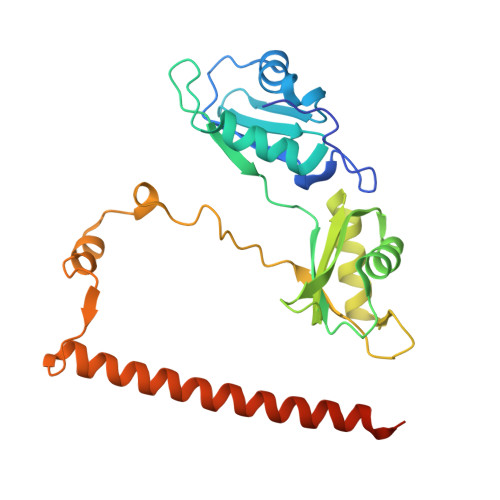
9NZI | pdb_00009nzi

NONO homodimer bound to (R)-SKBG-1


Experimental Data Snapshot

  • Method: X-RAY DIFFRACTION
  • Resolution: 2.52 Å
  • R-Value Free: 
    0.268 (Depositor), 0.269 (DCC) 
  • R-Value Work: 
    0.225 (Depositor), 0.226 (DCC) 
  • R-Value Observed: 
    0.227 (Depositor) 

Starting Model: experimental
View more details

wwPDB Validation 3D Report Full Report

Validation slider image for 9NZI

Ligand Structure Quality Assessment 


This is version 1.1 of the entry. See complete history

Literature

Structural and mechanistic analysis of covalent ligands targeting the RNA-binding protein NONO.

Lindsey, G.L.Hockley, T.K.Gomez, A.V.Marshall, A.C.Brothers, W.R.Finney, C.T.Gross, J.Fox, A.H.Yeo, G.W.Melillo, B.Bond, C.S.Cravatt, B.F.

(2026) Cell Chem Biol 33: 256-267.e11

  • DOI: https://doi.org/10.1016/j.chembiol.2025.12.010
  • Primary Citation Related Structures: 
    9NZI

  • PubMed Abstract: 

    RNA-binding proteins (RBPs) play important roles in mRNA transcription, processing, and translation. Chemical tools are lacking for RBPs, which has hindered efforts to perturb and understand RBP function in cells. We previously described a chloroacetamide compound (R)-SKBG-1 that covalently binds the RBP NONO and stabilizes its interactions with mRNAs, leading to transcriptional remodeling and suppression of cancer cell growth. Here, we report the crystal structure of an (R)-SKBG-1:NONO complex, which confirms covalent modification of cysteine-145 at a pocket proximal to the RNA-binding interface of the protein. We show that this pocket can also be targeted by a lower reactivity chlorofluoroacetamide analog (R, R)-GL-373, which retains the pharmacological properties of (R)-SKBG-1, including blockade of estrogen receptor expression in breast cancer cells, while displaying much greater proteome-wide selectivity. Our findings thus show that NONO can be targeted by covalent ligands with high specificity to pharmacologically suppress pro-tumorigenic gene products in cancer cells.


  • Organizational Affiliation
    • Department of Chemistry, The Scripps Research Institute, La Jolla, CA, USA.

Macromolecule Content 

  • Total Structure Weight: 122.84 kDa 
  • Atom Count: 8,116 
  • Modeled Residue Count: 980 
  • Deposited Residue Count: 1,044 
  • Unique protein chains: 1

Macromolecules

Find similar proteins by:|  3D Structure
Entity ID: 1
MoleculeChains  Sequence LengthOrganismDetailsImage
Non-POU domain-containing octamer-binding protein
A, B, C, D
261Homo sapiensMutation(s): 0 
Gene Names: NONONRB54
UniProt & NIH Common Fund Data Resources
Find proteins for Q15233 (Homo sapiens)
Explore Q15233 
Go to UniProtKB:  Q15233
PHAROS:  Q15233
GTEx:  ENSG00000147140 
Entity Groups
Sequence Clusters30% Identity50% Identity70% Identity90% Identity95% Identity100% Identity
UniProt GroupQ15233
Sequence Annotations
Expand
Reference Sequence

Experimental Data & Validation

Experimental Data

  • Method: X-RAY DIFFRACTION
  • Resolution: 2.52 Å
  • R-Value Free:  0.268 (Depositor), 0.269 (DCC) 
  • R-Value Work:  0.225 (Depositor), 0.226 (DCC) 
  • R-Value Observed: 0.227 (Depositor) 
Space Group: P 1 21 1
Unit Cell:
Length ( Å )Angle ( ˚ )
a = 96.627α = 90
b = 71.141β = 118.656
c = 101.748γ = 90
Software Package:
Software NamePurpose
PHENIXrefinement
XDSdata reduction
Aimlessdata scaling
MOLREPphasing

Structure Validation

View Full Validation Report


Ligand Structure Quality Assessment 


Entry History 

& Funding Information

Deposition Data


Funding OrganizationLocationGrant Number
Australian Research Council (ARC)AustraliaDP220103667
Australian Research Council (ARC)AustraliaLE230100156
Australian Research Council (ARC)AustraliaLE140100096

Revision History  (Full details and data files)

  • Version 1.0: 2025-12-17
    Type: Initial release
  • Version 1.1: 2026-07-01
    Changes: Database references