Download Mendeley
A miniature CRISPR-Cas10 enzyme confers immunity by inhibitory signalling.
Doherty, E.E., Adler, B.A., Yoon, P.H., Hsieh, K., Loi, K., Armbruster, E.G., Lahiri, A., Bolling, C.S., Wilcox, X.E., Akkati, A., Iavarone, A.T., Pogliano, J., Doudna, J.A.(2025) Nature 647: 997-1004
- PubMed: 41034576 Search on PubMedSearch on PubMed Central
- DOI: https://doi.org/10.1038/s41586-025-09569-9
- Primary Citation Related Structures:
9NWN - PubMed Abstract:
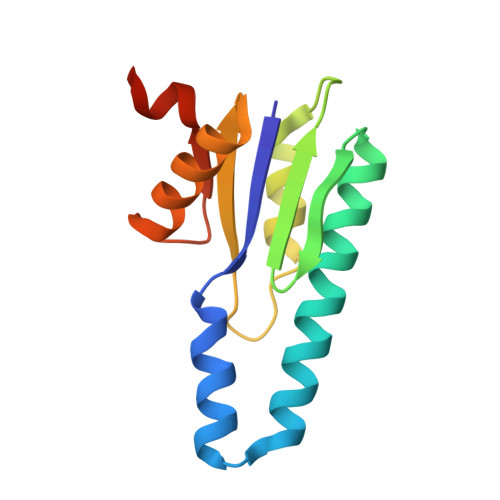
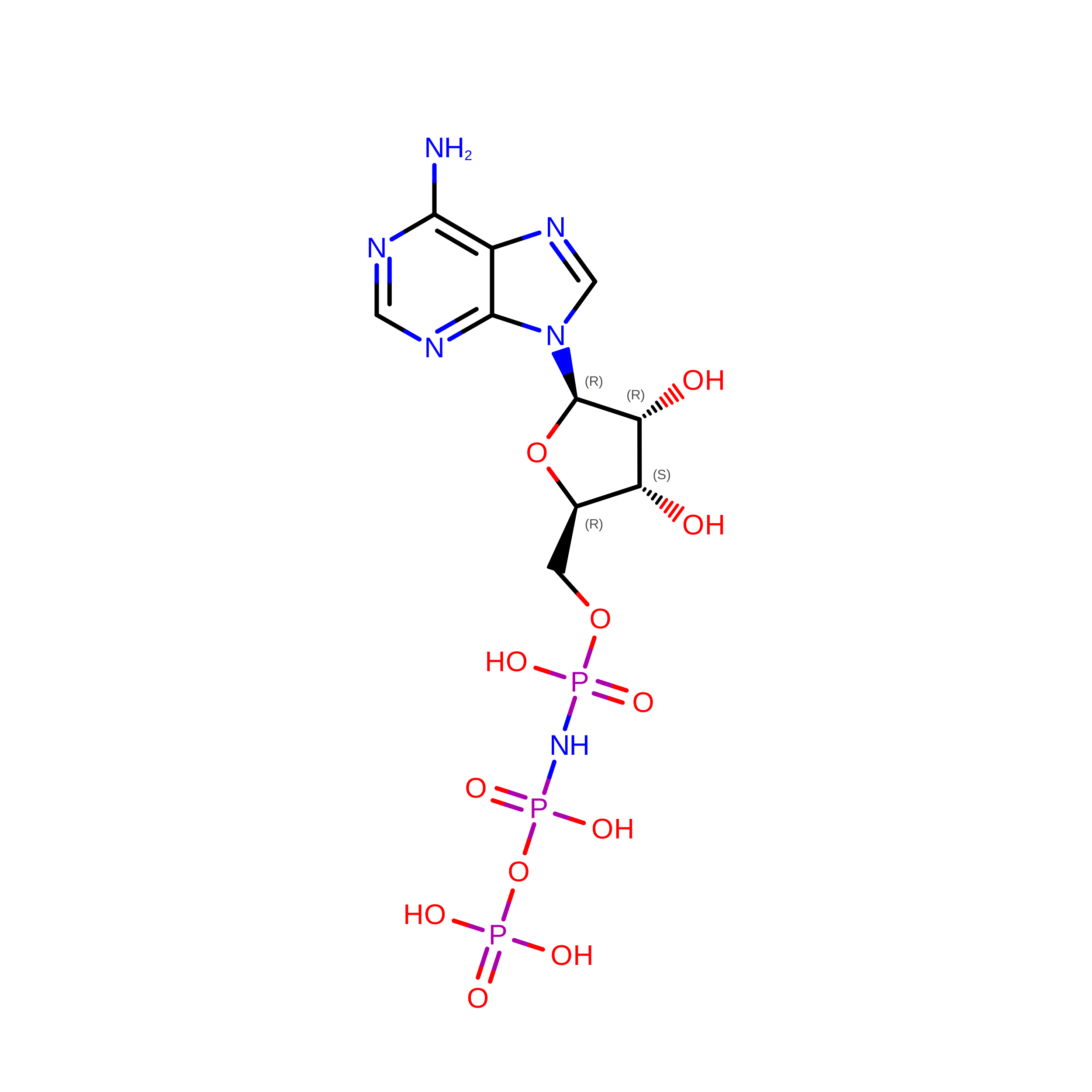
Microbial and viral co-evolution has created immunity mechanisms involving oligonucleotide signalling that share mechanistic features with human antiviral systems 1 . In these pathways, including cyclic oligonucleotide-based antiphage signalling systems (CBASSs) and type III CRISPR systems in bacteria and cyclic GMP-AMP synthase-stimulator of interferon genes (cGAS-STING) in humans, oligonucleotide synthesis occurs upon detection of virus or foreign genetic material in the cell, triggering the antiviral response 2-4 . Here, in an unexpected inversion of this process, we show that the CRISPR-related enzyme mCpol synthesizes cyclic oligonucleotides constitutively as part of an active mechanism that represses a toxic effector. Cell-based experiments demonstrated that the absence or loss of mCpol-produced cyclic oligonucleotides triggers cell death, preventing the spread of viruses that attempt immune evasion by depleting host cyclic nucleotides. Structural and mechanistic investigation revealed mCpol to be a di-adenylate cyclase whose product, c-di-AMP, prevents toxic oligomerization of the effector protein 2TMβ. Analysis of cells by fluorescence microscopy showed that lack of mCpol allows 2TMβ-mediated cell death due to inner membrane collapse. These findings unveil a powerful defence strategy against virus-mediated immune suppression, expanding our understanding of the role of oligonucleotides in immunity.
- Innovative Genomics Institute, University of California, Berkeley, Berkeley, CA, USA.
Organizational Affiliation: