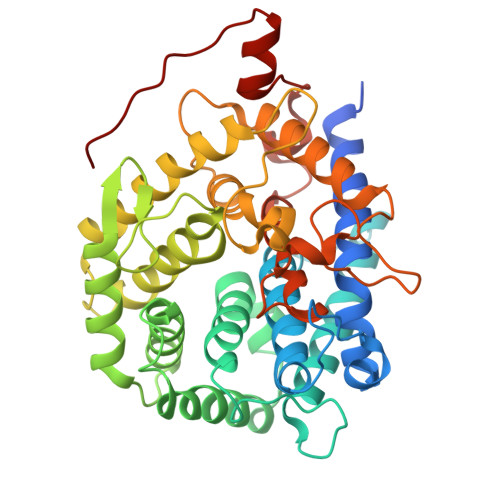
9NWF | pdb_00009nwf

Structure of an inactive beta-D-glucuronate dehydratase mutant in complex with chondrosine


Experimental Data Snapshot

  • Method: X-RAY DIFFRACTION
  • Resolution: 2.60 Å
  • R-Value Free: 
    0.262 (Depositor), 0.262 (DCC) 
  • R-Value Work: 
    0.191 (Depositor), 0.191 (DCC) 
  • R-Value Observed: 
    0.195 (Depositor) 

Starting Model: in silico
View more details

wwPDB Validation   3D Report Full Report


This is version 1.1 of the entry. See complete history


Literature

Analysis of chondroitin degradation by components of a Bacteroides caccae polysaccharide utilization locus.

Alvarez, B.Canil, O.F.Low, K.E.Hettle, A.G.Abbott, D.W.Boraston, A.B.

(2025) J Biological Chem : 110354-110354

  • DOI: https://doi.org/10.1016/j.jbc.2025.110354
  • Primary Citation of Related Structures:  
    9NWF, 9O3Q, 9O4U

  • PubMed Abstract: 

    The human gut microbiota (HGM) possesses enormously diverse capacity to metabolize both host and dietary glycans. Glycosaminoglycans (GAG) are complex polysaccharides that may be in the diet (e.g., from animal products) or may be presented by host tissues. These polysaccharides are known to be prioritized as a nutrient source by some members of the HGM. While significant advances in understanding how GAGs are metabolized by the HGM have been made, the varied architectures of the numerous polysaccharide utilization loci (PULs) targeting varied polysaccharides suggest that all the mechanisms of GAG degradation may not have been uncovered. Here we show that components of a (PUL) from Bacteroides caccae have activities consistent with comprising a unique pathway for depolymerization of chondroitin sulfate, a common GAG. After prior desulfation by an endo-sulfatase, BcSulf, to produce unsulfated chondroitin from chondroitin, the depolymerization pathway begins with the activity a polysaccharide lyase from family 35, BcPL35. BcPL35 activity is coupled with BcGH88, an exo-β-uronyl hydrolase, and presumably BcGH109, a confirmed α/β-N-acetylgalactosaminidase. The most unique feature of the pathway is a β-D-glucuronate dehydratase, BcGDH, which we show through structural and functional analyses primes saturated non-reducing end β-D-glucuronate residues for hydrolysis by BcGH88. BcGDH is a member of a large family previously classified as glycoside hydrolase family 154. The potential reclassification of GH154 enzymes as uronate sugar dehydratases not only improves our understanding of chondroitin metabolism by B. caccae but will be broadly applicable to predicting the function of other pathways relevant to uronate sugar metabolism.


  • Organizational Affiliation
    • Department of Biochemistry and Microbiology, University of Victoria, PO Box 1700 STN CSC, Victoria, British Columbia, V8W 2Y2, Canada.

Macromolecules
Find similar proteins by:  (by identity cutoff)  |  3D Structure
Entity ID: 1
MoleculeChains Sequence LengthOrganismDetailsImage
Glucuronate dehydratase
A, B, C, D
405Bacteroides caccae ATCC 43185Mutation(s): 1 
Gene Names: DW190_12820DW794_00720DXA49_19590ERS852494_00337F2Y31_01635F2Y35_19060F2Y36_02775F2Y39_01210NXW23_04330
UniProt
Find proteins for I9ECR6 (Bacteroides caccae CL03T12C61)
Explore I9ECR6 
Go to UniProtKB:  I9ECR6
Entity Groups  
Sequence Clusters30% Identity50% Identity70% Identity90% Identity95% Identity100% Identity
UniProt GroupI9ECR6
Sequence Annotations
Expand
  • Reference Sequence
Oligosaccharides

Help

Entity ID: 2
MoleculeChains Length2D Diagram Glycosylation3D Interactions
beta-D-glucopyranuronic acid-(1-3)-2-amino-2-deoxy-beta-D-galactopyranoseE,
F [auth G],
G [auth I],
H [auth J]
2N/A
Glycosylation Resources
GlyTouCan:  G54006FV
GlyCosmos:  G54006FV
Small Molecules
Ligands 1 Unique
IDChains Name / Formula / InChI Key2D Diagram3D Interactions
IOD
Query on IOD

Download Ideal Coordinates CCD File 
AA [auth C]
BA [auth C]
CA [auth C]
DA [auth C]
EA [auth D]
AA [auth C],
BA [auth C],
CA [auth C],
DA [auth C],
EA [auth D],
FA [auth D],
GA [auth D],
HA [auth D],
I [auth A],
IA [auth D],
J [auth A],
K [auth A],
L [auth A],
M [auth A],
N [auth A],
O [auth A],
P [auth A],
Q [auth A],
R [auth B],
S [auth B],
T [auth B],
U [auth B],
V [auth B],
W [auth B],
X [auth C],
Y [auth C],
Z [auth C]
IODIDE ION
I
XMBWDFGMSWQBCA-UHFFFAOYSA-M
Experimental Data & Validation

Experimental Data

  • Method: X-RAY DIFFRACTION
  • Resolution: 2.60 Å
  • R-Value Free:  0.262 (Depositor), 0.262 (DCC) 
  • R-Value Work:  0.191 (Depositor), 0.191 (DCC) 
  • R-Value Observed: 0.195 (Depositor) 
Space Group: P 21 21 21
Unit Cell:
Length ( Å )Angle ( ˚ )
a = 99.543α = 90
b = 105.84β = 90
c = 179.944γ = 90
Software Package:
Software NamePurpose
PHENIXrefinement
HKL-2000data scaling
HKL-2000data reduction
PHASERphasing

Structure Validation

View Full Validation Report


Entry History & Funding Information

Deposition Data


Funding OrganizationLocationGrant Number
Natural Sciences and Engineering Research Council (NSERC, Canada)Canada04355

Revision History  (Full details and data files)

  • Version 1.0: 2025-06-04
    Type: Initial release
  • Version 1.1: 2025-06-25
    Changes: Database references