9NTO | pdb_00009nto

Structure of Cap9-CdnD complex containing NDG modification


Experimental Data Snapshot

  • Method: X-RAY DIFFRACTION
  • Resolution: 2.15 Å
  • R-Value Free: 
    0.232 (Depositor), 0.230 (DCC) 
  • R-Value Work: 
    0.205 (Depositor), 0.205 (DCC) 
  • R-Value Observed: 
    0.206 (Depositor) 

Starting Model: in silico
View more details

wwPDB Validation 3D Report Full Report

Validation slider image for 9NTO

Ligand Structure Quality Assessment 


This is version 1.2 of the entry. See complete history

Literature

Deazaguanylation is a nucleobase-protein conjugation required for type IV CBASS immunity.

Wassarman, D.R.Pfaff, P.Paulo, J.A.Gygi, S.P.Shokat, K.M.Kranzusch, P.J.

(2025) Science 389: 1347-1352

  • DOI: https://doi.org/10.1126/science.adx6053
  • Primary Citation Related Structures: 
    9NTN, 9NTO

  • PubMed Abstract: 

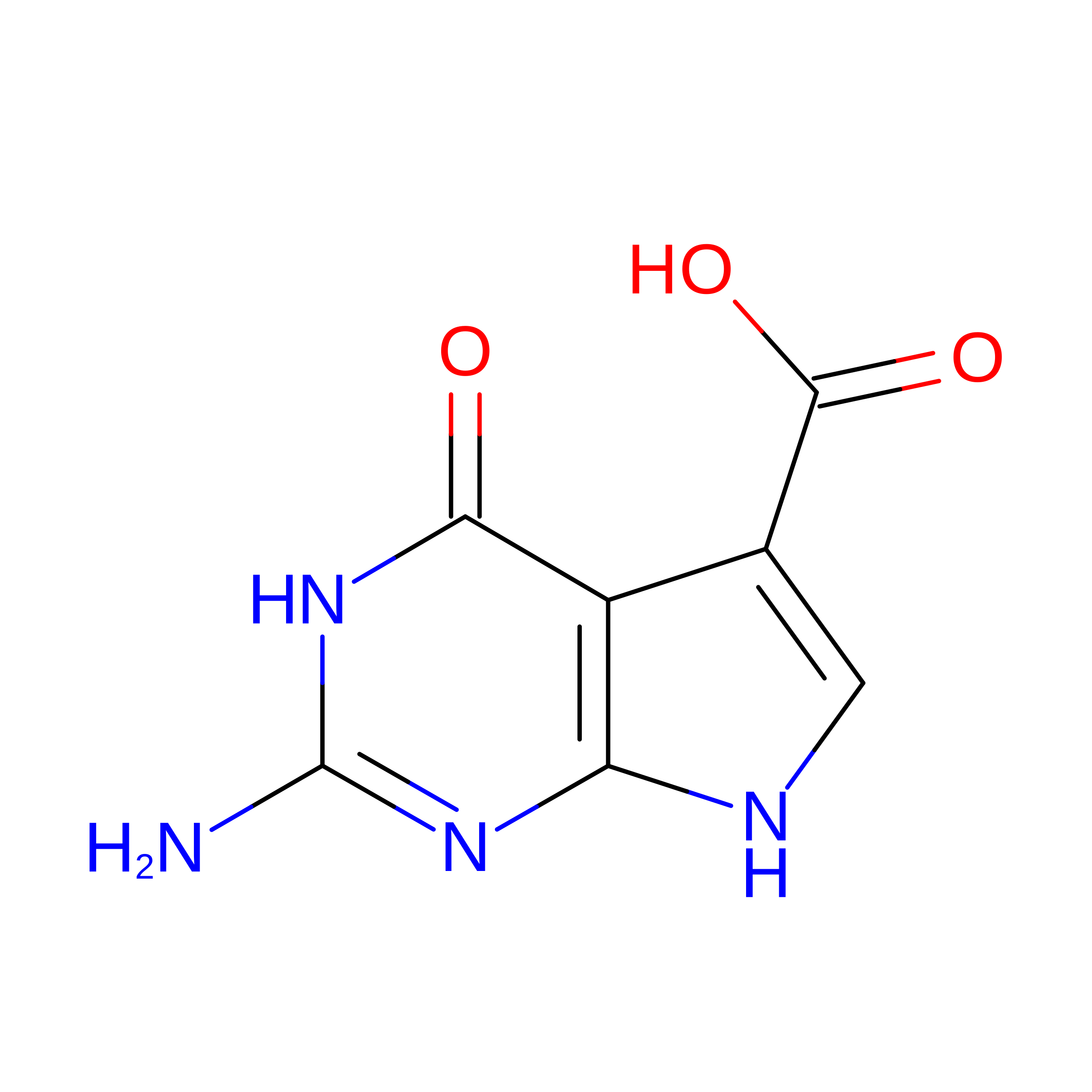
    7-Deazapurines are nucleobase analogs essential for nucleic acid modifications in nearly all cellular life. In this study, we discovered a role for 7-deazapurines in protein modification within type IV cyclic oligonucleotide-based antiviral signaling system (CBASS) antiphage defense and defined functions for CBASS ancillary proteins Cap9 and Cap10 in nucleobase-protein conjugation. A structure of Cap10 revealed a transfer RNA transglycosylase family enzyme remodeled to bind a partner cGAS/DncV-like nucleotidyltransferase that is modified with an N-terminal 7-amido-7-deazaguanine (NDG) nucleobase. A structure of Cap9 explained how this QueC-like enzyme co-opts a 7-deazapurine biosynthetic reaction to install NDG. We show that Cap9, Cap10, and protein deazaguanylation are essential for host defense against phage infection. Our results define a 7-deazapurine protein modification and explain how nucleobase biosynthetic machinery has been repurposed for antiviral immunity.


  • Organizational Affiliation
    • Department of Microbiology, Blavatnik Institute, Harvard Medical School, Boston, MA, USA.

Macromolecule Content 

  • Total Structure Weight: 55.37 kDa 
  • Atom Count: 3,743 
  • Modeled Residue Count: 464 
  • Deposited Residue Count: 511 
  • Unique protein chains: 2

Macromolecules

Find similar proteins by:|  3D Structure
Entity ID: 1
MoleculeChains  Sequence LengthOrganismDetailsImage
CdnD320HyphomicrobialesMutation(s): 0 
Find similar proteins by:|  3D Structure
Entity ID: 2
MoleculeChains  Sequence LengthOrganismDetailsImage
Cap9191HyphomicrobialesMutation(s): 0 

Experimental Data & Validation

Experimental Data

  • Method: X-RAY DIFFRACTION
  • Resolution: 2.15 Å
  • R-Value Free:  0.232 (Depositor), 0.230 (DCC) 
  • R-Value Work:  0.205 (Depositor), 0.205 (DCC) 
  • R-Value Observed: 0.206 (Depositor) 
Space Group: P 21 21 2
Unit Cell:
Length ( Å )Angle ( ˚ )
a = 92.664α = 90
b = 58.219β = 90
c = 89.228γ = 90
Software Package:
Software NamePurpose
PHENIXrefinement
AutoProcessdata processing
Cootmodel building
XDSdata reduction
Aimlessdata scaling
PHASERphasing

Structure Validation

View Full Validation Report


Ligand Structure Quality Assessment 


Entry History 

& Funding Information

Deposition Data


Funding OrganizationLocationGrant Number
National Institutes of Health/National Institute of General Medical Sciences (NIH/NIGMS)United States1DP2GM146250-01

Revision History  (Full details and data files)

  • Version 1.0: 2025-05-07
    Type: Initial release
  • Version 1.1: 2025-09-17
    Changes: Database references
  • Version 1.2: 2025-10-08
    Changes: Database references