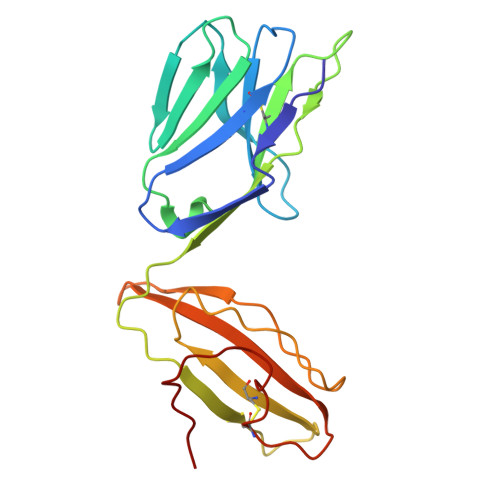
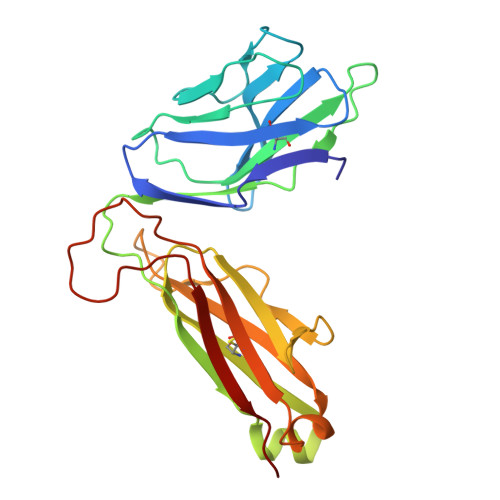
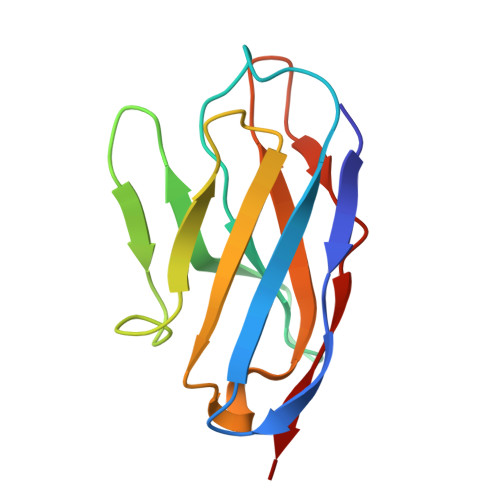
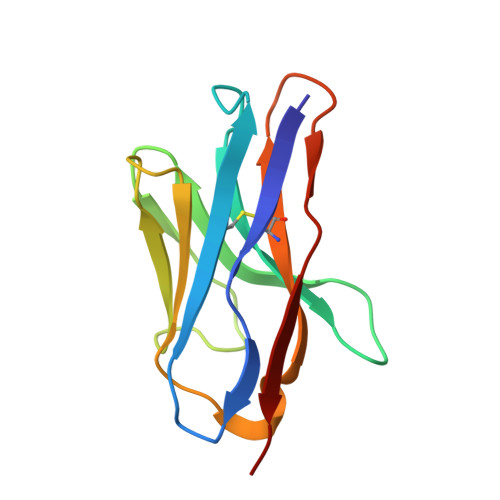
9NRJ | pdb_00009nrj

abTCR bound to SAR444200, a novel anti-GPC3 T-cell engager, for the treatment of GPC3+ solid tumors


Experimental Data Snapshot

  • Method: ELECTRON MICROSCOPY
  • Resolution: 3.40 Å
  • Aggregation State: 2D ARRAY 
  • Reconstruction Method: SINGLE PARTICLE 

wwPDB Validation   3D Report Full Report


This is version 1.0 of the entry. See complete history


Literature

Identification and non-clinical characterization of SAR444200, a novel anti-GPC3 NANOBODY® T-cell engager, for the treatment of GPC3+ solid tumors.

Meoni, P.Vintem, A.P.B.Cortez-Retamozo, V.F.Jacobs, J.De Tavernier, E.Fiorentini, P.Van Hoorick, D.Batchelor, J.D.Svidritskiy, E.Qiu, Y.Dejonckheere, E.Li, A.Pao, L.I.Buyse, M.A.

(2025) Mol Cancer Ther 

  • DOI: https://doi.org/10.1158/1535-7163.MCT-24-1049
  • Primary Citation of Related Structures:  
    9BDO, 9NRJ, 9NTQ

  • PubMed Abstract: 

    T-cell engager (TCE) immunotherapy has demonstrated significant clinical activity in multiple cancers by inducing co-engagement of T-cells and tumor cells, resulting in T-cell activation and T-cell-dependent cellular cytotoxicity (TDCC) against tumor cells. Current-generation TCEs are predominantly composed of antibody-based binding domains targeting the CD3e molecule of the T-cell antigen receptor (TCR)/CD3 complex on T-cells and a tumor-associated antigen on tumor cells. However, limitations of this approach include cytokine release syndrome and a limited therapeutic window. Here, we report the generation and preclinical evaluation of SAR444200, the first NANOBODY®-based TCE clinical candidate binding to TCRαβ and GPC3 to co-engage T-cells and GPC3+ tumor cells, causing TDCC. SAR444200 bound with nanomolar to picomolar affinity to TCRαβ and GPC3 respectively and induced in vitro TDCC against multiple human tumor cell lines with differential GPC3 expression with picomolar potency. In vivo analysis using human cancer cell line-derived (HuH-7 and HepG2) xenografts in immunodeficient mice showed complete tumor regression at doses starting from 0.7 mg/kg. In exploratory non-human primate studies, intravenous administration of SAR444200 was well tolerated up to 8 mg/kg and exhibited greater than dose-proportional clearances and dose-proportional maximum concentrations across the tested dose range. The highly potent and efficacious activity of SAR444200 in diverse models of GPC3+ tumors and the extremely wide tolerated dose range merits further development of this compound. Furthermore, NANOBODY®-based TCEs developed using an anti-TCRαβ moiety may have specific advantages for the development of TCEs.


  • Organizational Affiliation
    • Sanofi (Belgium), Ghent, Belgium.

Macromolecules
Find similar proteins by:  (by identity cutoff)  |  3D Structure
Entity ID: 1
MoleculeChains Sequence LengthOrganismDetailsImage
M1-specific T cell receptor alpha chain199Homo sapiensMutation(s): 0 
Gene Names: TRA
UniProt
Find proteins for P0DSE1 (Homo sapiens)
Explore P0DSE1 
Go to UniProtKB:  P0DSE1
Entity Groups  
Sequence Clusters30% Identity50% Identity70% Identity90% Identity95% Identity100% Identity
UniProt GroupP0DSE1
Glycosylation
Glycosylation Sites: 2
Sequence Annotations
Expand
  • Reference Sequence
Find similar proteins by:  (by identity cutoff)  |  3D Structure
Entity ID: 2
MoleculeChains Sequence LengthOrganismDetailsImage
M1-specific T cell receptor beta chain242Homo sapiensMutation(s): 0 
Gene Names: TRB
UniProt
Find proteins for P0DSE2 (Homo sapiens)
Explore P0DSE2 
Go to UniProtKB:  P0DSE2
Entity Groups  
Sequence Clusters30% Identity50% Identity70% Identity90% Identity95% Identity100% Identity
UniProt GroupP0DSE2
Glycosylation
Glycosylation Sites: 1
Sequence Annotations
Expand
  • Reference Sequence
Find similar proteins by:  (by identity cutoff)  |  3D Structure
Entity ID: 3
MoleculeChains Sequence LengthOrganismDetailsImage
2C04114Homo sapiensMutation(s): 0 
Entity Groups  
Sequence Clusters30% Identity50% Identity70% Identity90% Identity95% Identity100% Identity
Sequence Annotations
Expand
  • Reference Sequence
Find similar proteins by:  (by identity cutoff)  |  3D Structure
Entity ID: 4
MoleculeChains Sequence LengthOrganismDetailsImage
TCE01D [auth T]117Homo sapiensMutation(s): 0 
Entity Groups  
Sequence Clusters30% Identity50% Identity70% Identity90% Identity95% Identity100% Identity
Sequence Annotations
Expand
  • Reference Sequence
Oligosaccharides

Help

Entity ID: 5
MoleculeChains Length2D Diagram Glycosylation3D Interactions
2-acetamido-2-deoxy-beta-D-glucopyranose-(1-4)-[alpha-L-fucopyranose-(1-6)]2-acetamido-2-deoxy-beta-D-glucopyranoseE [auth D]3N-Glycosylation
Glycosylation Resources
GlyTouCan:  G21290RB
GlyCosmos:  G21290RB
GlyGen:  G21290RB
Entity ID: 6
MoleculeChains Length2D Diagram Glycosylation3D Interactions
beta-D-mannopyranose-(1-4)-2-acetamido-2-deoxy-beta-D-glucopyranose-(1-4)-2-acetamido-2-deoxy-beta-D-glucopyranoseF [auth E]3N-Glycosylation
Glycosylation Resources
GlyTouCan:  G15407YE
GlyCosmos:  G15407YE
GlyGen:  G15407YE
Entity ID: 7
MoleculeChains Length2D Diagram Glycosylation3D Interactions
2-acetamido-2-deoxy-beta-D-glucopyranose-(1-4)-2-acetamido-2-deoxy-beta-D-glucopyranoseG [auth F]2N-Glycosylation
Glycosylation Resources
GlyTouCan:  G42666HT
GlyCosmos:  G42666HT
GlyGen:  G42666HT
Experimental Data & Validation

Experimental Data

  • Method: ELECTRON MICROSCOPY
  • Resolution: 3.40 Å
  • Aggregation State: 2D ARRAY 
  • Reconstruction Method: SINGLE PARTICLE 

Structure Validation

View Full Validation Report


Entry History & Funding Information

Deposition Data


Funding OrganizationLocationGrant Number
Not funded--

Revision History  (Full details and data files)

  • Version 1.0: 2025-10-15
    Type: Initial release