Download Mendeley
Redefining the role of the EryM acetyltransferase in natural product biosynthetic pathways.
Li, Y., Liu, X., Harris, N.R., Roberts, J.R., Valdivia, E.M., Ji, X., Smith, J.L.(2025) Structure 33: 1352-1361.e3
- PubMed: 40516533 Search on PubMedSearch on PubMed Central
- DOI: https://doi.org/10.1016/j.str.2025.05.011
- Primary Citation Related Structures:
9NNQ, 9NNR, 9NNS, 9OA7 - PubMed Abstract:
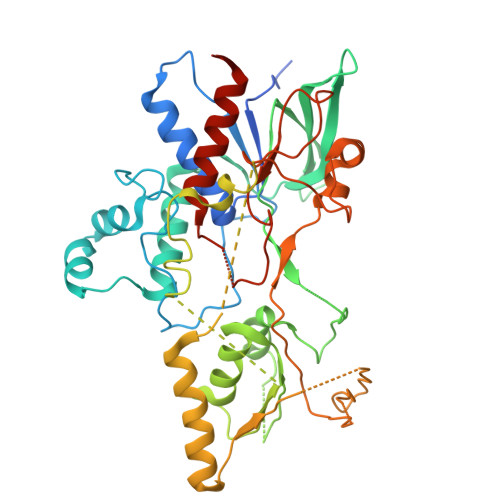
The GNAT (GCN5-related N-acetyltransferase) superfamily comprises enzymes with a conserved fold and diverse catalytic activities, including primarily acyl transfer, with a few examples of decarboxylation. EryM, a GNAT from Saccharopolyspora erythraea, has been implicated in both erythromycin and erythrochelin biosynthesis, with dual functionality as an acetyltransferase and a decarboxylase. Despite an historical association with malonyl-coenzyme A decarboxylation activity, this dual activity has remained enigmatic as its close homologs were identified with only acyl transfer activity. Here, functional assays demonstrate that EryM catalyzes acyl transfer but lacks decarboxylation activity, challenging long-standing assumptions about its biosynthetic role. Crystal structures of EryM and an acetyl-CoA complex and comparison with homologs in siderophore pathways reveal a conserved catalytic pocket with an essential His and identically positioned side chains common to GNAT enzymes for N-acyl transfer from CoA to primary hydroxylamine substrates. Bioinformatic analysis defines a large GNAT subfamily broadly distributed in the microbial world.
- Life Sciences Institute, University of Michigan, Ann Arbor, MI 48109, USA; Department of Biophysics, University of Michigan, Ann Arbor, MI 48109, USA.
Organizational Affiliation: