9N95 | pdb_00009n95

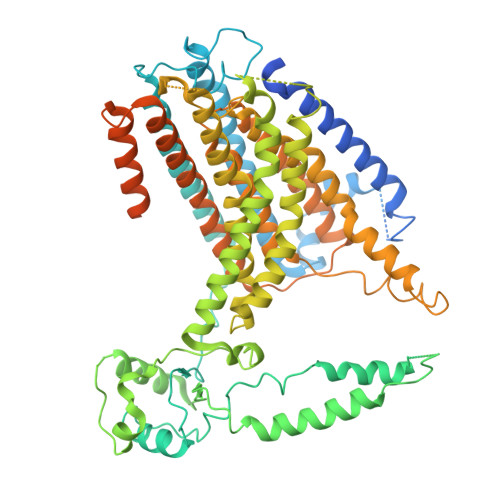
Human TMEM63A mutant V53M closed state

  • Classification: TRANSPORT PROTEIN
  • Organism(s): Homo sapiens
  • Expression System: Homo sapiens
  • Mutation(s): Yes 

  • Deposited: 2025-02-10 Released: 2025-06-11 
  • Deposition Author(s): Zheng, W., Fu, T.M., Holt, J.R.
  • Funding Organization(s): National Institutes of Health/National Institute on Deafness and Other Communication Disorders (NIH/NIDCD)

Experimental Data Snapshot

  • Method: ELECTRON MICROSCOPY
  • Resolution: 3.65 Å
  • Aggregation State: PARTICLE 
  • Reconstruction Method: SINGLE PARTICLE 

wwPDB Validation   3D Report Full Report


This is version 1.2 of the entry. See complete history


Literature

Structural and functional basis of mechanosensitive TMEM63 channelopathies.

Zheng, W.Lowry, A.J.Smith, H.E.Xie, J.Rawson, S.Wang, C.Ou, J.Sotomayor, M.Fu, T.M.Yang, H.Holt, J.R.

(2025) Neuron 113: 2474

  • DOI: https://doi.org/10.1016/j.neuron.2025.05.009
  • Primary Citation of Related Structures:  
    9N93, 9N95

  • PubMed Abstract: 

    TMEM63A, -B, and -C constitute a mammalian family of mechanosensitive ion channels that are mutated in neurodevelopmental disorders. The molecular mechanisms underlying TMEM63 activation by force and the impact of disease-associated mutations have not been clarified. Here, we elucidate the structural and functional bases of a prevalent TMEM63B mutation p.V44M. We first found that TMEM63B p.V44M and the homologous TMEM63A p.V53M are gain-of-function mutations that do not enhance channel activity but instead evoke constitutive lipid scramblase activity. We then solved TMEM63A p.V53M mutant structures in both closed and lipid-open states, which revealed major rearrangements of pore-lining helices, creating a lateral cleft across the membrane. Simulation studies revealed lipid scrambling through this cleft. The structural rearrangements were triggered by disruption of a surface-proximal hydrophobic latch, a putative force-sensing module that includes a cluster of disease mutation sites. Our findings provide mechanistic insight into TMEM63 channelopathies and suggest a possible force-sensing mechanism.


  • Organizational Affiliation
    • Departments of Otolaryngology & Neurology, Boston Children's Hospital and Harvard Medical School, Boston, MA 02115, USA; Department of Neuroscience, University of Wisconsin-Madison, Madison, WI 53705, USA. Electronic address: wzheng86@wisc.edu.

Macromolecules
Find similar proteins by:  (by identity cutoff)  |  3D Structure
Entity ID: 1
MoleculeChains Sequence LengthOrganismDetailsImage
CSC1-like protein 1807Homo sapiensMutation(s): 1 
Gene Names: TMEM63AKIAA0489KIAA0792
UniProt & NIH Common Fund Data Resources
Find proteins for O94886 (Homo sapiens)
Explore O94886 
Go to UniProtKB:  O94886
PHAROS:  O94886
GTEx:  ENSG00000196187 
Entity Groups  
Sequence Clusters30% Identity50% Identity70% Identity90% Identity95% Identity100% Identity
UniProt GroupO94886
Sequence Annotations
Expand
  • Reference Sequence
Experimental Data & Validation

Experimental Data

  • Method: ELECTRON MICROSCOPY
  • Resolution: 3.65 Å
  • Aggregation State: PARTICLE 
  • Reconstruction Method: SINGLE PARTICLE 
EM Software:
TaskSoftware PackageVersion
MODEL REFINEMENTPHENIX1.21.1_5286:

Structure Validation

View Full Validation Report


Entry History & Funding Information

Deposition Data


Funding OrganizationLocationGrant Number
National Institutes of Health/National Institute on Deafness and Other Communication Disorders (NIH/NIDCD)United StatesDC01352

Revision History  (Full details and data files)

  • Version 1.0: 2025-06-11
    Type: Initial release
  • Version 1.1: 2025-06-18
    Changes: Data collection, Database references
  • Version 1.2: 2025-08-20
    Changes: Data collection, Database references