9N7E | pdb_00009n7e

Eptesicus fuscus ACE2 peptidase domain bound to VsCoV-a7 RBD complex


Experimental Data Snapshot

  • Method: ELECTRON MICROSCOPY
  • Resolution: 2.50 Å
  • Aggregation State: PARTICLE 
  • Reconstruction Method: SINGLE PARTICLE 

wwPDB Validation 3D Report Full Report

Validation slider image for 9N7E

This is version 1.0 of the entry. See complete history

Literature

ACE2 utilization of HKU25 clade MERS-related coronaviruses with broad geographic distribution.

Liu, C.Park, Y.J.Ma, C.B.Stuart, C.Gen, R.Sun, Y.C.Yang, X.Lin, M.Y.Xiong, Q.Si, J.Y.Liu, P.Veesler, D.Yan, H.

(2025) bioRxiv 

  • DOI: https://doi.org/10.1101/2025.02.19.639017
  • Primary Citation Related Structures: 
    9N7D, 9N7E

  • PubMed Abstract: 

    Dipeptidyl peptidase-4 (DPP4) is a well-established receptor for several MERS-related coronaviruses (MERSr-CoVs) isolated from humans, camels, pangolins, and bats (1-6). However, the receptor usage of many genetically diverse bat MERSr-CoVs with broad geographical distributions remains poorly understood. Recent studies have identified angiotensin-converting enzyme 2 (ACE2) as an entry receptor for multiple merbecovirus clades. Here, using viral antigen and pseudovirus-based functional assays, we demonstrate that several bat merbecoviruses from the HKU25 clade previously thought to utilize DPP4 (7), employ ACE2 as their functional receptor. Cryo-electron microscopy analysis revealed that HsItaly2011 and VsCoV-a7 recognize ACE2 with a binding mode sharing similarity with that of HKU5 but involving remodeled interfaces and distinct ortholog selectivity, suggesting a common evolutionary origin of ACE2 utilization for these two clades of viruses. EjCoV-3, a strain closely related to the DPP4-using MERSr-CoV BtCoV-422, exhibited relatively broad ACE2 ortholog tropism and could utilize human ACE2 albeit suboptimally. Despite differences in entry mechanisms and spike proteolytic activation compared to MERS-CoV, these viruses remain sensitive to several broadly neutralizing antibodies and entry inhibitors. These findings redefine our understanding of the evolution of receptor usage among MERSr-CoVs and highlight the versatility of ACE2 as a functional receptor for diverse coronaviruses.


  • Organizational Affiliation
    • State Key Laboratory of Virology and Biosafety, College of Life Sciences, TaiKang Center for Life and Medical Sciences, Wuhan University; Wuhan, Hubei, 430072, China.

Macromolecule Content 

  • Total Structure Weight: 122.26 kDa 
  • Atom Count: 7,050 
  • Modeled Residue Count: 880 
  • Deposited Residue Count: 1,043 
  • Unique protein chains: 2

Macromolecules

Find similar proteins by:|  3D Structure
Entity ID: 1
MoleculeChains  Sequence LengthOrganismDetailsImage
Angiotensin-converting enzyme 2773Eptesicus fuscusMutation(s): 0 
EC: 3.4.17.23 (PDB Primary Data), 3.4.17 (PDB Primary Data)
UniProt
Find proteins for Q56H28 (Felis catus)
Explore Q56H28 
Go to UniProtKB:  Q56H28
Entity Groups
Sequence Clusters30% Identity50% Identity70% Identity90% Identity95% Identity100% Identity
UniProt GroupQ56H28
Glycosylation
Glycosylation Sites: 9
Sequence Annotations
Expand
Reference Sequence
Find similar proteins by:|  3D Structure
Entity ID: 2
MoleculeChains  Sequence LengthOrganismDetailsImage
VsCoV-a7-S RBD270MerbecovirusMutation(s): 0 
UniProt
Find proteins for A3EXD0 (Bat coronavirus HKU5)
Explore A3EXD0 
Go to UniProtKB:  A3EXD0
Entity Groups
Sequence Clusters30% Identity50% Identity70% Identity90% Identity95% Identity100% Identity
UniProt GroupA3EXD0
Glycosylation
Glycosylation Sites: 2
Sequence Annotations
Expand
Reference Sequence

Oligosaccharides

Help  
Entity ID: 3
MoleculeChains Length2D Diagram GlycosylationD Interactions
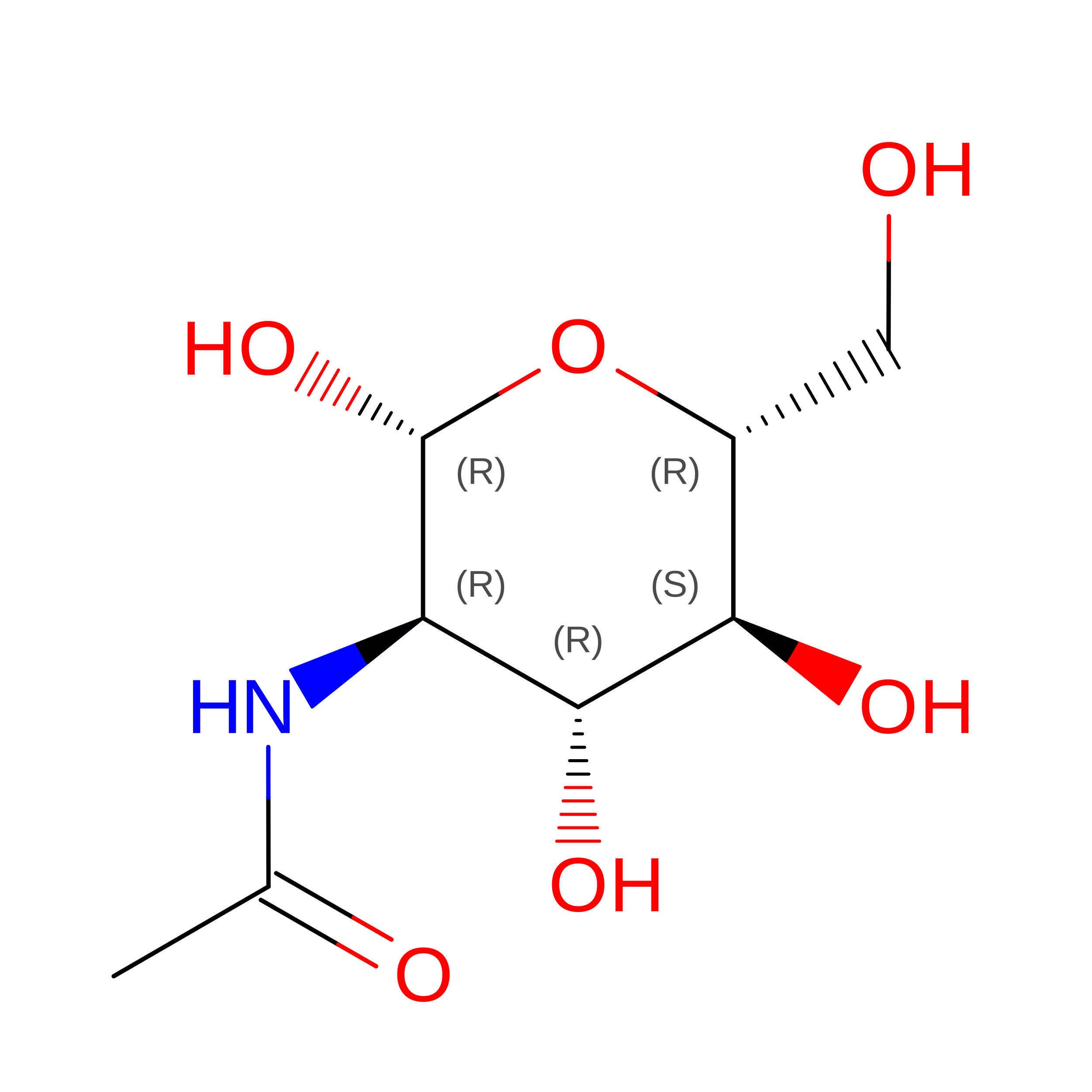
2-acetamido-2-deoxy-beta-D-glucopyranose-(1-4)-2-acetamido-2-deoxy-beta-D-glucopyranose
C, D, E, F
2N-Glycosylation
Glycosylation Resources
GlyTouCan: G42666HT
GlyCosmos: G42666HT
GlyGen: G42666HT

Small Molecules

Ligands 2 Unique
IDChains Name / Formula / InChI Key2D Diagram3D Interactions
NAG

Query on NAG


Download:Ideal Coordinates CCD File
G [auth A]
H [auth A]
I [auth A]
J [auth A]
K [auth A]
G [auth A],
H [auth A],
I [auth A],
J [auth A],
K [auth A],
M [auth B],
N [auth B]
2-acetamido-2-deoxy-beta-D-glucopyranose
C8 H15 N O6
OVRNDRQMDRJTHS-FMDGEEDCSA-N
ZN

Query on ZN


Download:Ideal Coordinates CCD File
L [auth A]ZINC ION
Zn
PTFCDOFLOPIGGS-UHFFFAOYSA-N

Experimental Data & Validation

Experimental Data

  • Method: ELECTRON MICROSCOPY
  • Resolution: 2.50 Å
  • Aggregation State: PARTICLE 
  • Reconstruction Method: SINGLE PARTICLE 
EM Software:
TaskSoftware PackageVersion
MODEL REFINEMENTPHENIX1.18.2_3874

Structure Validation

View Full Validation Report


Entry History 

& Funding Information

Deposition Data


Funding OrganizationLocationGrant Number
National Institutes of Health/National Institute Of Allergy and Infectious Diseases (NIH/NIAID)United States--

Revision History  (Full details and data files)

  • Version 1.0: 2025-08-27
    Type: Initial release