Download Mendeley
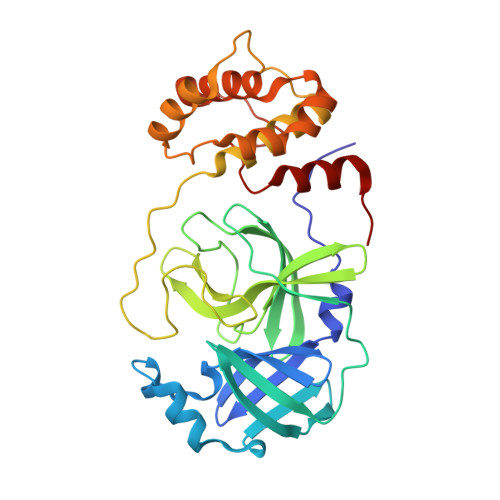
Structural insights into the nirmatrelvir-resistant SARS-CoV-2 M pro L50F/E166A/L167F triple mutant-inhibitor-complex reveal strategies for next generation coronaviral inhibitor design.
Fischer, C., Lu, J., van Belkum, M.J., Demmon, S., Chen, P., Wang, C., Van Oers, T.J., Lamer, T., Lemieux, M.J., Vederas, J.C.(2025) RSC Med Chem 16: 5032-5040
- PubMed: 40823489 Search on PubMedSearch on PubMed Central
- DOI: https://doi.org/10.1039/d5md00356c
- Primary Citation Related Structures:
9N3M - PubMed Abstract:
Drug-resistance is an eminent threat in antiviral therapy, and is currently a concern in nirmatrelvir-based therapy of SARS-CoV-2. Nirmatrelvir (antiviral component in Paxlovid) binds covalently to the active site cysteine of the main protease of SARS-CoV-2 (M pro ), thereby blocking enzyme activity and halting viral replication. In vitro passage experiments mimicking a multi-dosage nirmatrelvir treatment regime, identified M pro variants with mutations in the active site and near the C-terminal dimerization interface with variable levels of nirmatrelvir resistance. One such variant harbors a triple mutation in M pro , L50F/E166A/L167F, that displays decreased potency for nirmatrelvir (IC 50 ∼ 850-1600 nM) and ibuzatrelvir while viral replication remained similar to that of the wildtype (WT) virus. We here confirm a previously developed short peptide aldehyde bisulfite compound 4 as potent inhibitor for SARS-CoV-2 M pro L50F/E166A/L167F and related variants. A co-crystal structure reveals tight inhibitor binding that is stabilized by a network of hydrogen bonds formed by the mutated residues A166 and F167. This study provides the groundwork for optimized M pro inhibitors against potential emerging variants of SARS-CoV-2, as well as strategies for broad-spectrum inhibitor design against variants of M pro .
- Department of Chemistry, University of Alberta Edmonton AB T6G 2G2 Canada john.vederas@ualberta.ca.
Organizational Affiliation: