9MYE | pdb_00009mye

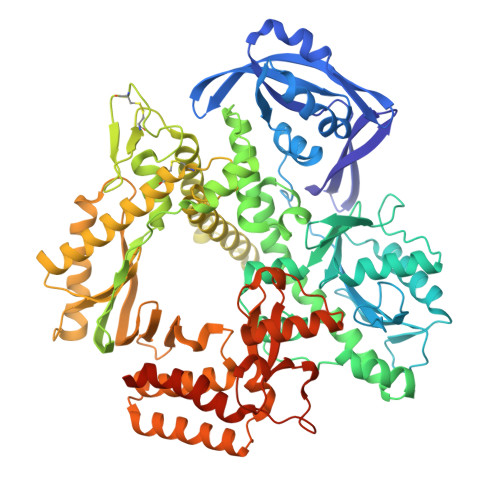
C28 Polymerase Incorporating RNA, n+1


Experimental Data Snapshot

  • Method: X-RAY DIFFRACTION
  • Resolution: 2.22 Å
  • R-Value Free: 
    0.272 (Depositor), 0.256 (DCC) 
  • R-Value Work: 
    0.241 (Depositor), 0.240 (DCC) 

Starting Model: experimental
View more details

wwPDB Validation   3D Report Full Report


This is version 1.2 of the entry. See complete history


Literature

Rapid evolution of a highly efficient RNA polymerase by homologous recombination.

Medina, E.L.Maola, V.A.Hajjar, M.Ko, G.K.Ho, E.J.Horton, A.R.Chim, N.Chaput, J.C.

(2026) Nat Chem Biol 

  • DOI: https://doi.org/10.1038/s41589-025-02124-7
  • Primary Citation of Related Structures:  
    9MYE

  • PubMed Abstract: 

    Engineering DNA polymerases to efficiently synthesize artificial or noncognate nucleic acids remains an essential challenge in synthetic biology. Here we describe an evolutionary campaign designed to convert a family of highly selective DNA polymerases into an unnatural homolog with strong RNA synthesis activity. Starting from a homologous recombination library, a short evolutionary path was achieved using a single-cell droplet-based microfluidic selection strategy to produce C28, a newly engineered polymerase that can synthesize RNA with a rate of ~3 nt s -1 and of >99% fidelity. C28 is capable of long-range RNA synthesis, reverse transcription and chimeric DNA-RNA amplification using the PCR. Despite strong discrimination against other genetic systems, C28 readily accepts several 2'F and base-modified RNA analogs. Together, these findings highlight the power of directed evolution as an approach for reprogramming DNA polymerases with activities that could help drive future applications in biotechnology and medicine.


  • Organizational Affiliation
    • Department of Pharmaceutical Sciences, University of California, Irvine, Irvine, CA, USA.

Macromolecules

Find similar proteins by:  (by identity cutoff)  |  3D Structure
Entity ID: 1
MoleculeChains Sequence LengthOrganismDetailsImage
DNA polymerase774Thermococcus gorgonariusMutation(s): 0 
Gene Names: polpolA
EC: 2.7.7.7
UniProt
Find proteins for P56689 (Thermococcus gorgonarius)
Explore P56689 
Go to UniProtKB:  P56689
Entity Groups  
Sequence Clusters30% Identity50% Identity70% Identity90% Identity95% Identity100% Identity
UniProt GroupP56689
Sequence Annotations
Expand
  • Reference Sequence

Find similar nucleic acids by:  Sequence   |   3D Structure  

Entity ID: 2
MoleculeChains LengthOrganismImage
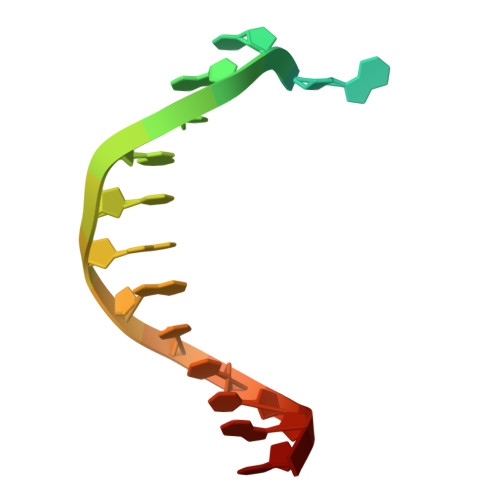
TemplateB [auth T]18synthetic construct
Sequence Annotations
Expand
  • Reference Sequence

Find similar nucleic acids by:  Sequence   |   3D Structure  

Entity ID: 3
MoleculeChains LengthOrganismImage
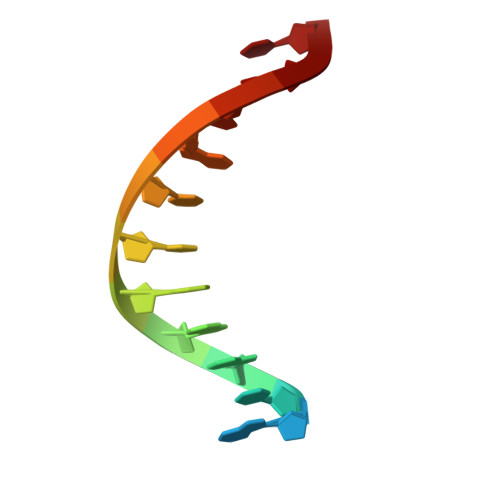
PrimerC [auth P]12synthetic construct
Sequence Annotations
Expand
  • Reference Sequence
Experimental Data & Validation

Experimental Data

  • Method: X-RAY DIFFRACTION
  • Resolution: 2.22 Å
  • R-Value Free:  0.272 (Depositor), 0.256 (DCC) 
  • R-Value Work:  0.241 (Depositor), 0.240 (DCC) 
Space Group: P 21 21 21
Unit Cell:
Length ( Å )Angle ( ˚ )
a = 77.97α = 90
b = 102.34β = 90
c = 112.23γ = 90
Software Package:
Software NamePurpose
Blu-Icedata collection
iMOSFLMdata reduction
Aimlessdata scaling
pointlessdata scaling
PHASERphasing
PHENIXrefinement
Cootmodel building

Structure Validation

View Full Validation Report


Entry History & Funding Information

Deposition Data


Funding OrganizationLocationGrant Number
Not funded--

Revision History  (Full details and data files)

  • Version 1.0: 2025-12-17
    Type: Initial release
  • Version 1.1: 2026-01-14
    Changes: Database references
  • Version 1.2: 2026-01-21
    Changes: Database references