9MX3 | pdb_00009mx3

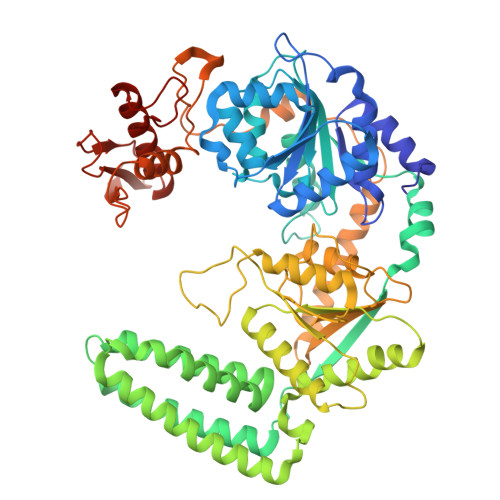
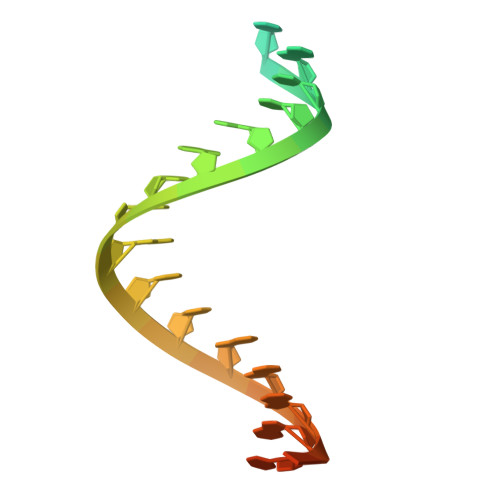
Cryo-EM structure of ancestral Dicer helicase bound to 27-bp dsRNA in post-hydrolysis semi-closed state


Experimental Data Snapshot

  • Method: ELECTRON MICROSCOPY
  • Resolution: 3.00 Å
  • Aggregation State: PARTICLE 
  • Reconstruction Method: SINGLE PARTICLE 

Starting Model: in silico
View more details

wwPDB Validation   3D Report Full Report


This is version 1.1 of the entry. See complete history


Literature

Biochemical and structural basis of Dicer helicase function unveiled by resurrecting ancient proteins.

Aderounmu, A.M.Maus-Conn, J.Consalvo, C.D.Shen, P.S.Bass, B.L.

(2025) Proc Natl Acad Sci U S A 122: e2500825122-e2500825122

  • DOI: https://doi.org/10.1073/pnas.2500825122
  • Primary Citation of Related Structures:  
    9MW6, 9MW7, 9MW8, 9MX3, 9MX5

  • PubMed Abstract: 

    A fully functional Dicer helicase, present in the modern arthropod, uses energy from ATP hydrolysis to power translocation on bound dsRNA, enabling the processive dsRNA cleavage required for efficient antiviral defense. However, modern Dicer orthologs exhibit divergent helicase functions that affect their ability to contribute to antiviral defense. Moreover, mechanisms that couple ATP hydrolysis to Dicer helicase movement on dsRNA remain enigmatic. We used biochemical and structural analyses of ancestrally reconstructed Dicer helicases to map evolution of dsRNA binding affinity, ATP hydrolysis and translocation. Loss of affinity for dsRNA occurred early in Dicer evolution, coinciding with a decline in translocation activity, despite preservation of ATP hydrolysis activity. Ancestral nematode Dicer also exhibited significant decline in ATP hydrolysis and translocation, but studies of antiviral activities in the modern nematode Caenorhabditis elegans indicate Dicer retained a role in antiviral defense by recruiting a second helicase. Cryogenic electron microscopy (cryo-EM) analyses of an ancient metazoan Dicer allowed capture of multiple helicase states revealing the mechanism that connects each step of ATP hydrolysis to unidirectional movement along dsRNA. Our study rationalizes the diversity in modern Dicer helicases by connecting ancestral functions to observations in extant enzymes.


  • Organizational Affiliation
    • Department of Biochemistry, University of Utah, Salt Lake City, UT 84112.

Macromolecules

Find similar proteins by:  (by identity cutoff)  |  3D Structure
Entity ID: 1
MoleculeChains Sequence LengthOrganismDetailsImage
AncD1D2652synthetic constructMutation(s): 0 
Entity Groups  
Sequence Clusters30% Identity50% Identity70% Identity90% Identity95% Identity100% Identity
Sequence Annotations
Expand
  • Reference Sequence
Find similar nucleic acids by:  (by identity cutoff)  |  3D Structure
Entity ID: 2
MoleculeChains LengthOrganismImage
RNA (27-MER)B [auth C]27synthetic construct
Sequence Annotations
Expand
  • Reference Sequence
Find similar nucleic acids by:  (by identity cutoff)  |  3D Structure
Entity ID: 3
MoleculeChains LengthOrganismImage
RNA (27-MER)C [auth B]27synthetic construct
Sequence Annotations
Expand
  • Reference Sequence
Small Molecules
Ligands 1 Unique
IDChains Name / Formula / InChI Key2D Diagram3D Interactions
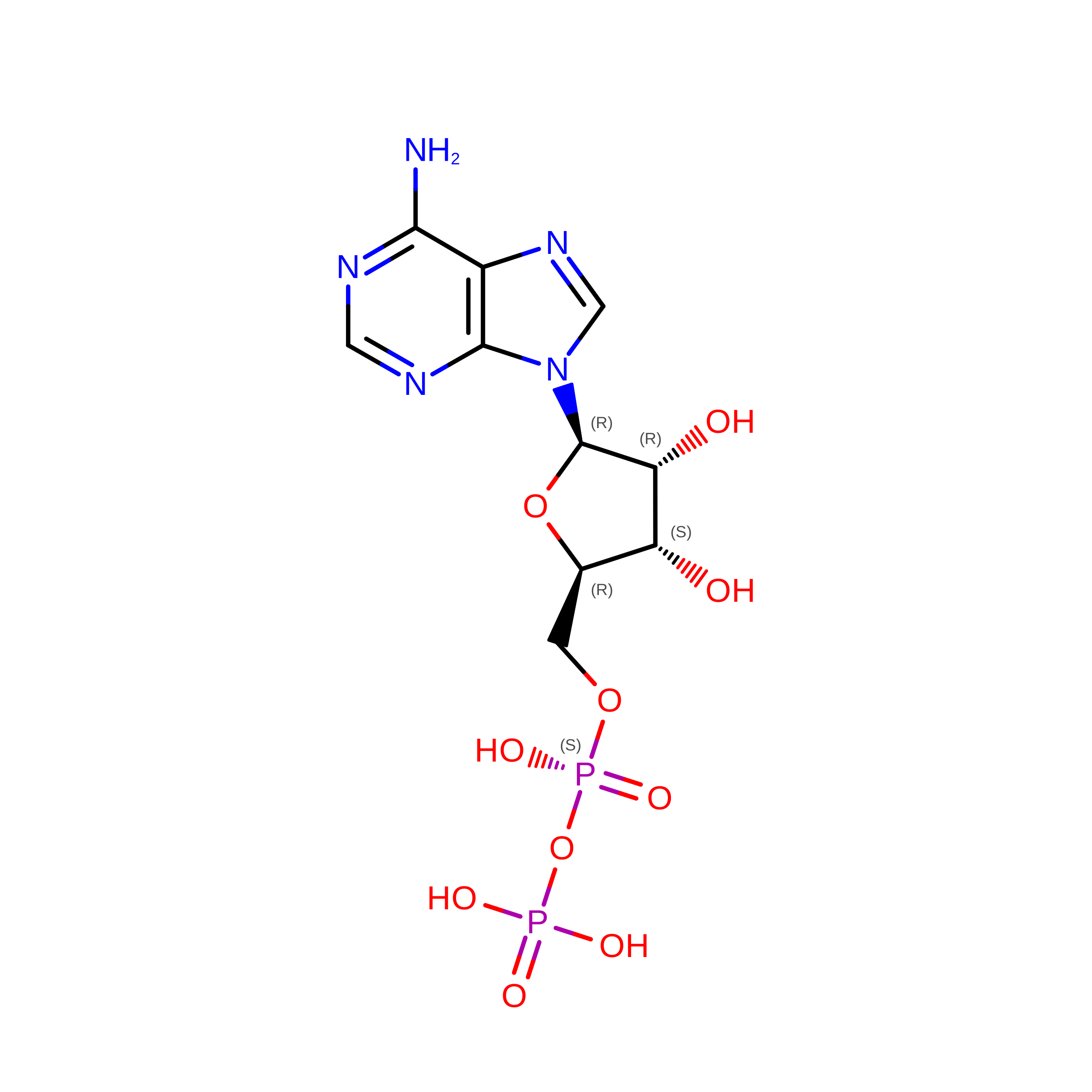
ADP (Subject of Investigation/LOI)
Query on ADP

Download Ideal Coordinates CCD File 
D [auth A]ADENOSINE-5'-DIPHOSPHATE
C10 H15 N5 O10 P2
XTWYTFMLZFPYCI-KQYNXXCUSA-N
Experimental Data & Validation

Experimental Data

  • Method: ELECTRON MICROSCOPY
  • Resolution: 3.00 Å
  • Aggregation State: PARTICLE 
  • Reconstruction Method: SINGLE PARTICLE 
EM Software:
TaskSoftware PackageVersion
MODEL REFINEMENTPHENIX1.21.1_5286
RECONSTRUCTIONcryoSPARC

Structure Validation

View Full Validation Report


Entry History & Funding Information

Deposition Data


Funding OrganizationLocationGrant Number
National Institutes of Health/National Institute of General Medical Sciences (NIH/NIGMS)United StatesR35 GM141262

Revision History  (Full details and data files)

  • Version 1.0: 2025-03-12
    Type: Initial release
  • Version 1.1: 2025-06-04
    Changes: Data collection, Database references