9MTC | pdb_00009mtc

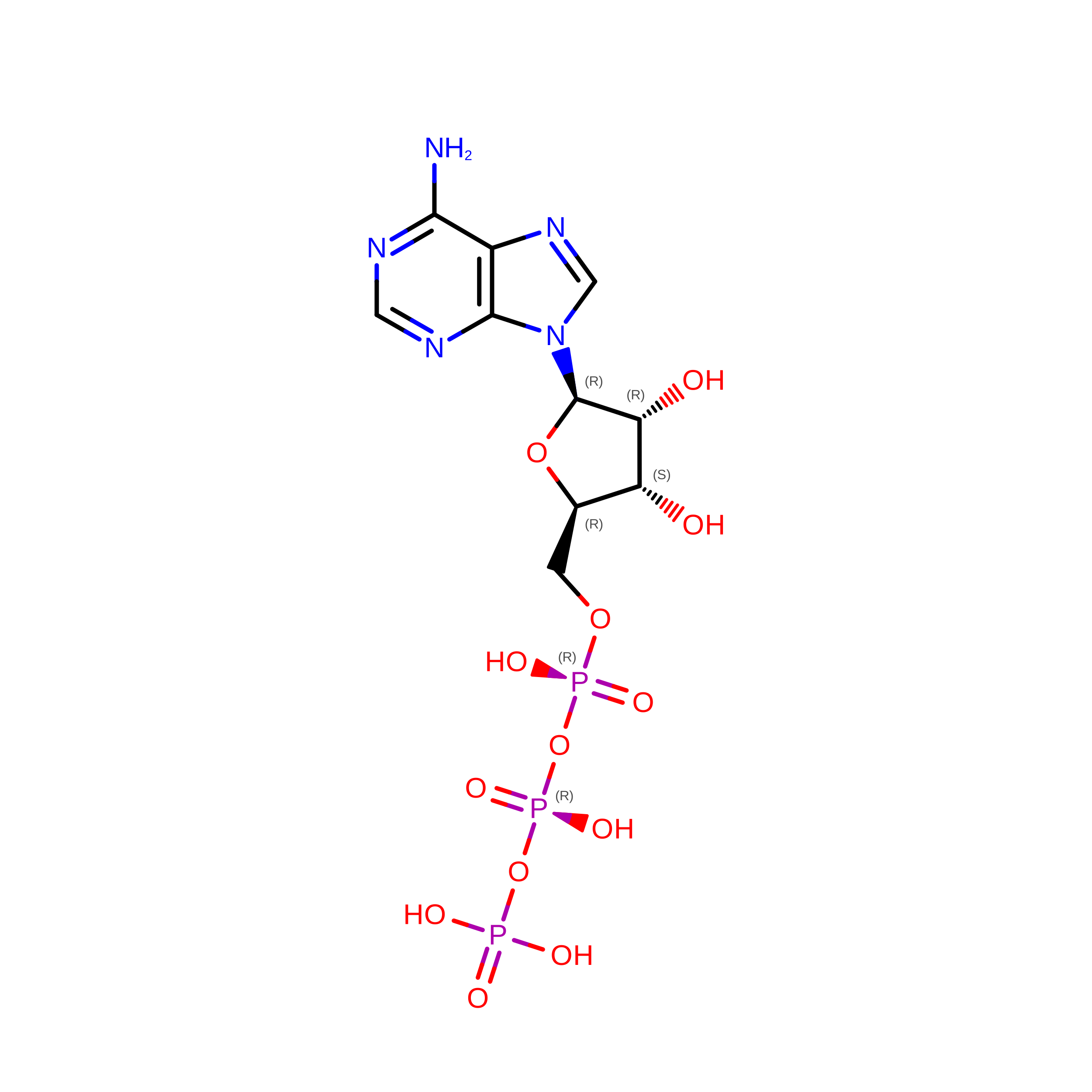
Cryo-EM structure of the human TRPM4 channel in a ATP bound inhibited state

  • Classification: TRANSPORT PROTEIN
  • Organism(s): Homo sapiens
  • Expression System: Homo sapiens
  • Mutation(s): No 

  • Deposited: 2025-01-10 Released: 2025-10-29 
  • Deposition Author(s): Teixeira-Duarte, C.M., Jiang, Y.
  • Funding Organization(s): Howard Hughes Medical Institute (HHMI), National Institutes of Health/National Institute of General Medical Sciences (NIH/NIGMS), Welch Foundation

Experimental Data Snapshot

  • Method: ELECTRON MICROSCOPY
  • Resolution: 2.63 Å
  • Aggregation State: PARTICLE 
  • Reconstruction Method: SINGLE PARTICLE 

wwPDB Validation   3D Report Full Report


This is version 1.1 of the entry. See complete history


Literature

Structural landscape of activation, desensitization and inhibition in the human TRPM4 channel.

Teixeira-Duarte, C.M.Zeng, W.Jiang, Y.

(2025) Nat Struct Mol Biol 

  • DOI: https://doi.org/10.1038/s41594-025-01705-3
  • Primary Citation of Related Structures:  
    9MRT, 9MT8, 9MTA, 9MTC

  • PubMed Abstract: 

    TRPM4 is a member of the transient receptor potential melastatin channel subfamily and functions as a Ca 2+ -activated monovalent-selective cation channel. It is widely expressed in various cells and tissues, where its activation depolarizes the plasma membrane potential and modulates various Ca 2+ -dependent biological processes. TRPM4 activity is potentiated by membrane phosphatidylinositol 4,5-bisphosphate (PtdIns(4,5)P 2 ) and inhibited by cytosolic free adenosine triphosphate (ATP), allowing the channel to transition between different functional states in response to dynamic changes in cellular Ca 2+ , ATP and PtdIns(4,5)P 2 levels during signaling events. Here we present single-particle cryo-electron microscopy structures of human TRPM4 in four distinct states: apo closed, Ca 2+ -bound putative desensitized, Ca 2+ -PtdIns(4,5)P 2 -bound open and ATP-bound inhibited. Combined with mutagenesis and electrophysiological analyses, these structures reveal the molecular mechanisms underlying TRPM4 activation, desensitization and inhibition. Given the central roles of Ca 2+ , PtdIns(4,5)P 2 and ATP in cellular signaling, this work provides a structural foundation to decipher the physiological functions of TRPM4 across diverse biological systems.


  • Organizational Affiliation
    • Howard Hughes Medical Institute and Department of Physiology, University of Texas Southwestern Medical Center, Dallas, TX, USA.

Macromolecules
Find similar proteins by:  (by identity cutoff)  |  3D Structure
Entity ID: 1
MoleculeChains Sequence LengthOrganismDetailsImage
Transient receptor potential cation channel subfamily M member 4A [auth B],
B [auth A],
C,
D
1,214Homo sapiensMutation(s): 0 
Gene Names: TRPM4LTRPC4
UniProt & NIH Common Fund Data Resources
Find proteins for Q8TD43 (Homo sapiens)
Explore Q8TD43 
Go to UniProtKB:  Q8TD43
PHAROS:  Q8TD43
GTEx:  ENSG00000130529 
Entity Groups  
Sequence Clusters30% Identity50% Identity70% Identity90% Identity95% Identity100% Identity
UniProt GroupQ8TD43
Sequence Annotations
Expand
  • Reference Sequence
Experimental Data & Validation

Experimental Data

  • Method: ELECTRON MICROSCOPY
  • Resolution: 2.63 Å
  • Aggregation State: PARTICLE 
  • Reconstruction Method: SINGLE PARTICLE 
EM Software:
TaskSoftware PackageVersion
MODEL REFINEMENTPHENIX1.21.2_5419

Structure Validation

View Full Validation Report


Entry History & Funding Information

Deposition Data


Funding OrganizationLocationGrant Number
Howard Hughes Medical Institute (HHMI)United States--
National Institutes of Health/National Institute of General Medical Sciences (NIH/NIGMS)United StatesR35 GM140892
Welch FoundationUnited StatesI-1578

Revision History  (Full details and data files)

  • Version 1.0: 2025-10-29
    Type: Initial release
  • Version 1.1: 2025-11-12
    Changes: Data collection, Database references