9MND | pdb_00009mnd

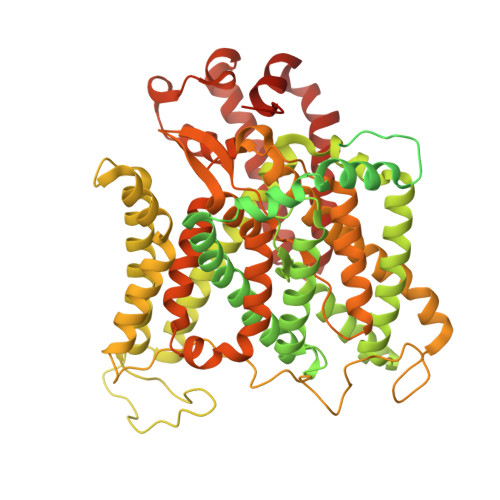
Band 3 OF/IF1

  • Classification: MEMBRANE PROTEIN
  • Organism(s): Homo sapiens
  • Mutation(s): No 

  • Deposited: 2024-12-20 Released: 2025-12-10 
  • Deposition Author(s): Vallese, F., Kim, K., Clarke, O.B.
  • Funding Organization(s): National Institutes of Health/National Heart, Lung, and Blood Institute (NIH/NHLBI)

Experimental Data Snapshot

  • Method: ELECTRON MICROSCOPY
  • Resolution: 2.40 Å
  • Aggregation State: PARTICLE 
  • Reconstruction Method: SINGLE PARTICLE 

wwPDB Validation   3D Report Full Report


This is version 1.1 of the entry. See complete history


Literature

Impact of anionic lipids on the energy landscape of conformational transition in anion exchanger 1 (AE1).

Chen, T.Vallese, F.Gil-Iturbe, E.Kim, K.Cali, T.Quick, M.Clarke, O.B.Tajkhorshid, E.

(2025) Nat Commun 16: 11664-11664

  • DOI: https://doi.org/10.1038/s41467-025-66786-6
  • Primary Citation of Related Structures:  
    9MND, 9MNG, 9MOS

  • PubMed Abstract: 

    Anion Exchanger 1 (AE1) is an elevator-type transporter that plays a key role in acid-base homeostasis of erythrocytes. Here, we report three high-resolution cryo-electron microscopy (cryo-EM) structures of distinct states of AE1: two inward-facing (IF1 and IF2) and one outward-facing (OF). Uptake assay revealed the modulatory effect of phosphatidylinositol 4,5-bisphosphate (PIP 2 ) lipids on AE1. Molecular dynamics simulations are conducted on these structures to determine the anion binding sites in AE1. We then use advanced enhanced sampling to study the OF⇌IF transition in AE1 in three systems: apo, HCO 3 - -bound, and an AE1 system in which cryo-EM-determined PIP 2 lipids had been removed. The transition pathways were then used to calculate the free energy of the OF⇌IF transition in AE1 under different conditions. The results show how substrate reduces the transition barrier against transport. Furthermore, they capture the inhibitory effect of PIP 2 lipids and provide a molecular mechanism for this inhibitory effect.


  • Organizational Affiliation
    • Theoretical and Computational Biophysics Group, NIH Resource for Macromolecular Modeling and Visualization, Beckman Institute for Advanced Science and Technology, Department of Biochemistry, and Center for Biophysics and Quantitative Biology, University of Illinois, Urbana-Champaign, Urbana, IL, USA.

Macromolecules
Find similar proteins by:  (by identity cutoff)  |  3D Structure
Entity ID: 1
MoleculeChains Sequence LengthOrganismDetailsImage
Band 3 anion transport proteinA [auth C],
B [auth A]
911Homo sapiensMutation(s): 0 
UniProt & NIH Common Fund Data Resources
Find proteins for P02730 (Homo sapiens)
Explore P02730 
Go to UniProtKB:  P02730
PHAROS:  P02730
GTEx:  ENSG00000004939 
Entity Groups  
Sequence Clusters30% Identity50% Identity70% Identity90% Identity95% Identity100% Identity
UniProt GroupP02730
Glycosylation
Glycosylation Sites: 1Go to GlyGen: P02730-1
Sequence Annotations
Expand
  • Reference Sequence
Oligosaccharides

Help

Entity ID: 2
MoleculeChains Length2D Diagram Glycosylation3D Interactions
2-acetamido-2-deoxy-beta-D-glucopyranose-(1-4)-[alpha-L-fucopyranose-(1-6)]2-acetamido-2-deoxy-beta-D-glucopyranoseC [auth B],
D
3N-Glycosylation
Glycosylation Resources
GlyTouCan:  G21290RB
GlyCosmos:  G21290RB
GlyGen:  G21290RB
Experimental Data & Validation

Experimental Data

  • Method: ELECTRON MICROSCOPY
  • Resolution: 2.40 Å
  • Aggregation State: PARTICLE 
  • Reconstruction Method: SINGLE PARTICLE 
EM Software:
TaskSoftware PackageVersion
MODEL REFINEMENTPHENIXdev_5420

Structure Validation

View Full Validation Report


Entry History & Funding Information

Deposition Data


Funding OrganizationLocationGrant Number
National Institutes of Health/National Heart, Lung, and Blood Institute (NIH/NHLBI)United States1R01HL168178

Revision History  (Full details and data files)

  • Version 1.0: 2025-12-10
    Type: Initial release
  • Version 1.1: 2026-01-14
    Changes: Data collection, Database references