Download Mendeley
Evaluating TcAs for Use in Biotechnology Applications.
Martin, C.L., Hill, J.H., Wright, B.D., Fernandez, S.R., Miller, A.L., Yoon, K.J., Lapi, S.E., Aller, S.G.(2025) BioTech (Basel) 14
- PubMed: 39982272 Search on PubMedSearch on PubMed Central
- DOI: https://doi.org/10.3390/biotech14010005
- Primary Citation Related Structures:
9MLG, 9MLH, 9MLI - PubMed Abstract:
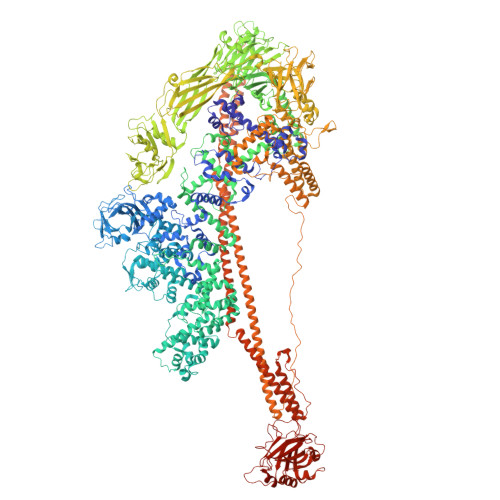
ABC toxin complexes (Tcs) are tripartite complexes that come together to form nano-syringe-like translocation systems. ABC Tcs are often compared with Bacillus thuringiensis (Bt) toxins, and as such, they have been highly studied as a potential novel pesticide to combat growing insect resistance. Moreover, it is possible to substitute the cytotoxic hypervariable region with alternative peptides, which promise potential use as a novel peptide delivery system. These toxins possess the unique ability to form active chimeric holotoxins across species and display the capability to translocate a variety of payloads across membrane bilayers. Additionally, mutagenesis on the linker region and the receptor binding domains (RBDs) show that mutations do not inherently cause a loss of functionality for translocation. For these reasons, Tcs have emerged as an ideal candidate for targeted protein engineering. However, elucidation of the specific function of each RBD in relation to target receptor recognition currently limits the use of a rational design approach with any ABC Tc. Additionally, there is a distinct lack of targeting and biodistribution data for many Tcs among mammals and mammalian cell lines. Here, we outline two separate strategies for modifying the targeting capabilities of the A subunit (TcA) from Xenorhabdus nematophilus , Xn-XptA2. We identify novel structural differences that make Xn-XptA2 different than other characterized TcAs and display the modular capabilities of substituting RBDs from alternative TcAs into the Xn-XptA2 scaffold. Finally, we show the first, to our knowledge, biodistribution data of any TcA in mice.
- Graduate Biomedical Sciences Pathobiology, Physiology and Pharmacology Theme, University of Alabama at Birmingham, Birmingham, AL 35294, USA.
Organizational Affiliation: