Download Mendeley
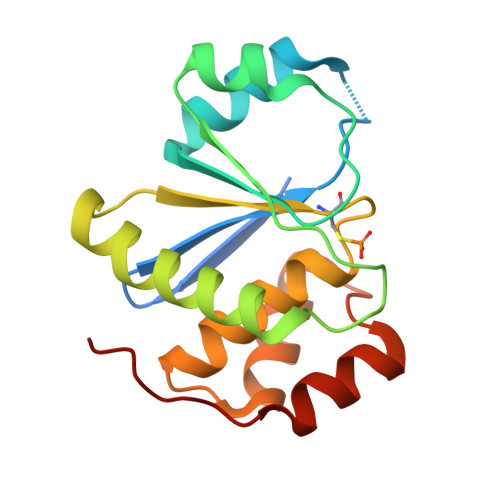
Structure of the phosphocysteine intermediate of the phosphatase of regenerating liver PTP4A1.
Mahbub, L., Kozlov, G., Knorn, C., Gehring, K.(2025) J Biological Chem 301: 110251-110251
- PubMed: 40398601 Search on PubMed
- DOI: https://doi.org/10.1016/j.jbc.2025.110251
- Primary Citation Related Structures:
9MEX - PubMed Abstract:
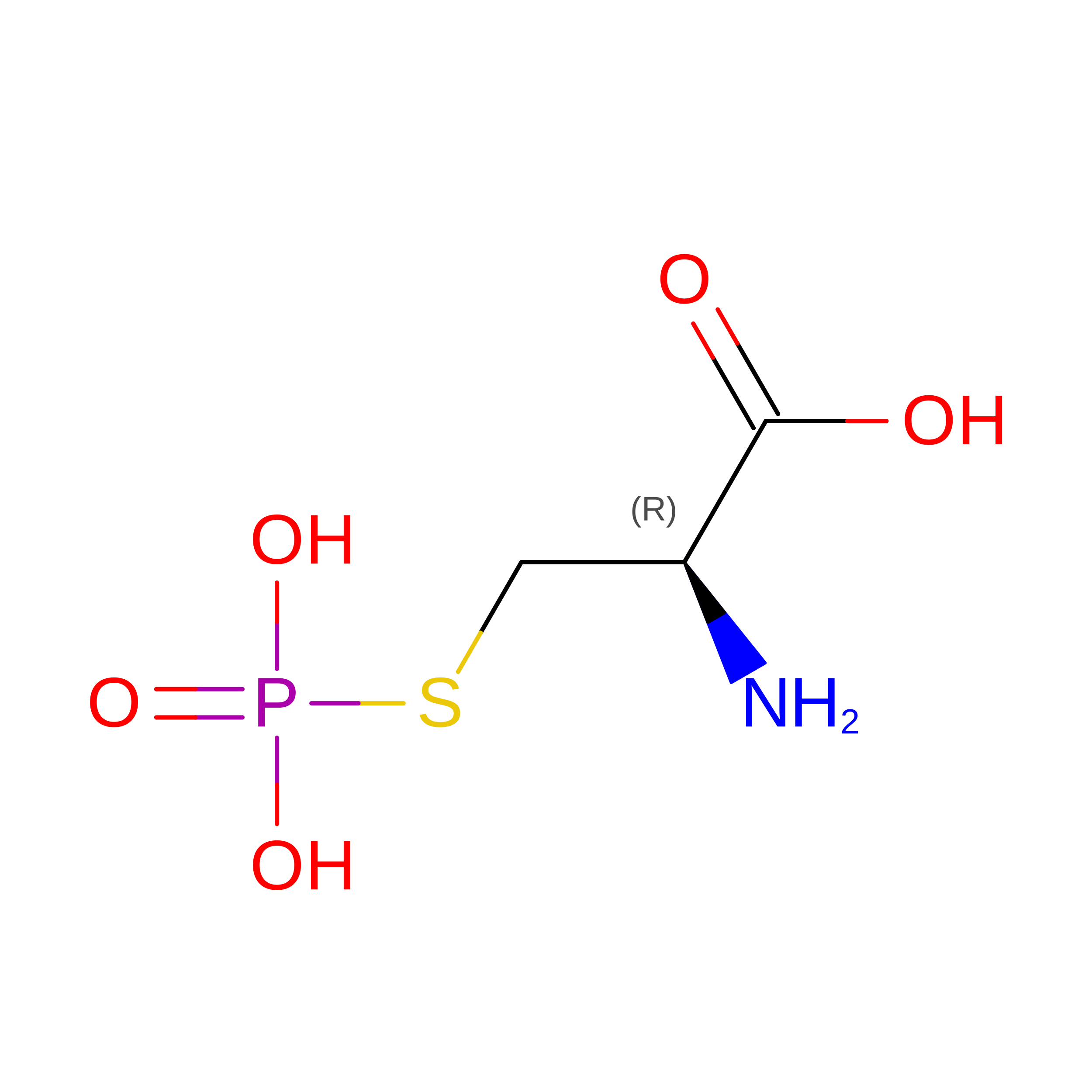
Phosphatases of regenerating liver (PRL or PTP4A) are protein phosphatases implicated in cell growth, magnesium homeostasis, and cancer metastasis. During catalysis, a phosphocysteine intermediate forms, which must undergo hydrolysis to regenerate the active enzyme. In addition to dephosphorylating substrates, PRLs act as pseudo-phosphatases and bind CBS-pair domain divalent metal cation transport mediators (CNNMs) to regulate magnesium transport. In this study, we investigate the role of PRL residues in phosphocysteine hydrolysis using mutagenesis, enzyme assays, and X-ray crystallography. Loss of an aspartic acid and cysteine in the catalytic site disrupts hydrolysis and stabilizes the phosphocysteine intermediate for weeks. We use this C49S/D72A double mutant to determine the crystal structure of the cysteine phosphorylated form of PRL1 (PTP4A1). The structure confirms that phosphocysteine sterically interferes with CNNM binding, consistent with previous biochemical studies. In vitro enzyme assays reveal the aspartic acid mutation increases the initial rate of catalysis for all three PRL paralogs while the homologous mutation in the phosphatases, PTP1B and PTPN12, disrupts catalysis. This highlights the mechanistic differences between PRLs and classical protein tyrosine phosphatases. Our findings refine our understanding of PRL catalysis and identify novel mutations for investigating PRL function in cancer and magnesium homeostasis.
- Department of Biochemistry, McGill University, Montreal, QC, H3G0B1, Canada; Centre de Recherche en Biologie Structurale, McGill University, Montreal, QC, H3G0B1, Canada.
Organizational Affiliation: