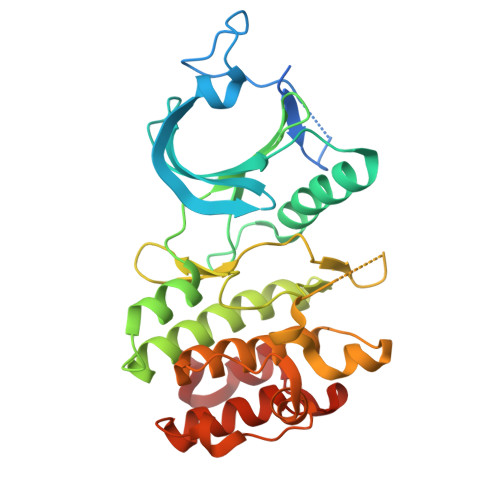
9M6P | pdb_00009m6p

Discovery of a bifunctional PKMYT1-targeting PROTAC empowered by AI-generation


Experimental Data Snapshot

  • Method: X-RAY DIFFRACTION
  • Resolution: 2.38 Å
  • R-Value Free: 
    0.290 (Depositor), 0.290 (DCC) 
  • R-Value Work: 
    0.203 (Depositor), 0.206 (DCC) 

Starting Model: experimental
View more details

wwPDB Validation   3D Report Full Report


Ligand Structure Quality Assessment 


This is version 1.1 of the entry. See complete history


Literature

Discovery of a bifunctional PKMYT1-targeting PROTAC empowered by AI-generation.

Wang, Y.Wang, X.Liu, T.Wang, C.Meng, Q.Meng, F.Yu, J.Liu, J.Fan, Y.Gennert, D.Pun, F.W.Aliper, A.Ren, F.Zhang, M.Cai, X.Ding, X.Zhavoronkov, A.

(2025) Nat Commun 16: 10759-10759

  • DOI: https://doi.org/10.1038/s41467-025-65796-8
  • Primary Citation of Related Structures:  
    9M6P

  • PubMed Abstract: 

    PKMYT1 has recently emerged as a compelling therapeutic target for precision cancer therapy due to its synthetic lethality with oncogenic alterations such as CCNE1 amplification and mutations in FBXW7 and PPP2R1A. Current small molecule PKMYT1 inhibitors face limitations, such as insufficient molecular diversity and poor selectivity. We herein use our generative AI platform to develop a bifunctional PKMYT1 degrader by linking an entirely novel PKMYT1 inhibitor to an optimized cereblon (CRBN) binder. The lead PROTAC D16-M1P2 demonstrates dual mechanisms of PKMYT1 degradation and inhibition, with strong antiproliferative potency facilitated by high selectivity. It also exhibits favorable oral bioavailability, stronger pharmacodynamic effects relative to the PKMYT1 inhibitor alone, and robust antitumor response as a monotherapy in xenograft models. This PROTAC serves as a precise chemical probe to explore PKMYT1 biology and a promising lead for further cancer therapy exploration.


  • Organizational Affiliation
    • Insilico Medicine Shanghai Ltd., Shanghai, China.

Macromolecules
Find similar proteins by:  (by identity cutoff)  |  3D Structure
Entity ID: 1
MoleculeChains Sequence LengthOrganismDetailsImage
Membrane-associated tyrosine- and threonine-specific cdc2-inhibitory kinaseA [auth AAA],
B [auth BBB]
311Homo sapiensMutation(s): 0 
Gene Names: PKMYT1MYT1
EC: 2.7.11.1
UniProt & NIH Common Fund Data Resources
Find proteins for Q99640 (Homo sapiens)
Explore Q99640 
Go to UniProtKB:  Q99640
PHAROS:  Q99640
GTEx:  ENSG00000127564 
Entity Groups  
Sequence Clusters30% Identity50% Identity70% Identity90% Identity95% Identity100% Identity
UniProt GroupQ99640
Sequence Annotations
Expand
  • Reference Sequence
Small Molecules
Experimental Data & Validation

Experimental Data

  • Method: X-RAY DIFFRACTION
  • Resolution: 2.38 Å
  • R-Value Free:  0.290 (Depositor), 0.290 (DCC) 
  • R-Value Work:  0.203 (Depositor), 0.206 (DCC) 
Space Group: H 3 2
Unit Cell:
Length ( Å )Angle ( ˚ )
a = 127.927α = 90
b = 127.927β = 90
c = 184.655γ = 120
Software Package:
Software NamePurpose
REFMACrefinement
Aimlessdata scaling
XDSdata reduction
PHASERphasing

Structure Validation

View Full Validation Report


Ligand Structure Quality Assessment 


Entry History & Funding Information

Deposition Data


Funding OrganizationLocationGrant Number
Not funded--

Revision History  (Full details and data files)

  • Version 1.0: 2025-11-05
    Type: Initial release
  • Version 1.1: 2025-12-17
    Changes: Database references