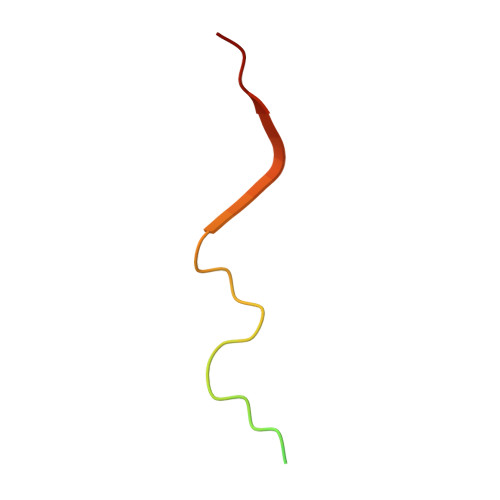
9M5R | pdb_00009m5r

ES-type (short pitch) amyloid fibril (40) of Tottori (D7N) mutant

  • Classification: PROTEIN FIBRIL
  • Organism(s): Homo sapiens
  • Mutation(s): Yes 

  • Deposited: 2025-03-06 Released: 2025-07-09 
  • Deposition Author(s): Burton-Smith, R.N., Murata, K.
  • Funding Organization(s): Ministry of Education, Culture, Sports, Science and Technology (Japan)

Experimental Data Snapshot

  • Method: ELECTRON MICROSCOPY
  • Resolution: 3.60 Å
  • Aggregation State: HELICAL ARRAY 
  • Reconstruction Method: HELICAL 

wwPDB Validation   3D Report Full Report


This is version 1.1 of the entry. See complete history


Literature

Microgravity-Assisted Exploration of the Conformational Space of Amyloid beta Affected by Tottori-Type Familial Mutation D7N.

Yagi-Utsumi, M.Yanaka, S.Burton-Smith, R.N.Song, C.Ganser, C.Yamazaki, C.Kasahara, H.Shimazu, T.Uchihashi, T.Murata, K.Kato, K.

(2025) ACS Chem Neurosci 16: 2682-2690

  • DOI: https://doi.org/10.1021/acschemneuro.5c00217
  • Primary Citation of Related Structures:  
    9M5P, 9M5Q, 9M5R, 9UMH

  • PubMed Abstract: 

    The amyloid β (Aβ) Tottori variant (D7N) exhibits unique aggregation behaviors and altered fibril formation, posing challenges for structural characterization. To overcome this, the microgravity environment on the International Space Station was employed to study Tottori-type Aβ40 fibril formation and structure. Under Earth gravity, Tottori-type Aβ40 primarily formed nonfibrillar aggregates, hindering detailed structural analysis. In contrast, microgravity significantly enhanced fibril formation and minimized amorphous aggregates. Cryo-electron microscopy revealed two structurally distinct fibril types, each comprising different protomer conformations. In both types, the N-terminal segment was disordered and nor resolved in the density maps. The D7N mutation disrupts the protection of the core by the N-terminal segment often observed in wild-type Aβ40 fibrils, enhancing the hydrophobicity-mediated aggregation propensity. However, microgravity suppressed kinetic traps and facilitated high-quality fibril formation suitable for structural studies that can explore the free energy landscape of Aβ fibril formation. These findings demonstrate the utility of microgravity for studying familial Aβ variants and potentially accelerate our understanding of Aβ aggregation mechanisms in Alzheimer's disease.


  • Organizational Affiliation
    • Exploratory Research Center on Life and Living Systems, National Institutes of Natural Sciences, Okazaki, Aichi 444-8787, Japan.

Macromolecules
Find similar proteins by:  (by identity cutoff)  |  3D Structure
Entity ID: 1
MoleculeChains Sequence LengthOrganismDetailsImage
Amyloid-beta protein 40
A [auth 0],
AA [auth Z],
AB [auth z],
AC [auth AQ],
AD [auth Aq],
AE [auth BG],
AF [auth Bg],
B [auth A],
BA [auth a],
BB [auth 1],
BC [auth AR],
BD [auth Ar],
BE [auth BH],
BF [auth Bh],
C [auth B],
CA [auth b],
CB [auth 2],
CC [auth AS],
CD [auth As],
CE [auth BI],
CF [auth Bi],
D [auth C],
DA [auth c],
DB [auth 3],
DC [auth AT],
DD [auth At],
DE [auth BJ],
DF [auth Bj],
E [auth D],
EA [auth d],
EB [auth 4],
EC [auth AU],
ED [auth Au],
EE [auth BK],
EF [auth Bk],
F [auth E],
FA [auth e],
FB [auth 5],
FC [auth AV],
FD [auth Av],
FE [auth BL],
FF [auth Bl],
G [auth F],
GA [auth f],
GB [auth 6],
GC [auth AW],
GD [auth Aw],
GE [auth BM],
GF [auth Bm],
H [auth G],
HA [auth g],
HB [auth 7],
HC [auth AX],
HD [auth Ax],
HE [auth BN],
HF [auth Bn],
I [auth H],
IA [auth h],
IB [auth 8],
IC [auth AY],
ID [auth Ay],
IE [auth BO],
IF [auth Bo],
J [auth I],
JA [auth i],
JB [auth 9],
JC [auth AZ],
JD [auth Az],
JE [auth BP],
JF [auth Bp],
K [auth J],
KA [auth j],
KB [auth AA],
KC [auth Aa],
KD [auth A0],
KE [auth BQ],
KF [auth Bq],
L [auth K],
LA [auth k],
LB [auth AB],
LC [auth Ab],
LD [auth A1],
LE [auth BR],
LF [auth Br],
M [auth L],
MA [auth l],
MB [auth AC],
MC [auth Ac],
MD [auth A2],
ME [auth BS],
MF [auth Bs],
N [auth M],
NA [auth m],
NB [auth AD],
NC [auth Ad],
ND [auth A3],
NE [auth BT],
NF [auth Bt],
O [auth N],
OA [auth n],
OB [auth AE],
OC [auth Ae],
OD [auth A4],
OE [auth BU],
OF [auth Bu],
P [auth O],
PA [auth o],
PB [auth AF],
PC [auth Af],
PD [auth A5],
PE [auth BV],
PF [auth Bv],
Q [auth P],
QA [auth p],
QB [auth AG],
QC [auth Ag],
QD [auth A6],
QE [auth BW],
R [auth Q],
RA [auth q],
RB [auth AH],
RC [auth Ah],
RD [auth A7],
RE [auth BX],
S [auth R],
SA [auth r],
SB [auth AI],
SC [auth Ai],
SD [auth A8],
SE [auth BY],
T [auth S],
TA [auth s],
TB [auth AJ],
TC [auth Aj],
TD [auth A9],
TE [auth BZ],
U [auth T],
UA [auth t],
UB [auth AK],
UC [auth Ak],
UD [auth BA],
UE [auth Ba],
V [auth U],
VA [auth u],
VB [auth AL],
VC [auth Al],
VD [auth BB],
VE [auth Bb],
W [auth V],
WA [auth v],
WB [auth AM],
WC [auth Am],
WD [auth BC],
WE [auth Bc],
X [auth W],
XA [auth w],
XB [auth AN],
XC [auth An],
XD [auth BD],
XE [auth Bd],
Y [auth X],
YA [auth x],
YB [auth AO],
YC [auth Ao],
YD [auth BE],
YE [auth Be],
Z [auth Y],
ZA [auth y],
ZB [auth AP],
ZC [auth Ap],
ZD [auth BF],
ZE [auth Bf]
40Homo sapiensMutation(s): 1 
UniProt & NIH Common Fund Data Resources
Find proteins for P05067 (Homo sapiens)
Explore P05067 
Go to UniProtKB:  P05067
PHAROS:  P05067
GTEx:  ENSG00000142192 
Entity Groups  
Sequence Clusters30% Identity50% Identity70% Identity90% Identity95% Identity100% Identity
UniProt GroupP05067
Sequence Annotations
Expand
  • Reference Sequence
Experimental Data & Validation

Experimental Data

  • Method: ELECTRON MICROSCOPY
  • Resolution: 3.60 Å
  • Aggregation State: HELICAL ARRAY 
  • Reconstruction Method: HELICAL 

Structure Validation

View Full Validation Report


Entry History & Funding Information

Deposition Data


Funding OrganizationLocationGrant Number
Ministry of Education, Culture, Sports, Science and Technology (Japan)JapanJP24ama121005

Revision History  (Full details and data files)

  • Version 1.0: 2025-07-09
    Type: Initial release
  • Version 1.1: 2025-07-23
    Changes: Data collection, Database references