9M58 | pdb_00009m58

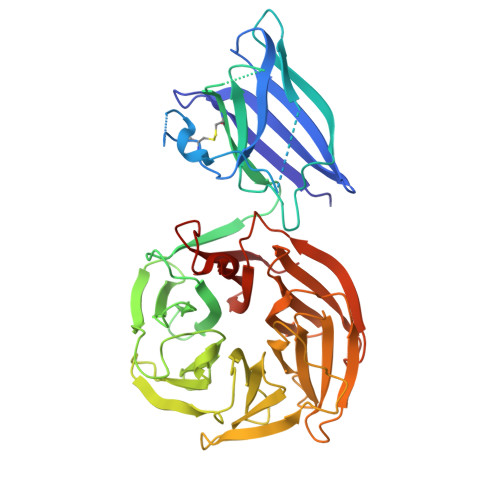
Cu/Zn-superoxide dismutase from Deinococcus radiodurans (Calcium-free)


Experimental Data Snapshot

  • Method: X-RAY DIFFRACTION
  • Resolution: 1.80 Å
  • R-Value Free: 
    0.197 (Depositor), 0.197 (DCC) 
  • R-Value Work: 
    0.164 (Depositor), 0.164 (DCC) 
  • R-Value Observed: 
    0.165 (Depositor) 

Starting Model: in silico
View more details

wwPDB Validation   3D Report Full Report


Ligand Structure Quality Assessment 


This is version 1.0 of the entry. See complete history


Literature

Cu/Zn-superoxide dismutase naturally fused with a beta-propeller lactonase in Deinococcus radiodurans.

Furukawa, Y.Megata, M.Shintani, A.Sue, K.Morohoshi, T.Akutsu, M.Muraki, N.

(2025) J Biological Chem 301: 110499-110499

  • DOI: https://doi.org/10.1016/j.jbc.2025.110499
  • Primary Citation of Related Structures:  
    9M58, 9M59

  • PubMed Abstract: 

    Cu/Zn-superoxide dismutase (Cu/Zn-SOD) is an antioxidant enzyme widely present across species; however, the structural diversity and physiological roles of Cu/Zn-SOD are yet to be fully uncovered. Here, we show a unique type of Cu/Zn-SOD from Deinococcus radiodurans (DrSOD) with an additional β-propeller domain. Our structural analysis of DrSOD revealed a typical bacterial Cu/Zn-SOD domain, binding both a copper and zinc ion, alongside a six-bladed β-propeller domain coordinating a calcium ion. DrSOD was indeed expressed in D. radiodurans, but its deletion did not lead to any noticeable changes in resistance to DNA-damaging stresses, a characteristic trait of D. radiodurans. Despite this, the Cu/Zn-SOD domain retained superoxide dismutase activity, and the β-propeller domain was found to exhibit a lactonase activity specifically for hydrolyzing 2-coumaranone. Taken together, while the precise physiological role of DrSOD needs to be further investigated, our findings here reveal a unique multi-functional enzyme architecture, expanding the known structural diversity of Cu/Zn-SODs.


  • Organizational Affiliation
    • Department of Chemistry, Keio University, Yokohama, Kanagawa, Japan. Electronic address: furukawa.a3@keio.jp.

Macromolecules
Find similar proteins by:  (by identity cutoff)  |  3D Structure
Entity ID: 1
MoleculeChains Sequence LengthOrganismDetailsImage
Superoxide dismutase (SodC), Cu-Zn family
A, B
441Deinococcus radiodurans R1 = ATCC 13939 = DSM 20539Mutation(s): 0 
Gene Names: DR_A0202
EC: 1.15.1.1
UniProt
Find proteins for Q9RYV4 (Deinococcus radiodurans (strain ATCC 13939 / DSM 20539 / JCM 16871 / CCUG 27074 / LMG 4051 / NBRC 15346 / NCIMB 9279 / VKM B-1422 / R1))
Explore Q9RYV4 
Go to UniProtKB:  Q9RYV4
Entity Groups  
Sequence Clusters30% Identity50% Identity70% Identity90% Identity95% Identity100% Identity
UniProt GroupQ9RYV4
Sequence Annotations
Expand
  • Reference Sequence
Experimental Data & Validation

Experimental Data

  • Method: X-RAY DIFFRACTION
  • Resolution: 1.80 Å
  • R-Value Free:  0.197 (Depositor), 0.197 (DCC) 
  • R-Value Work:  0.164 (Depositor), 0.164 (DCC) 
  • R-Value Observed: 0.165 (Depositor) 
Space Group: P 43
Unit Cell:
Length ( Å )Angle ( ˚ )
a = 83.067α = 90
b = 83.067β = 90
c = 119.525γ = 90
Software Package:
Software NamePurpose
PHENIXrefinement
XDSdata reduction
SCALAdata scaling
MOLREPphasing

Structure Validation

View Full Validation Report


Ligand Structure Quality Assessment 


Entry History & Funding Information

Deposition Data


Funding OrganizationLocationGrant Number
Ministry of Education, Culture, Sports, Science and Technology (Japan)Japan19H05765
Ministry of Education, Culture, Sports, Science and Technology (Japan)Japan22H02768
Ministry of Education, Culture, Sports, Science and Technology (Japan)Japan22K19389

Revision History  (Full details and data files)

  • Version 1.0: 2025-09-24
    Type: Initial release