Download Mendeley
Structure and function of the keratin 17 tail domain associated with keratin intermediate filament organization.
Yeom, J., Lee, S., Ko, Y.H., Hong, E., Kim, J.H., Coulombe, P.A., Lee, C.H.(2025) Eur J Cell Biol 104: 151519-151519
- PubMed: 41043210 Search on PubMedSearch on PubMed Central
- DOI: https://doi.org/10.1016/j.ejcb.2025.151519
- Primary Citation Related Structures:
9M1Y - PubMed Abstract:
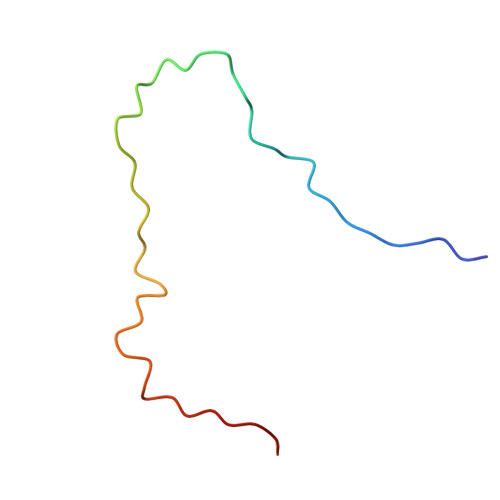
Keratins are the largest subgroup of intermediate filament proteins, forming 10-nm filaments from type I/II heterodimers, and occur primarily in epithelial cells. Keratin 6 (K6; type II) and Keratin 17 (K17; type I) show a complex expression pattern that includes induction following stress and in several diseases, including carcinomas. K17 is being used as a biomarker for several types of cancer. K6 and K17 sequences are respectively highly homologous to K5 and K14, which are expressed in the progenitor compartment of epidermis and related epithelia. The mechanical support roles of the K6/K17 and K5/K14 pairing require 10 nm filament assembly and the subsequent lateral association of these filaments to form thicker bundles. Previous studies showed that the non-helical tail domain of K14 is dispensable for 10 nm filament assembly but essential to the bundling of K5/K14 filaments. Whether the K6/K17 pairing undergoes bundling, and whether the tail domain of K17 plays a role, is unknown. Here, we use sedimentation assays and electron microscopy to show that, when paired with K6, tailless K17 forms filaments that do not readily bundle. Nuclear magnetic resonance analysis revealed that the isolated K17 tail domain is an intrinsically disordered region (IDR). Follow-up studies with mutant K17 tail constructs suggest that IDR-like tail domains of keratins can form a curved local structure required for bundling and interact dynamically with other regions of keratin filaments in a flexible and heterogeneous manner.
- Department of New Biology, Daegu Gyeongbuk Institute of Science and Technology, Republic of Korea.
Organizational Affiliation: