9LUK | pdb_00009luk

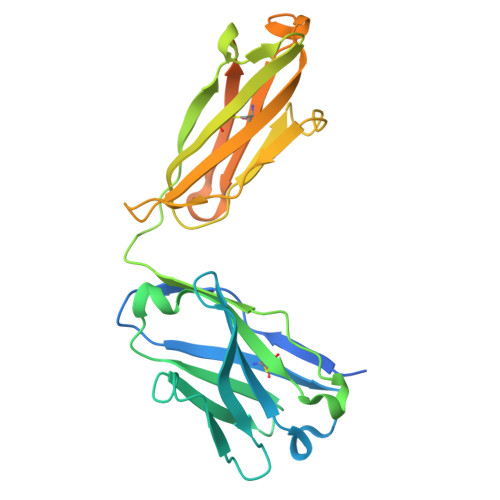
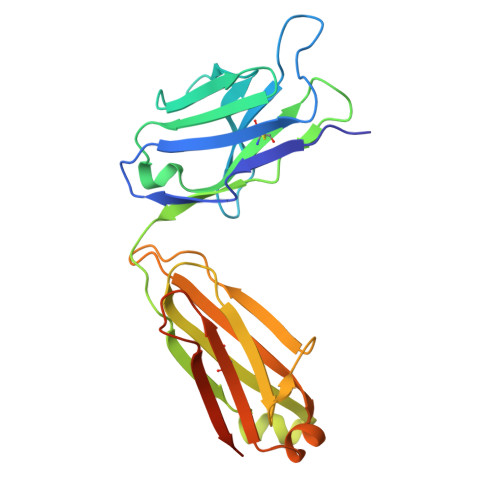
Crystal structure of Switchbody based on anti-osteocalcin antibody KTM219 Fab


Experimental Data Snapshot

  • Method: X-RAY DIFFRACTION
  • Resolution: 1.95 Å
  • R-Value Free: 
    0.238 (Depositor), 0.242 (DCC) 
  • R-Value Work: 
    0.202 (Depositor), 0.209 (DCC) 
  • R-Value Observed: 
    0.204 (Depositor) 

Starting Model: experimental
View more details

wwPDB Validation 3D Report Full Report

Validation slider image for 9LUK

This is version 1.1 of the entry. See complete history

Literature

Switchbody, an Antigen-Responsive Enzyme Switch Based on Antibody and Its Working Principle.

Yasuda, T.Ueno, Y.Taguchi, M.Tochio, N.Yagi, H.Yazaki, S.Arai, R.Zhu, B.Kigawa, T.Ueda, H.Kitaguchi, T.

(2025) Adv Sci (Weinh) 12: e08422-e08422

  • DOI: https://doi.org/10.1002/advs.202508422
  • Primary Citation Related Structures: 
    9LUK

  • PubMed Abstract: 

    An enzyme switch, termed "Switchbody", is developed by fusing an antibody with a fragment of a split enzyme for the precise regulation of enzyme activity in response to an antigen. A luciferase-based Switchbody is engineered by fusing the NanoLuc luciferase fragment HiBiT to the N-terminus of an antibody. The enzyme activity of the Switchbody increases upon the addition of an antigen in a dose-dependent manner in the presence of the complementary fragment LgBiT and its substrate furimazine, demonstrating the potential of the luciferase-based Switchbody as a biosensor. As its working principle, ELISA shows that the interaction between HiBiT and LgBiT is facilitated by antigen binding. Moreover, X-ray crystallography and NMR reveal the heterogeneous trapped state of the HiBiT region and an increasing motility of HiBiT region upon antigen binding, respectively. MD simulations and luminescence measurements show that antigen disrupted the trapping of HiBiT in the antibody, enabling its release. By applying this "Trap and Release" principle to Protein M, an antibody-binding protein, label-free IgG antibodies are successfully converted into bioluminescent Switchbodies. This adaptable Switchbody platform has the potential to expand switching technology beyond luciferase to various other enzymes in the future.


  • Organizational Affiliation
    • Laboratory for Chemistry and Life Science, Institute of Integrated Research, Institute of Science Tokyo, Yokohama, 226-8501, Japan.

Macromolecule Content 

  • Total Structure Weight: 54.64 kDa 
  • Atom Count: 3,553 
  • Modeled Residue Count: 433 
  • Deposited Residue Count: 510 
  • Unique protein chains: 2

Macromolecules

Find similar proteins by:|  3D Structure
Entity ID: 1
MoleculeChains  Sequence LengthOrganismDetailsImage
Heavy chain fragment (Fd) of anti-osteocalcin antibody KTM219 with N-terminal HiBiTA [auth H]278Mus musculusMutation(s): 0 
Find similar proteins by:|  3D Structure
Entity ID: 2
MoleculeChains  Sequence LengthOrganismDetailsImage
Light chain of anti-osteocalcin antibody KTM219B [auth L]232Mus musculusMutation(s): 0 

Small Molecules

Ligands 1 Unique
IDChains Name / Formula / InChI Key2D Diagram3D Interactions
GOL

Query on GOL


Download:Ideal Coordinates CCD File
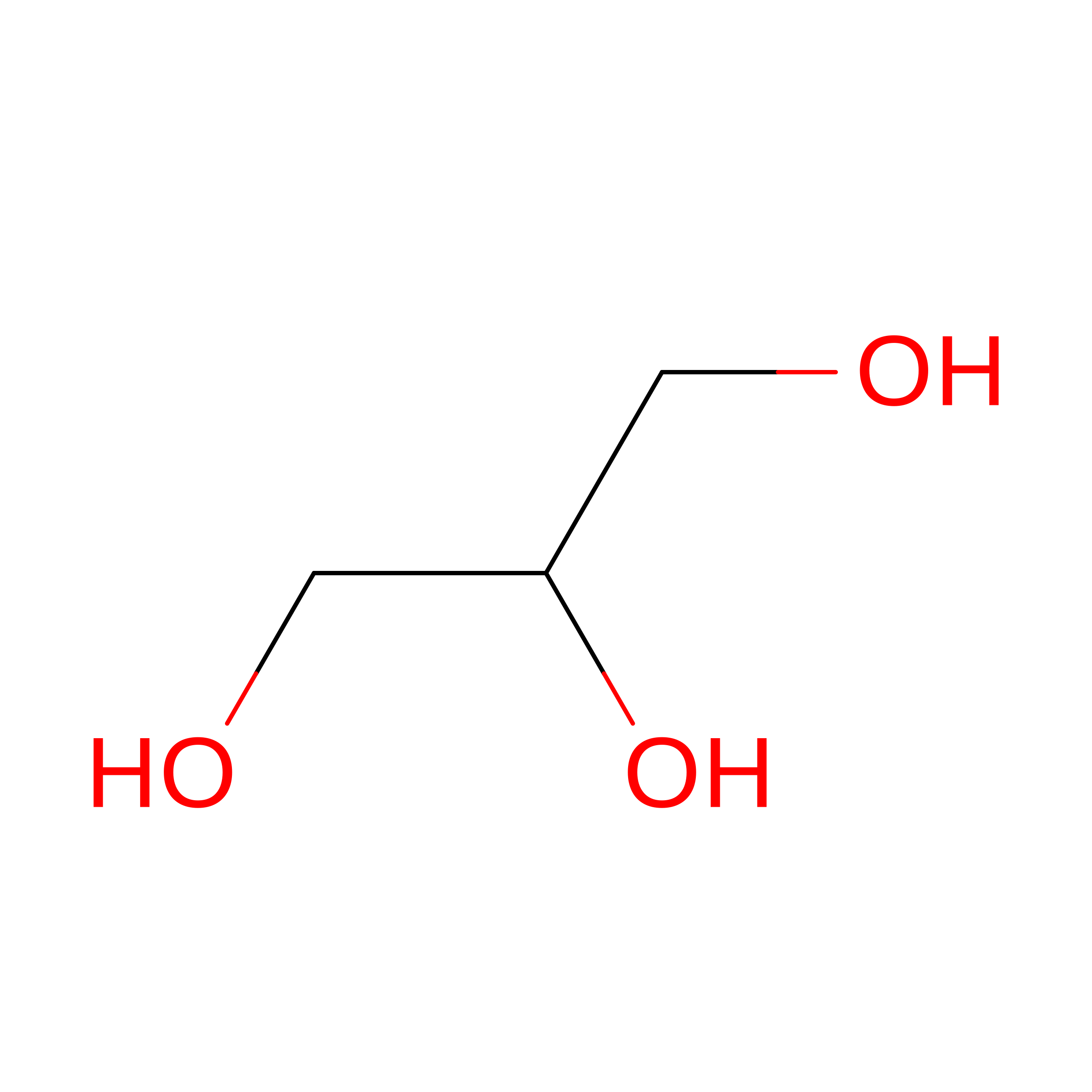
C [auth L]GLYCEROL
C3 H8 O3
PEDCQBHIVMGVHV-UHFFFAOYSA-N

Experimental Data & Validation

Experimental Data

  • Method: X-RAY DIFFRACTION
  • Resolution: 1.95 Å
  • R-Value Free:  0.238 (Depositor), 0.242 (DCC) 
  • R-Value Work:  0.202 (Depositor), 0.209 (DCC) 
  • R-Value Observed: 0.204 (Depositor) 
Space Group: P 21 21 2
Unit Cell:
Length ( Å )Angle ( ˚ )
a = 95.841α = 90
b = 65.909β = 90
c = 69.557γ = 90
Software Package:
Software NamePurpose
XDSdata reduction
Aimlessdata scaling
PHASERphasing
REFMACrefinement

Structure Validation

View Full Validation Report


Entry History 

& Funding Information

Deposition Data


Funding OrganizationLocationGrant Number
Japan Society for the Promotion of Science (JSPS)JapanJP24K01267, JP19H02522, JP17KK0104, JP16K05841, JP16H00761, JP24780097, JP15H04191, JP18H03851
Ministry of Education, Culture, Sports, Science and Technology (Japan)JapanCooperative Research Program of Network Joint Research Center for Materials and Devices

Revision History  (Full details and data files)

  • Version 1.0: 2025-10-08
    Type: Initial release
  • Version 1.1: 2025-12-10
    Changes: Database references