Download Mendeley
Mesostructured Water Enhances Stability of ProteinMPNN-Designed Ubiquitin-Fold Proteins.
Chen, L.Y., Lu, W.L., Pathania, T., Chu, I.H., Ho, M.R., Chuang, W.C., Lou, Y.C., Hung, T.I., Miyanoiri, Y., Chang, C.A., Wu, K.P.(2026) J Am Chem Soc 148: 7363-7377
- PubMed: 41643123 Search on PubMedSearch on PubMed Central
- DOI: https://doi.org/10.1021/jacs.5c19875
- Primary Citation Related Structures:
9LQK, 9LQM, 9M8W, 9M8X, 9M9G, 9M9H - PubMed Abstract:
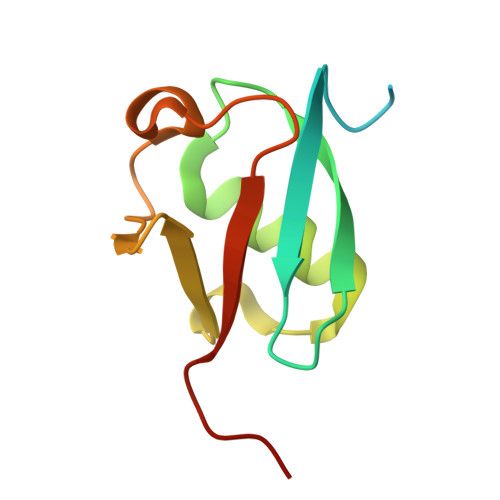
AI-designed protein variants have demonstrated remarkable resistance to heat and chemical stress, yet the molecular mechanisms underlying this stability remain unclear. Here, we present a comprehensive biophysical and nuclear magnetic resonance (NMR) analysis of thermally stable ubiquitin and its ProteinMPNN-designed variants, R4 and R10, together with a second system based on the less stable ISG15 C-terminal domain (ISG15-CTD). Both R4/R10 and ProteinMPNN-designed ISG15-CTD variants (ICVs) exhibit extraordinary thermostability beyond 120 °C, and resist extreme denaturation at pH 3.0 in 8 M urea. NMR relaxation and hydrogen-deuterium exchange, and molecular-dynamics simulations reveal a protective mesostructured hydration shell that strengthens the hydrogen bonding network between protein-bound and bulk water, thereby suppressing unfolding. Sequence and electrostatic analyses indicate that this hydration arises from charge enrichment and clustering on the protein surface. These findings identify mesostructured hydration as a general, sequence-encoded mechanism of ProteinMPNN-driven stability and provide a physical framework for designing highly resilient biomolecules.
- Institute of Biological Chemistry, Academia Sinica, Taipei 115201, Taiwan.
Organizational Affiliation: