Download Mendeley
Remote on-off switching of protein activity by intrinsically disordered region.
Ji, T., Ge, P., Zhang, S., Wan, C., Liu, H., Qu, X., Zhu, F., Gong, Q., Xu, W., Wang, C., Wang, Y., Huang, C.(2025) Nat Struct Mol Biol 32: 2088-2098
- PubMed: 40467883 Search on PubMedSearch on PubMed Central
- DOI: https://doi.org/10.1038/s41594-025-01585-7
- Primary Citation Related Structures:
9LLV - PubMed Abstract:
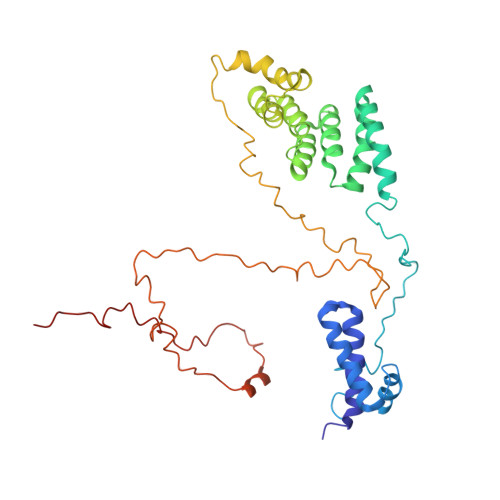
While the regulation of protein function theoretically encompasses alterations in both structural conformation and dynamic properties, the latter aspect, specifically conformational entropy, remains relatively unexplored. Here we show that an intrinsically disordered region (IDR), a prominent component of the proteome, can remotely switch protein activity on or off through a nonbinding, entropy-driven mechanism. Focusing on the disordered C-terminal tail of Sgt2, a chaperone in the guided entry of tail-anchored protein pathway, we demonstrate that it allosterically inhibits the N-terminal domain without direct contact, preventing unproductive chaperone-chaperone interactions. This inhibition is relieved upon client binding. These effects depend on specific IDR sequences but not the intervening regions. Beyond acting as a relay signal, the IDR also forms a dynamic complex with transmembrane domains of tail-anchored clients, serving as an entropic shelter. Moreover, the IDR-mediated activity of Sgt2 correlates with fast internal dynamics, establishing conformational entropy as a key regulatory principle. Our findings reveal IDRs as two-way entropic modulators, enabling distant, on-demand activity switching.
- Ministry of Education Key Laboratory for Membrane-less Organelles and Cellular Dynamics, Center for Advanced Interdisciplinary Science and Biomedicine of IHM, Biomedical Sciences and Health Laboratory of Anhui Province, Hefei National Laboratory for Physical Sciences at the Microscale, School of Life Sciences, Division of Life Sciences and Medicine, University of Science and Technology of China, Hefei, P. R. China.
Organizational Affiliation: