Download Mendeley
Molecular recognition and effects of a benzothiazole derivative targeting the MYC G-quadruplex.
Ni, X., Hu, X.D., Long, W., Lan, W., Wang, C., Wong, W.L., Cao, C.(2025) Nucleic Acids Res 53
- PubMed: 40966493 Search on PubMedSearch on PubMed Central
- DOI: https://doi.org/10.1093/nar/gkaf888
- Primary Citation Related Structures:
9L4E - PubMed Abstract:
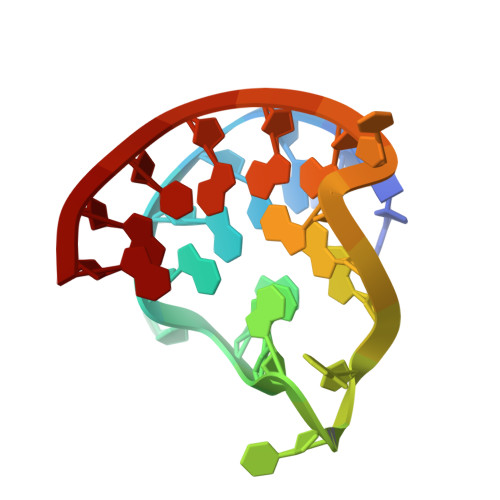
Small-molecule intervention and stabilization of G-quadruplexes (G4s) have been investigated for the potential as therapeutic approaches. MYC plays diverse roles in cellular functions, making it a highly desirable yet challenging target. One promising strategy includes DNA G4 structures, which mediate transcriptional control over MYC in the presence of small-molecule ligands. Unraveling the effects of these ligands on G4 stability and functionality is seldom achieved yet essential for designing potent ligands against these intractable targets. This study introduces BTO-28, a benzothiazole-based ligand that binds with high affinity to the MYC G4. In vitro experiments, NMR analysis, and intracellular assays collectively indicate that BTO-28 potentially downregulates MYC transcription through a G4-mediated mechanism. Structural determination of the 2:1 benzothiazole-MYC G4 complex provides insights into unexpected molecular interactions, highlighting for the first time a unique hydrogen-bonding pattern involving the nucleobase surrogate and flanking residues. The protonated pyrrolidine side chains of BTO-28 reorient to form hydrogen bonding with the external G-tetrad, establishing a previously uncharacterized ligand-G4 interface. This work advances the rational design of G4-binding ligands and clarifies the molecular basis underlying MYC recognition.
- State Key Laboratory of Chemical Biology, Shanghai Institute of Organic Chemistry, University of Chinese Academy of Sciences, Chinese Academy of Sciences, Shanghai 200032, China.
Organizational Affiliation: