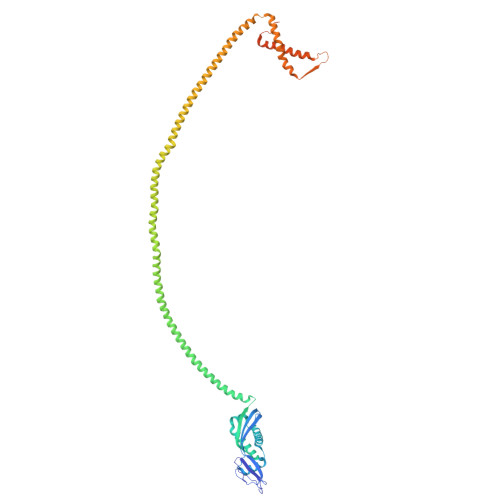
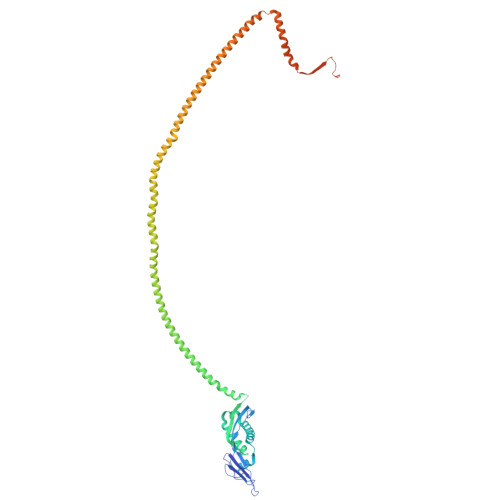
9L3G | pdb_00009l3g

Structure of the flotillin complex

  • Classification: MEMBRANE PROTEIN
  • Organism(s): Homo sapiens
  • Expression System: Homo sapiens
  • Mutation(s): No 

  • Deposited: 2024-12-18 Released: 2025-12-24 
  • Deposition Author(s): Lu, M., Gao, N.
  • Funding Organization(s): National Natural Science Foundation of China (NSFC)

Experimental Data Snapshot

  • Method: ELECTRON MICROSCOPY
  • Resolution: 3.58 Å
  • Aggregation State: PARTICLE 
  • Reconstruction Method: SINGLE PARTICLE 

wwPDB Validation   3D Report Full Report


This is version 1.1 of the entry. See complete history


Literature

Molecular mechanisms of flotillin complexes in organizing membrane microdomains.

Lu, M.A.Qian, Y.Ma, L.Hong, J.Li, X.Yu, L.Guo, Q.Gao, N.

(2026) Nat Commun 

  • DOI: https://doi.org/10.1038/s41467-026-69197-3
  • Primary Citation of Related Structures:  
    9L3G

  • PubMed Abstract: 

    Flotillin-1 and flotillin-2 form hetero-oligomers to create flotillin membrane microdomains essential for endocytosis and protein sorting. However, the mechanisms of flotillin oligomerization and microdomain organization remain incompletely understood. Here, we present the cryo-EM structure of human flotillin complex, showing that flotillin-1 and -2 form a 44-mer, membrane attached, and dome-shaped structure that defines a 30-nm circular membrane domain. The cryo-ET data demonstrates that while attached to the cytoplasmic leaflet, flotillin complexes possess intrinsic structural plasticity in situ on the native membrane. Each flotillin complex may represent a fundamental unit of membrane microdomains, with their clustering enabling the formation of larger and more elaborate domains. We further reveal that phosphorylation at residues Y160 (flotillin-1) and Y163 (flotillin-2) may act as a molecular switch to modulate complex assembly, potentially regulating its function in endocytosis. These findings demonstrate the molecular mechanism of flotillin-mediated membrane segregation and microdomain formation, and suggest a previously unrecognized role of flotillin in sequestrating membrane proteins.


  • Organizational Affiliation
    • State Key Laboratory of Membrane Biology, Peking-Tsinghua Joint Center for Life Sciences, Academy for Advanced Interdisciplinary Studies, School of Life Sciences, Peking University, Beijing, China.

Macromolecules
Find similar proteins by:  (by identity cutoff)  |  3D Structure
Entity ID: 1
MoleculeChains Sequence LengthOrganismDetailsImage
Flotillin-1462Homo sapiensMutation(s): 0 
Gene Names: FLOT1
UniProt & NIH Common Fund Data Resources
Find proteins for O75955 (Homo sapiens)
Explore O75955 
Go to UniProtKB:  O75955
PHAROS:  O75955
GTEx:  ENSG00000137312 
Entity Groups  
Sequence Clusters30% Identity50% Identity70% Identity90% Identity95% Identity100% Identity
UniProt GroupO75955
Sequence Annotations
Expand
  • Reference Sequence
Find similar proteins by:  (by identity cutoff)  |  3D Structure
Entity ID: 2
MoleculeChains Sequence LengthOrganismDetailsImage
Flotillin-2428Homo sapiensMutation(s): 0 
Gene Names: FLOT2ESA1M17S1
UniProt & NIH Common Fund Data Resources
Find proteins for Q14254 (Homo sapiens)
Explore Q14254 
Go to UniProtKB:  Q14254
PHAROS:  Q14254
GTEx:  ENSG00000132589 
Entity Groups  
Sequence Clusters30% Identity50% Identity70% Identity90% Identity95% Identity100% Identity
UniProt GroupQ14254
Sequence Annotations
Expand
  • Reference Sequence
Experimental Data & Validation

Experimental Data

  • Method: ELECTRON MICROSCOPY
  • Resolution: 3.58 Å
  • Aggregation State: PARTICLE 
  • Reconstruction Method: SINGLE PARTICLE 

Structure Validation

View Full Validation Report


Entry History & Funding Information

Deposition Data

  • Released Date: 2025-12-24 
  • Deposition Author(s): Lu, M., Gao, N.

Funding OrganizationLocationGrant Number
National Natural Science Foundation of China (NSFC)China92354306

Revision History  (Full details and data files)

  • Version 1.0: 2025-12-24
    Type: Initial release
  • Version 1.1: 2026-02-18
    Changes: Data collection, Database references