Find PDB structures and Computed Structure Models (CSM) by combining queries from tools in this suite: Attribute Search, Sequence Similarity, Sequence Motif, 3D Similarity, and 3D Motif with 'AND' logic.
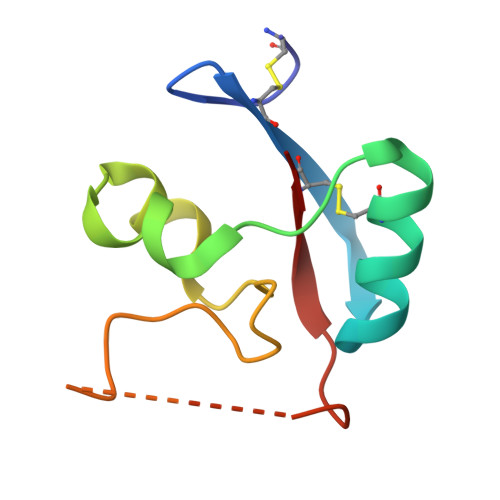
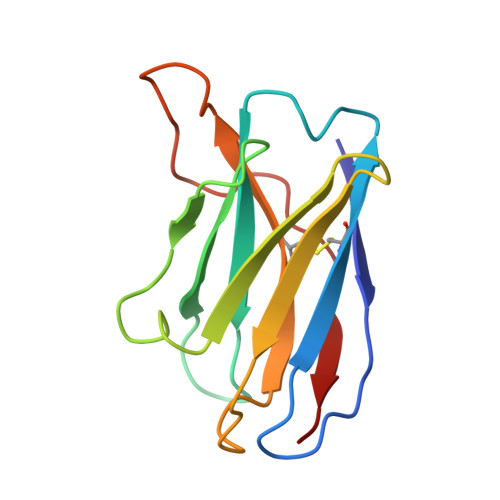
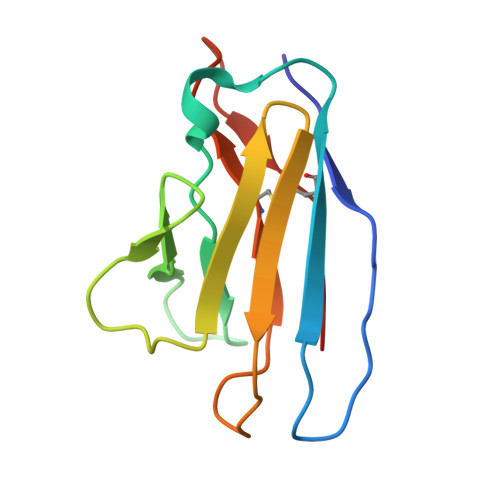
The A35 protein, expressed on the enveloped virion of monkeypox (mpox) virus (MPXV), is essential for viral infection and spread within the host, making it an effective antiviral target. In this study, we demonstrated two human anti-A35 monoclonal antibodies (mAbs) displayed potential protection against MPXV in CAST/EiJ mice and rhesus macaques. Using cryo-electron microscopy, we determined two high-resolution structures of the A35 dimer in complex with the fragment of antigen binding of mAb 975 or mAb 981, revealing detailed interactions at the antigen-antibody interfaces. Structural analysis showed that these structurally conserved mAbs bind to a groove region at the interface of A35 dimer. Overall, we provided a proof of concept for a single administration of anti-A35 mAbs mitigating the pathogenic effects of MPXV infection in rhesus macaques. These human-derived mAbs could be served as antibody drug candidates, and their binding models to the A35 dimer will provide valuable insights for future vaccine design.
Organizational Affiliation:
Institute for Hepatology, National Clinical Research Center for Infectious Disease, Shenzhen Third People's Hospital, The Second Affiliated Hospital, School of Medicine, Southern University of Science and Technology, Shenzhen, Guangdong Province 518112, China; Guangdong Key Laboratory for Anti-infection Drug Quality Evaluation, Shenzhen, Guangdong Province 518112, China. Electronic address: jubin2013@163.com.
Institute for Hepatology, National Clinical Research Center for Infectious Disease, Shenzhen Third People's Hospital, The Second Affiliated Hospital, School of Medicine, Southern University of Science and Technology, Shenzhen, Guangdong Province 518112, China.
State Key Laboratory of Respiratory Health and Multimorbidity, NHC Key Laboratory of Human Disease Comparative Medicine, Institute of Laboratory Animal Science, Chinese Academy of Medical Sciences, Comparative Medicine Center, Peking Union Medical College, Beijing 100021, China.
Department of Biochemistry, Key University Laboratory of Metabolism and Health of Guangdong, SUSTech Homeostatic Medicine Institute, School of Medicine, Institute for Biological Electron Microscopy, Southern University of Science and Technology, Shenzhen, Guangdong Province 518055, China; Tsinghua-Peking Joint Center for Life Sciences, School of Life Sciences, Tsinghua University, Beijing 100084, China.
Department of Biochemistry, Key University Laboratory of Metabolism and Health of Guangdong, SUSTech Homeostatic Medicine Institute, School of Medicine, Institute for Biological Electron Microscopy, Southern University of Science and Technology, Shenzhen, Guangdong Province 518055, China.
NHC Key Laboratory of Biosafety, National Institute for Viral Disease Control and Prevention, Chinese Center for Disease Control and Prevention, Beijing 102206, China.
NHC Key Laboratory of Biosafety, National Institute for Viral Disease Control and Prevention, Chinese Center for Disease Control and Prevention, Beijing 102206, China. Electronic address: tanwj@ivdc.chinacdc.cn.
Department of Biochemistry, Key University Laboratory of Metabolism and Health of Guangdong, SUSTech Homeostatic Medicine Institute, School of Medicine, Institute for Biological Electron Microscopy, Southern University of Science and Technology, Shenzhen, Guangdong Province 518055, China. Electronic address: yanrh@sustech.edu.cn.
State Key Laboratory of Respiratory Health and Multimorbidity, NHC Key Laboratory of Human Disease Comparative Medicine, Institute of Laboratory Animal Science, Chinese Academy of Medical Sciences, Comparative Medicine Center, Peking Union Medical College, Beijing 100021, China. Electronic address: xuejing@cnilas.org.
Institute for Hepatology, National Clinical Research Center for Infectious Disease, Shenzhen Third People's Hospital, The Second Affiliated Hospital, School of Medicine, Southern University of Science and Technology, Shenzhen, Guangdong Province 518112, China; Guangdong Key Laboratory for Anti-infection Drug Quality Evaluation, Shenzhen, Guangdong Province 518112, China; Shenzhen Research Center for Communicable Disease Diagnosis and Treatment, Chinese Academy of Medical Sciences, Shenzhen, Guangdong Province 518112, China. Electronic address: zhangzheng1975@aliyun.com.

 Download Mendeley