9KWL | pdb_00009kwl

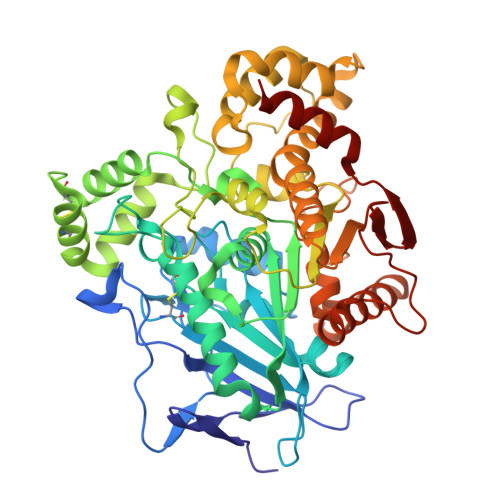
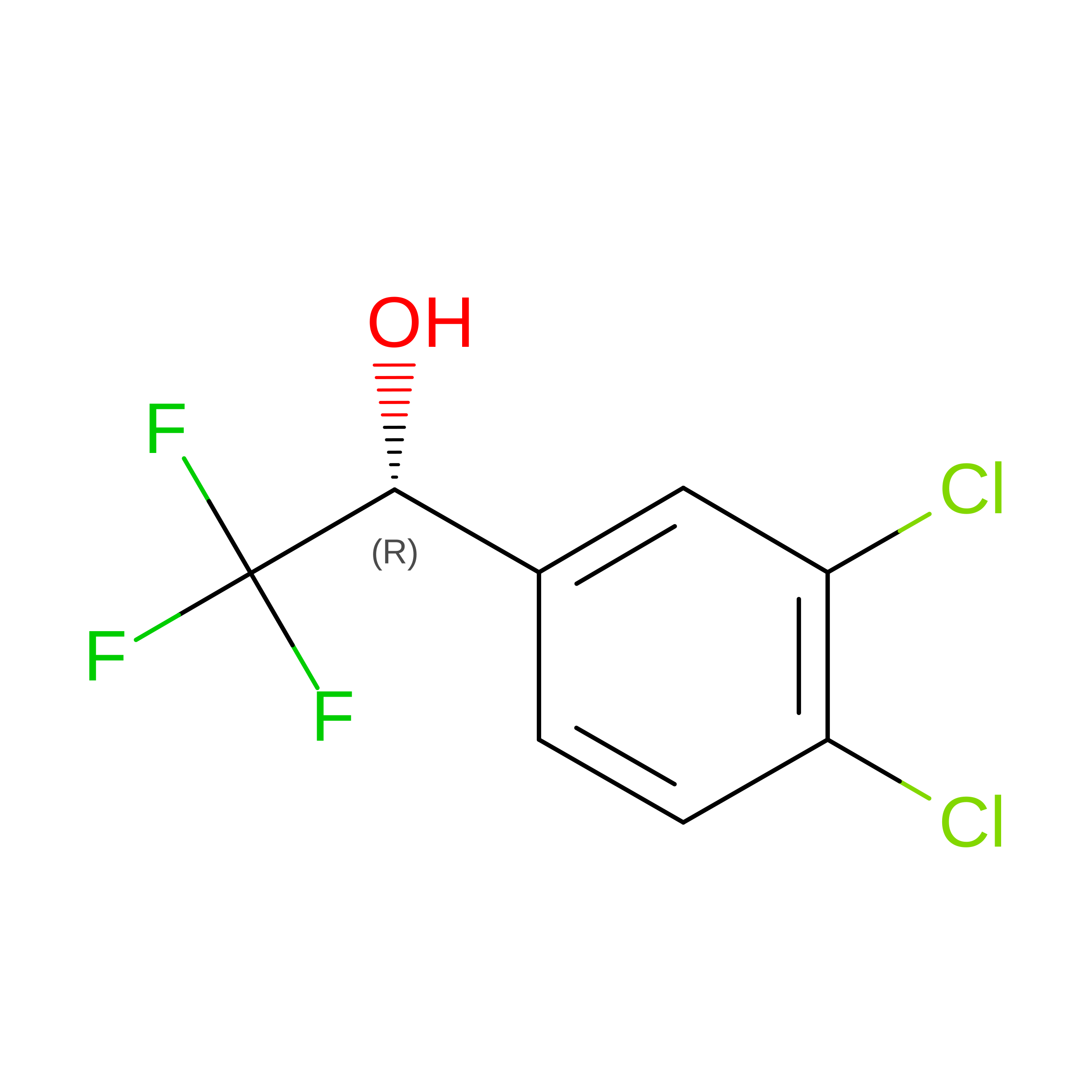
hCES1A contently binding with compound F-3 at the catalytic pocket.

  • Classification: HYDROLASE
  • Organism(s): Homo sapiens
  • Expression System: Homo sapiens
  • Mutation(s): No 

  • Deposited: 2024-12-06 Released: 2025-01-29 
  • Deposition Author(s): Gai, C., Zhao, Q.
  • Funding Organization(s): National Natural Science Foundation of China (NSFC)

Experimental Data Snapshot

  • Method: X-RAY DIFFRACTION
  • Resolution: 1.83 Å
  • R-Value Free: 
    0.186 (Depositor), 0.190 (DCC) 
  • R-Value Work: 
    0.172 (Depositor) 
  • R-Value Observed: 
    0.172 (Depositor) 

Starting Model: experimental
View more details

wwPDB Validation 3D Report Full Report

Validation slider image for 9KWL

Ligand Structure Quality Assessment 


This is version 1.0 of the entry. See complete history

Literature

The study of halogen effect on the reactivity of the serine-targeting covalent warheads.

Gai, C.Zhang, Y.Zhang, S.Hu, X.Song, Y.Q.Zhuang, X.Chai, X.Zou, Y.Ge, G.B.Zhao, Q.

(2024) Front Chem 12: 1504453-1504453

  • DOI: https://doi.org/10.3389/fchem.2024.1504453
  • Primary Citation Related Structures: 
    9KWL, 9KWM

  • PubMed Abstract: 

    Halogens favorably contributes to the drug potency and metabolic stability via electrostatic interactions. Herein, the halogen effects on the reactivity of the halogenated 2,2,2-trifluoroacetophenones as serine-targeting covalent warheads were investigated. Our results showed that introducing halogen atoms, especially Cl or Br, into the phenyl scaffold would influence the electron density around the ring, which led to different time-dependent inhibition response to the target serine hydrolase (hCES1A). Co-crystallography analysis not only verified that halogenated molecules preferred to form covalent adducts, but also provided the conformational information for the design of covalent inhibitors targeting to hCES1A protein for the treatment of drug-induced acute enteritis.


  • Organizational Affiliation
    • Organic Chemistry Group, College of Pharmacy, Naval Medical University, Shanghai, China.

Macromolecule Content 

  • Total Structure Weight: 59.07 kDa 
  • Atom Count: 4,711 
  • Modeled Residue Count: 533 
  • Deposited Residue Count: 533 
  • Unique protein chains: 1

Macromolecules

Find similar proteins by:|  3D Structure
Entity ID: 1
MoleculeChains  Sequence LengthOrganismDetailsImage
Liver carboxylesterase 1533Homo sapiensMutation(s): 0 
Gene Names: CES1CES2SES1
EC: 3.1.1.1 (PDB Primary Data), 3.1.1.13 (PDB Primary Data), 3.1.1.56 (PDB Primary Data)
UniProt & NIH Common Fund Data Resources
Find proteins for P23141 (Homo sapiens)
Explore P23141 
Go to UniProtKB:  P23141
PHAROS:  P23141
GTEx:  ENSG00000198848 
Entity Groups
Sequence Clusters30% Identity50% Identity70% Identity90% Identity95% Identity100% Identity
UniProt GroupP23141
Sequence Annotations
Expand
Reference Sequence

Small Molecules

Experimental Data & Validation

Experimental Data

  • Method: X-RAY DIFFRACTION
  • Resolution: 1.83 Å
  • R-Value Free:  0.186 (Depositor), 0.190 (DCC) 
  • R-Value Work:  0.172 (Depositor) 
  • R-Value Observed: 0.172 (Depositor) 
Space Group: H 3 2
Unit Cell:
Length ( Å )Angle ( ˚ )
a = 110.469α = 90
b = 110.469β = 90
c = 278.259γ = 120
Software Package:
Software NamePurpose
PHENIXrefinement
XDSdata reduction
XDSdata scaling
PHENIXphasing

Structure Validation

View Full Validation Report


Ligand Structure Quality Assessment 


Entry History 

& Funding Information

Deposition Data


Funding OrganizationLocationGrant Number
National Natural Science Foundation of China (NSFC)China82204347

Revision History  (Full details and data files)

  • Version 1.0: 2025-01-29
    Type: Initial release