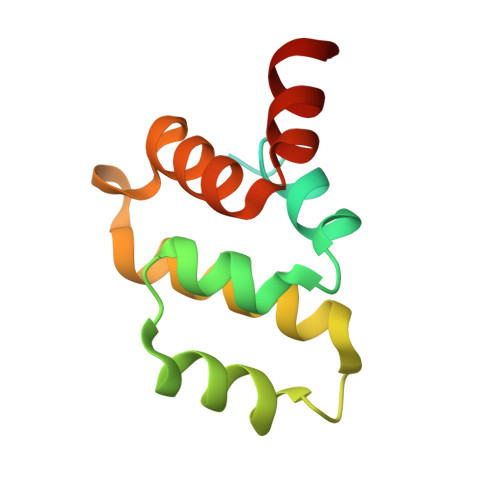
9KV7 | pdb_00009kv7

Cryo-EM structure of mouse RIPK1-DD filament

  • Classification: IMMUNE SYSTEM
  • Organism(s): Mus musculus
  • Expression System: Escherichia coli
  • Mutation(s): No 

  • Deposited: 2024-12-04 Released: 2025-10-15 
  • Deposition Author(s): Zhang, H.
  • Funding Organization(s): Ministry of Science and Technology (MoST, China), National Natural Science Foundation of China (NSFC)

Experimental Data Snapshot

  • Method: ELECTRON MICROSCOPY
  • Resolution: 3.02 Å
  • Aggregation State: FILAMENT 
  • Reconstruction Method: HELICAL 

wwPDB Validation   3D Report Full Report


This is version 1.0 of the entry. See complete history


Literature

RIPK1 senses S-adenosylmethionine scarcity to drive cell death and inflammation.

Chen, Z.Gu, X.Chen, H.Zhang, H.Liu, J.Yang, X.Cai, Y.Zhang, M.Yan, L.Yang, Y.Shan, B.Zhu, Z.J.Zhang, Y.Gu, J.Xu, D.

(2025) Cell Metab 37: 1732-1749.e9

  • DOI: https://doi.org/10.1016/j.cmet.2025.05.014
  • Primary Citation of Related Structures:  
    9KV7

  • PubMed Abstract: 

    The capacity of cells to sense and respond to nutrient availability is essential for metabolic homeostasis. Failure in this process may cause cell death and associated diseases. While nutrient sensing in metabolic pathways is well understood, the mechanisms linking nutrient signals to cell death remain unclear. Here, we show that RIPK1, a key mediator of cell death and inflammation, senses methionine and its metabolite, S-adenosylmethionine (SAM), to dictate cell survival and death. SAM-mediated symmetrical dimethylation at RIPK1 Arg606 by PRMT5 functions as a physiological protective brake against RIPK1 activation. Metabolic perturbations, such as methionine restriction or disrupted one-carbon flux, reduce SAM levels and unmask Arg606, promoting RIPK1 self-association and trans-activation, thereby triggering apoptosis and inflammation. Thus, RIPK1 is a physiological SAM sensor linking methionine and one-carbon metabolism to the control of life-or-death decisions. Our findings suggest that RIPK1 could be a potential target for diseases associated with disrupted SAM availability.


  • Organizational Affiliation
    • Interdisciplinary Research Center on Biology and Chemistry, Shanghai Institute of Organic Chemistry, Chinese Academy of Sciences, Shanghai 201210, China; University of Chinese Academy of Sciences, Beijing 101408, China.

Macromolecules
Find similar proteins by:  (by identity cutoff)  |  3D Structure
Entity ID: 1
MoleculeChains Sequence LengthOrganismDetailsImage
Receptor-interacting serine/threonine-protein kinase 1120Mus musculusMutation(s): 0 
Gene Names: Ripk1RinpRip
EC: 2.7.11.1
UniProt
Find proteins for Q60855 (Mus musculus)
Explore Q60855 
Go to UniProtKB:  Q60855
Entity Groups  
Sequence Clusters30% Identity50% Identity70% Identity90% Identity95% Identity100% Identity
UniProt GroupQ60855
Sequence Annotations
Expand
  • Reference Sequence
Experimental Data & Validation

Experimental Data

  • Method: ELECTRON MICROSCOPY
  • Resolution: 3.02 Å
  • Aggregation State: FILAMENT 
  • Reconstruction Method: HELICAL 
EM Software:
TaskSoftware PackageVersion
MODEL REFINEMENTPHENIX1.18.2_3874

Structure Validation

View Full Validation Report


Entry History & Funding Information

Deposition Data

  • Released Date: 2025-10-15 
  • Deposition Author(s): Zhang, H.

Funding OrganizationLocationGrant Number
Ministry of Science and Technology (MoST, China)China--
National Natural Science Foundation of China (NSFC)China--

Revision History  (Full details and data files)

  • Version 1.0: 2025-10-15
    Type: Initial release