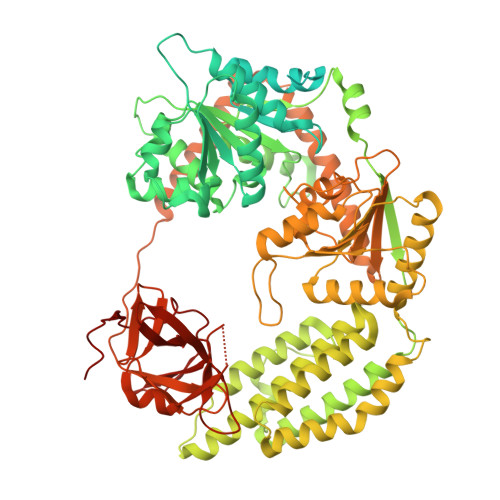
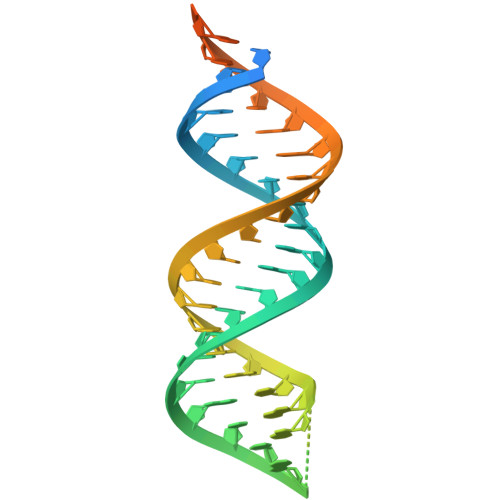
9KTW | pdb_00009ktw

Cryo-EM structure of wild type RIG-I with 5'p-RNA


Experimental Data Snapshot

  • Method: ELECTRON MICROSCOPY
  • Resolution: 2.60 Å
  • Aggregation State: PARTICLE 
  • Reconstruction Method: SINGLE PARTICLE 

Starting Model: experimental
View more details

wwPDB Validation 3D Report Full Report

Validation slider image for 9KTW

This is version 1.1 of the entry. See complete history

Literature

Local activation of mutant RIG-I by short noncoding Y-RNA in the kidney triggers lethal nephritis.

Satoh, S.Tan, Y.B.Heil, B.Yamada, S.Schutte, V.Phang, C.Tang, C.Tsukamoto, Y.Higuchi, T.Fujita, T.Behrendt, R.Schlee, M.Luo, D.Kato, H.

(2025) Sci Immunol 10: eadx1135-eadx1135

  • DOI: https://doi.org/10.1126/sciimmunol.adx1135
  • Primary Citation Related Structures: 
    9KTW, 9KU4

  • PubMed Abstract: 

    Detecting viral RNA by the ubiquitously expressed cytosolic receptor retinoic acid-inducible gene I (RIG-I) is critical for antiviral immune responses, including type I interferon (IFN-I) and chemokine induction. RIG-I has evolved to sensitively recognize viral RNA but tolerate self-RNA. RIG-I mutations causing self-tolerance loss induce IFN-I and chemokines in patients, initiating autoinflammation. We observed that mice expressing the RIG-I patient variant E373A spontaneously developed lupus-like nephritis. Kidney-derived chemokines attracted monocytes through CCR2 (C-C motif chemokine receptor 2) and induced interstitial inflammation and tubular damage. This led to renal dysfunction independently of immunoglobulin G-nucleic acid complex deposition. Sequencing of RIG-I E373A-bound RNA from kidney-derived cells identified short noncoding Y-RNA. Deletion of the most enriched Y-RNA species reduced RIG-I E373A-induced IFN-I responses. Cryo-electron microscopy and molecular analyses revealed that RIG-I E373A binding to the Y-RNA stem region resulted in its activation. Thus, we demonstrate that Y-RNA activates a RIG-I gain-of-function mutant in a tissue-specific manner, causing autoinflammation culminating in lupus nephritis.


  • Organizational Affiliation
    • Institute of Cardiovascular Immunology, Medical Faculty, University Hospital Bonn, University of Bonn, Bonn, Germany.

Macromolecule Content 

  • Total Structure Weight: 126.05 kDa 
  • Atom Count: 6,254 
  • Modeled Residue Count: 714 
  • Deposited Residue Count: 985 
  • Unique protein chains: 1
  • Unique nucleic acid chains: 1

Macromolecules


Find similar proteins by:|  3D Structure
Entity ID: 1
MoleculeChains  Sequence LengthOrganismDetailsImage
Antiviral innate immune response receptor RIG-IA [auth B]925Homo sapiensMutation(s): 0 
Gene Names: RIGIDDX58
EC: 3.6.4.13
UniProt & NIH Common Fund Data Resources
Find proteins for O95786 (Homo sapiens)
Explore O95786 
Go to UniProtKB:  O95786
PHAROS:  O95786
GTEx:  ENSG00000107201 
Entity Groups
Sequence Clusters30% Identity50% Identity70% Identity90% Identity95% Identity100% Identity
UniProt GroupO95786
Sequence Annotations
Expand
Reference Sequence
Find similar nucleic acids by:  (by identity cutoff) 
Entity ID: 2
MoleculeChains LengthOrganismImage
5'p-RNA (60-MER)B [auth C]60synthetic construct
Sequence Annotations
Expand
Reference Sequence

Small Molecules

Experimental Data & Validation

Experimental Data

  • Method: ELECTRON MICROSCOPY
  • Resolution: 2.60 Å
  • Aggregation State: PARTICLE 
  • Reconstruction Method: SINGLE PARTICLE 
EM Software:
TaskSoftware PackageVersion
RECONSTRUCTIONcryoSPARC
MODEL REFINEMENTPHENIX1.20.1_4487:

Structure Validation

View Full Validation Report


Entry History 

& Funding Information

Deposition Data


Funding OrganizationLocationGrant Number
Ministry of Education (MoE, Singapore)SingaporeMOE AcRF Tier 1 award RT22/23

Revision History  (Full details and data files)

  • Version 1.0: 2025-12-03
    Type: Initial release
  • Version 1.1: 2026-06-17
    Changes: Data collection, Database references