Download Mendeley
MORC2 mediates transcriptional regulation through liquid-liquid phase separation.
Zhang, Y., Xu, W., Duan, W., Wei, Y., Jiang, W., Zhu, F., Huang, C., Wang, C., Bi, Y.(2026) Elife 14
- PubMed: 42160388 Search on PubMedSearch on PubMed Central
- DOI: https://doi.org/10.7554/eLife.108479
- Primary Citation Related Structures:
9KQL - PubMed Abstract:
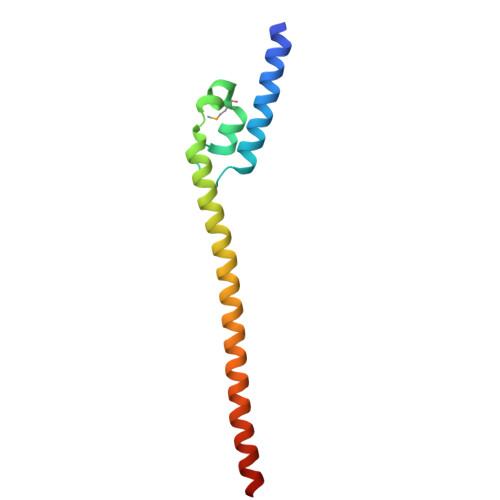
MORC2 is a chromatin-associated ATPase essential for transcriptional silencing and genome stability, yet the biophysical principles governing its regulatory activity remain elusive. Here, we demonstrate that full-length MORC2 undergoes biomolecular condensation to form dynamic nuclear assemblies, a process fundamentally required for its repressor function. Endogenous MORC2 forms discrete, dynamic condensates in neurons from Morc2a EGFP chimeric mice, supporting the physiological relevance of these assemblies in vivo. Mechanistically, a 3.1 Å crystal structure of coiled-coil 3 (CC3) identifies a dimeric scaffold that serves as a structural hub, while multivalent 'sticker' interactions between an intrinsically disordered region (IDR) and a newly defined IDR-binding domain (IBD) drive condensation. We show that DNA acts as a molecular scaffold that triggers MORC2 condensation, which in turn allosterically stimulates its ATPase activity. Critically, by employing a 'killswitch' strategy to decouple assembly from internal fluidity, we reveal that only dynamic MORC2 condensates, not static aggregates or condensation-deficient mutants, can restore transcriptional regulation in MORC2 -knockout cells. Furthermore, pathogenic variants linked to CMT2Z and SMA differentially perturb these material properties and enzymatic turnover, providing a mechanistic link between condensate dysregulation and human neuropathies. Together, our findings establish a DNA-templated condensation mechanism for MORC2 and provide a molecular framework for understanding how the material state of chromatin-associated machinery dictates gene regulation and disease pathogenesis.
- Hefei National Research Center for Physical Sciences at the Microscale, Center for Advanced Interdisciplinary Science and Biomedicine of IHM, Division of Life Sciences and Medicine, University of Science and Technology of China, Hefei, China.
Organizational Affiliation: