Download Mendeley
Computational design of allulose-responsive biosensor toolbox for auto-inducible protein expression and CRISPRi mediated dynamic metabolic regulation.
Dong, Q., Chen, P., Guo, Z., Wei, H., Zeng, Y., Zhang, J., Men, Y., Liu, W., Sun, Y., Yang, J.(2025) Nat Commun 16: 11562-11562
- PubMed: 41430049 Search on PubMedSearch on PubMed Central
- DOI: https://doi.org/10.1038/s41467-025-67669-6
- Primary Citation Related Structures:
9KPR - PubMed Abstract:
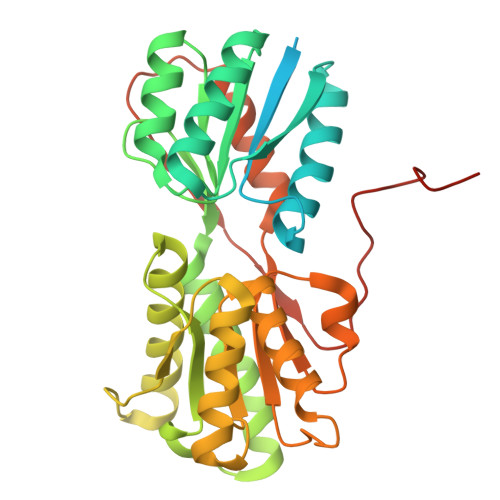
Biosensors based on transcription factors (TFs) have shown extensive applications in synthetic biology. Due to the complex multi-domain structure of effector-TF-DNA, computational design of TFs remains a challenge. Here, we present the successful structure-guided computational design of the access tunnel, ligand binding, allosteric transition process for an allulose-responsive PsiR. It enables a 20-fold increase in sensitivity, reducing the EC 50 of PsiR-allulose biosensors (PABs) from 16 mM to 0.8 mM, and delivers a PAB box possessing the detection range from 10 μM to 100 mM. We further validate its broader applicability in enhancing sensitivity of LacI-IPTG biosensor. Based on the developed PABs, we present the inducer-free allulose-mediated auto-inducible protein expression system, and demonstrate an allulose-triggered CRISPR interference circuit for dynamic metabolic regulation. It facilitates a 68% increase in allulose titer and achieves a high yield of 0.43 g/g glucose. This work provides the versatile TF toolbox for developing allulose-triggered regulation circuits in biotechnology application.
- Tianjin Institute of Industrial Biotechnology, Chinese Academy of Sciences, Tianjin, China.
Organizational Affiliation: