Download Mendeley
Structural insights into manganese-dependent arylsulfatase from Enterococcus faecium and its catalytic promiscuity.
Guo, L., Dong, X., Hu, Z., Zeng, L., Jin, Z., Jiang, L., Dai, W., Ma, J., Chen, S., Huang, Y.(2025) mBio 16: e0003125-e0003125
- PubMed: 40778759 Search on PubMedSearch on PubMed Central
- DOI: https://doi.org/10.1128/mbio.00031-25
- Primary Citation Related Structures:
9KOQ - PubMed Abstract:
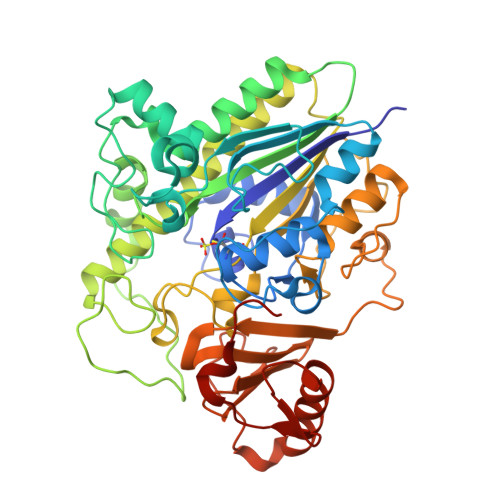
Catalytic promiscuity, wherein enzymes catalyze multiple distinct reactions by stabilizing various transition states, is well documented in the alkaline phosphatase superfamily. In this study, we determined the crystal structure of an arylsulfatase from Enterococcus faecium (EfAS), revealing a homotetrameric assembly with a windmill-like architecture not observed in other known arylsulfatases or phosphonoester hydrolases. This quaternary structure is stabilized by hydrogen bonding, salt bridges, and hydrophobic interactions, while retaining full accessibility to the catalytic groove. Moreover, by incorporating a manganese ion in its active site, EfAS provides the first crystallographically confirmed example of a Mn² + -dependent arylsulfatase, addressing previous uncertainties regarding metal specificity. Functional assays and site-directed mutagenesis showed that EfAS hydrolyzes sulfates, phosphates, and phosphonates, indicating broad substrate specificity. Furthermore, high-performance liquid chromatography-mass spectrometry demonstrated that EfAS removes sulfate groups from key bioactive molecules, such as caerulein and estrone sulfate. Collectively, these findings establish EfAS as an atypical member of the alkaline phosphatase superfamily, featuring a distinct oligomeric organization and broad substrate scope, and suggest its potential role in modulating sulfation of bioactive compounds.IMPORTANCEThis work provides the first crystallographically confirmed Mn² + -dependent arylsulfatase, unveiling a unique "windmill-like" homotetrameric architecture and demonstrating catalytic promiscuity toward sulfates, phosphates, and phosphonates. These findings address longstanding uncertainties about metal specificity in arylsulfatases, highlight the structural and functional diversity of the alkaline phosphatase superfamily, and suggest new strategies for modulating the sulfation of bioactive molecules.
- Shanghai Key Laboratory of Biliary Tract Disease Research, Department of General Surgery, Xinhua Hospital Affiliated to Shanghai Jiao Tong University School of Medicine, Shanghai, China.
Organizational Affiliation: