Download Mendeley
Deciphering Glutaminyl Cyclase Catalytic Pathways Enables Recognition of Anchor Pharmacophores for Inhibitor Discovery.
Wu, J.W., Ning, X.L., Tang, B.D., Chen, Y.T., Yang, Z.B., Meng, F.B., Zhou, C., Yu, J.L., Li, R., Li, Z., Li, G.B.(2025) J Chem Inf Model 65: 5006-5018
- PubMed: 40368832 Search on PubMed
- DOI: https://doi.org/10.1021/acs.jcim.5c00498
- Primary Citation Related Structures:
9KMB - PubMed Abstract:
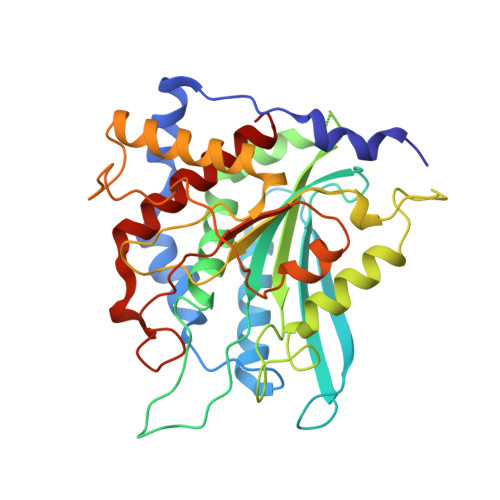
Glutaminyl cyclases are responsible for N-terminal pyroglutamate modifications of various protein/peptide substrates, influencing their metabolic stability or biological functions. However, the precise chemical pathways by which glutaminyl cyclases catalyze the conversion of N-terminal glutamine/glutamate to pyroglutamate are not yet fully understood. We initially identified the catalytically essential components by cross-species structural analysis, followed by ab initio quantum mechanics/molecular mechanics (QM/MM) calculations of human secretory glutaminyl cyclase (sQC) with two tripeptide substrates, QFA and EFA . The results revealed that sQC processes similar reaction pathways for QFA and EFA , but with distinctly different reaction energy barriers. In both reaction pathways, the catalytic triad E201 directly mediates multiple proton transfers, while D248 and D305 primarily maintain the orientation of the triad and stabilize substrate binding. Based on the anchor pharmacophores recognized by the analysis of sQC catalytic intermediates, we successfully identified the imidazole-sulfonamide inhibitors that mimic substrate binding, as validated by cocrystallographic analysis.
- Key Laboratory of Drug-Targeting and Drug Delivery System of the Education Ministry and Sichuan Province, Department of Medicinal Chemistry, West China School of Pharmacy, Sichuan University, Chengdu 610041, China.
Organizational Affiliation: