9KLL | pdb_00009kll

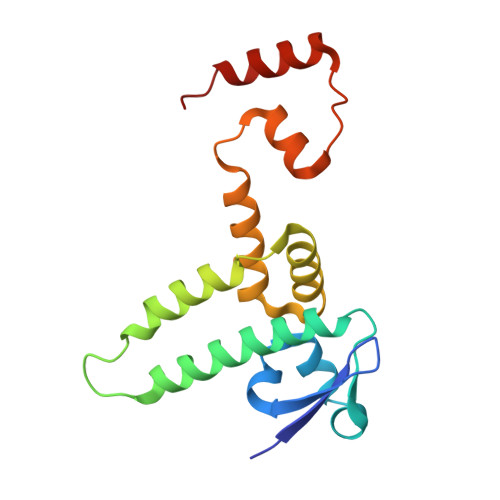
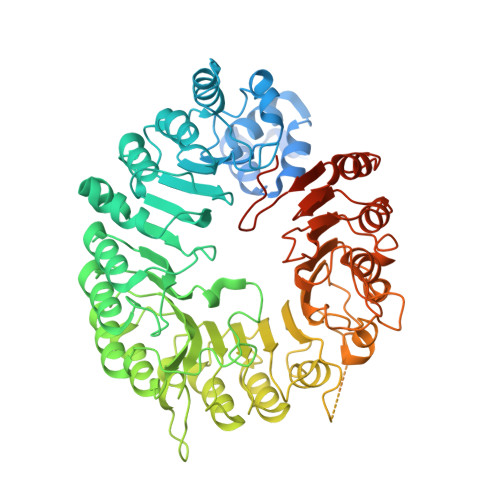
Striga MAX2-ASK1 complex


Experimental Data Snapshot

  • Method: ELECTRON MICROSCOPY
  • Resolution: 2.70 Å
  • Aggregation State: PARTICLE 
  • Reconstruction Method: SINGLE PARTICLE 

Starting Models: in silico
View more details

wwPDB Validation   3D Report Full Report


This is version 1.2 of the entry. See complete history


Literature

Mechanism of cooperative strigolactone perception by the MAX2 ubiquitin ligase-receptor-substrate complex.

Vancea, A.I.Huntington, B.Steinchen, W.Savva, C.G.Shahul Hameed, U.F.Arold, S.T.

(2025) Nat Commun 16: 10291-10291

  • DOI: https://doi.org/10.1038/s41467-025-65205-0
  • Primary Citation of Related Structures:  
    9KKX, 9KLD, 9KLK, 9KLL, 9KLV

  • PubMed Abstract: 

    Strigolactones are plant hormones that regulate development and mediate interactions with soil organisms, including the germination of parasitic plants such as Striga hermonthica. Strigolactone perception by receptors initiates the degradation of transcriptional repressors via E3 ubiquitin ligases, but the mechanistic link between hormone binding and substrate ubiquitination has remained unclear. We determine cryogenic electron microscopy structures of the receptor-ligase-substrate complex, composed of Arabidopsis ASK1 and substrate, and Striga F-box and receptor proteins. Strigolactone hydrolysis by the receptor, which covalently retains the D-ring, is a prerequisite for complex formation. The substrate engages the complex through two domains, forming a dynamic interface that stabilises the receptor-ligase assembly and repositions the ASK1, suggesting a mechanism for efficient ubiquitination. Here, we show how dynamic, multivalent interactions within the receptor-ligase-substrate complex translate hormone perception into targeted protein degradation, providing insight into how plants integrate hormonal signals into developmental decisions.


  • Organizational Affiliation
    • KAUST Center of Excellence for Smart Health, Biological and Environmental Science and Engineering Division, King Abdullah University of Science and Technology (KAUST), Thuwal, Saudi Arabia.

Macromolecules
Find similar proteins by:  (by identity cutoff)  |  3D Structure
Entity ID: 1
MoleculeChains Sequence LengthOrganismDetailsImage
SKP1-like protein 1AA [auth B]160Arabidopsis thalianaMutation(s): 0 
Gene Names: SKP1AASK1SKP1UIP1At1g75950T4O12.17
UniProt
Find proteins for Q39255 (Arabidopsis thaliana)
Explore Q39255 
Go to UniProtKB:  Q39255
Entity Groups  
Sequence Clusters30% Identity50% Identity70% Identity90% Identity95% Identity100% Identity
UniProt GroupQ39255
Sequence Annotations
Expand
  • Reference Sequence
Find similar proteins by:  (by identity cutoff)  |  3D Structure
Entity ID: 2
MoleculeChains Sequence LengthOrganismDetailsImage
F-box proteinB [auth C]771Striga hermonthicaMutation(s): 0 
Gene Names: MAX2
UniProt
Find proteins for T1RVG4 (Striga hermonthica)
Explore T1RVG4 
Go to UniProtKB:  T1RVG4
Entity Groups  
Sequence Clusters30% Identity50% Identity70% Identity90% Identity95% Identity100% Identity
UniProt GroupT1RVG4
Sequence Annotations
Expand
  • Reference Sequence
Experimental Data & Validation

Experimental Data

  • Method: ELECTRON MICROSCOPY
  • Resolution: 2.70 Å
  • Aggregation State: PARTICLE 
  • Reconstruction Method: SINGLE PARTICLE 
EM Software:
TaskSoftware PackageVersion
MODEL REFINEMENTPHENIX1.21_5207:

Structure Validation

View Full Validation Report


Entry History & Funding Information

Deposition Data


Funding OrganizationLocationGrant Number
Other privateSaudi ArabiaURF/1/4039-01-01 & URF/1/4080-01-01

Revision History  (Full details and data files)

  • Version 1.0: 2025-09-17
    Type: Initial release
  • Version 1.1: 2025-10-01
    Changes: Data collection
  • Version 1.2: 2025-12-03
    Changes: Data collection, Database references